Choosing the wrong truck for a task creates real problems. A standard dump truck sent down an unmaintained haul road gets stuck or damaged. A pickup truck loaded beyond its payload rating becomes a safety hazard. CPWR documented 809 dump-truck-related deaths among construction and extraction workers between 2011 and 2020, with improper loading identified as a contributing hazard.
This article covers the main types of construction trucks, what each one is built to do, and how to match the right truck to the right job.
Key Takeaways
- Construction trucks are purpose-built support vehicles (not tracked earthmovers) that handle hauling, mixing, lifting, and site maintenance
- Main types: pickup/service trucks, dump trucks, articulated dump trucks (ADTs), flatbeds, concrete mixers, water trucks, and crane/boom trucks
- Terrain, payload, and task type are the three factors that determine which truck fits a job
- Licensing requirements vary by truck class—CDL thresholds and crane operator certifications are separate obligations
- Overspecifying or underspecifying both cost money — match capability to actual site demands
What Are Construction Trucks?
Construction trucks are road- and site-capable vehicles engineered for specific support functions on active job sites. That separates them from tracked machinery like excavators or bulldozers, which do the earthmoving itself.
They span an enormous range—from half-ton pickups used by site supervisors for daily runs, to Class 8 heavy-duty trucks with specialized bodies carrying tens of thousands of pounds. Many are upfitted with custom bodies or mounted equipment to match a specific function, including:
- Crane booms for on-site lifting
- Rotating drums for concrete mixing and transport
- Water tanks for dust suppression and compaction
- Aerial platforms for elevated access work
The key distinction: a construction truck supports the work happening on site. It hauls the material, delivers the concrete, lifts the worker, or suppresses the dust. The earthmoving equipment just moves dirt. The sections below break down the main truck types you'll encounter on active job sites—and what each one is built to do.
Why the Right Truck Matters
Putting the wrong truck on a job creates more than a logistical headache. Equipment failures, project delays, and real safety hazards follow.
A stark example from OSHA records: a grossly overloaded dump truck lost its brakes on a steep grade, entered a work zone, and killed a worker. Payload overloading is among the most common and preventable mistakes on active sites.
Beyond safety, the wrong truck choice affects:
- Compliance — heavier trucks require a CDL, and crane or aerial boom trucks require separate operator certifications under OSHA 29 CFR 1926 Subpart CC
- Cost — overspecification drives up purchase costs; underspecification raises maintenance costs and cuts the truck's useful life (Work Truck)
- Productivity — a truck that can't access the site or handle the load slows every downstream operation it was supposed to support
Types of Trucks Used in Construction
Construction trucks aren't a single category. Each type is engineered around a specific task.
Pickup Trucks and Service Trucks
Pickup trucks (half-ton to one-ton class) and service trucks are the most common light-to-medium duty vehicles on construction sites. They handle:
- Crew transport between locations
- Tool and parts storage for field technicians
- Material runs for smaller quantities
- On-site repairs and maintenance support
What makes service trucks distinct from a bare pickup is the upfitting. A service truck is typically a pickup or cab-chassis unit fitted with a compartmentalized storage body, liftgate, or mounted work crane. Auto Crane® units—available through dealers like CUES, Inc.—are built for cab-chassis platforms and handle up to 6,000 lbs of lifting capacity directly on the job site, eliminating trips back to a depot.
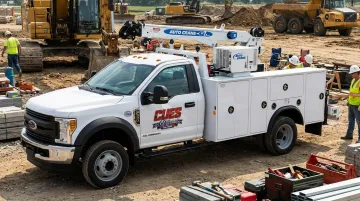
Best suited for: site supervisors, field technicians, small contractors, and utility crews who need mobility and tool access. Payload and towing limits make these unsuitable for bulk material transport.
Dump Trucks
Standard dump trucks are on-road heavy-duty vehicles with hydraulic lift beds for transporting and unloading loose materials—gravel, sand, topsoil, demolition debris—between suppliers, job sites, and disposal facilities.
They're built for paved roads and maintained site access routes. Body volume varies significantly by truck class and manufacturer; Ox Bodies, for example, markets Class 6-8 dump bodies ranging from under 7 to over 34 cubic yards depending on configuration and application.
Limitations: Standard dump trucks can't handle rough, unmaintained, or soft terrain. Wet ground, missing haul roads, and steep unimproved grades are conditions where standard dump trucks fail and articulated dump trucks take over.
Articulated Dump Trucks (ADTs)
ADTs are large off-road haulers with a pivot joint between the cab and the dump body. That pivot allows the front and rear sections to move independently, keeping all wheels in contact with the ground on soft, uneven, or broken terrain.
Current ADTs from major manufacturers cover a wide payload range:
| Manufacturer/Model | Rated Payload |
|---|---|
| Caterpillar 725 | 26.5 US tons |
| Komatsu HM300-5 | 30.9 US tons |
| Komatsu HM400-5 | 44.1 US tons |
| Volvo A50 | 50 tons |
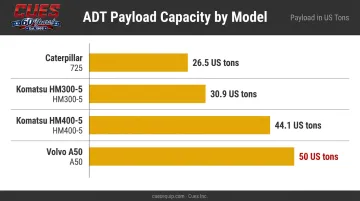
Best suited for: large earthmoving, land clearing, and mining projects with unimproved haul roads, steep grades, or muddy ground conditions.
Limitations: ADTs are not road-legal for highway use, require transport to and from the site, and carry higher operating costs than standard dump trucks.
Flatbed Trucks
Flatbed trucks—ranging from medium-duty pickups with flatbed bodies to full Class 8 semi-flatbeds—transport oversized materials and equipment that won't fit in enclosed truck bodies.
Common construction loads include:
- Structural steel and lumber
- Precast concrete panels
- Pipe and large-diameter conduit
- Construction machinery and equipment trailers
Flatbeds offer unmatched versatility for irregular-shaped loads. The open deck allows forklift loading and unloading from any angle.
Limitations: No weather protection for cargo; loads require proper tie-down and securement under DOT regulations. Not suited for loose or granular materials—those need a dump body.
Concrete Mixer Trucks
Concrete mixer trucks carry a large rotating drum that continuously mixes cement, water, sand, and aggregate during transit, keeping the concrete workable until it reaches the pour site. According to the NRMCA, typical truck-mixer capacity runs 9–11 cubic yards, with the 2023 US average load reported at 8.5 cubic yards across 400 million cubic yards delivered nationally.
The continuous rotation isn't a design convenience—it's a necessity. Concrete begins to set once mixed. A standard truck bed can't keep it workable. These trucks are irreplaceable for foundations, slabs, columns, footings, and roadwork.
Note: ASTM C94/C94M-21 removed the prior universal 90-minute discharge limit. Project specifications and current ASTM standards now control delivery windows—contractors should not rely on the old rule.
Limitations: Tight delivery windows, single-purpose design, and road access requirements. Concrete mixer trucks cannot operate on unmaintained terrain.
Water Trucks
Water trucks are tanker vehicles equipped with spray bars and nozzle systems that distribute water across construction sites for:
- Dust suppression
- Soil moisture conditioning ahead of compaction
- Fire prevention in dry conditions
OSHA's silica rule (29 CFR 1926.1153) requires engineering controls—including integrated water delivery for specified tasks—to manage respirable crystalline silica exposure on construction sites. Water trucks are frequently the practical solution for wet-suppression plans under this framework.
Limitations: Water trucks aren't material haulers. Their value depends entirely on project type and climate—on a project without dust exposure or compaction requirements, they add cost without function.
Crane Trucks and Aerial Boom Trucks
Crane trucks and aerial boom trucks are heavy-duty work vehicles fitted with mounted cranes or articulating booms, used to:
- Lift and position materials at height
- Provide elevated access platforms for workers
- Support overhead installation, utility, and steel erection work
What separates them from standalone mobile cranes is self-propulsion and road legality. A truck-mounted crane or boom truck drives to the work location, extends the boom, completes the lift, and drives away—no separate transport or extended setup required.
For contractors in New England and New York, CUES, Inc. supplies both categories as an authorized dealer for Elliott® and Auto Crane®:
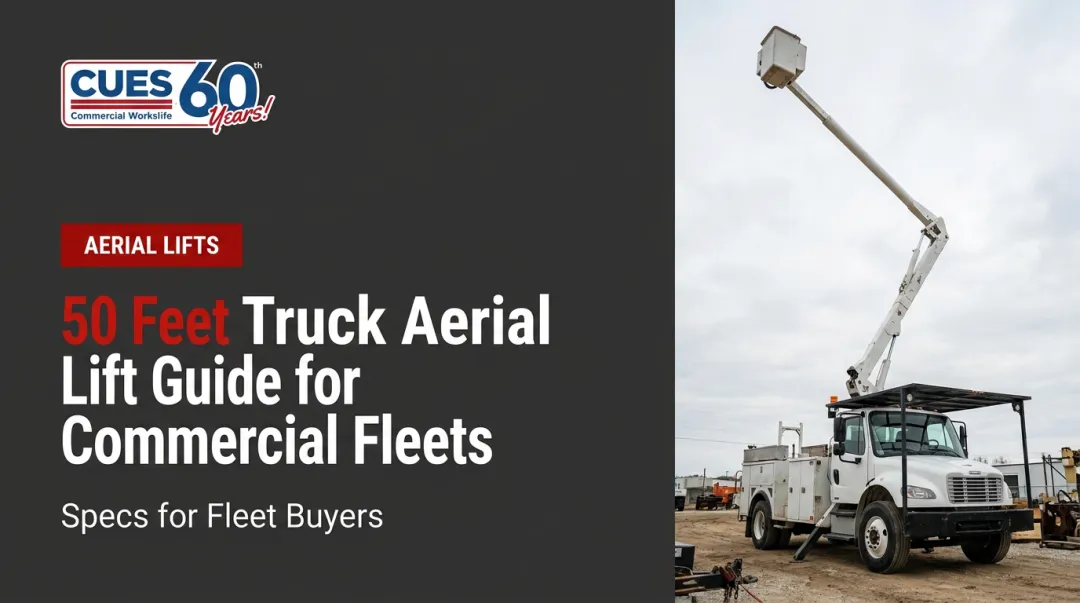
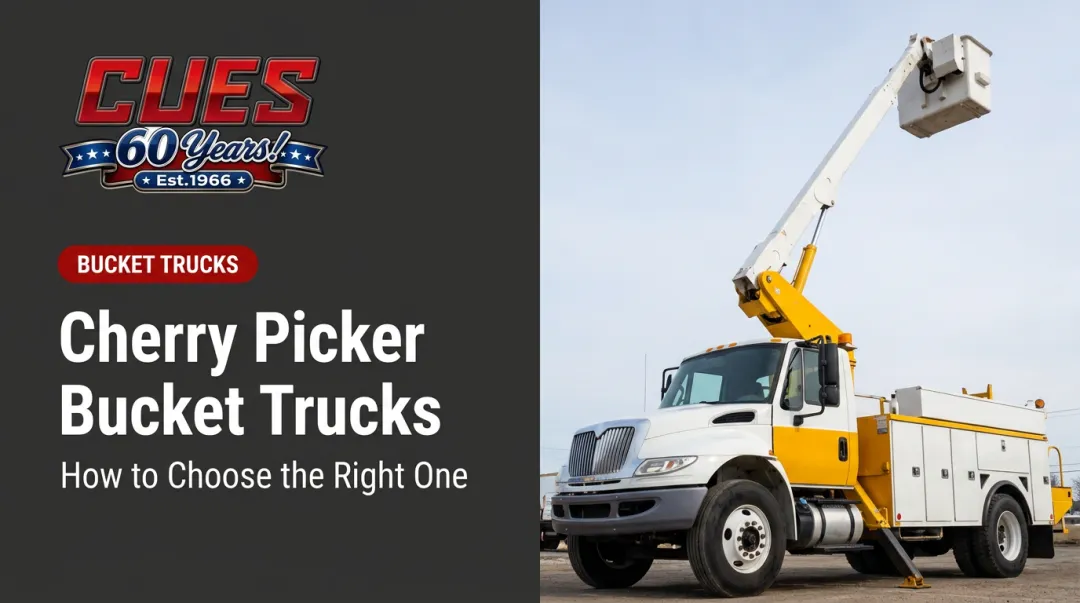
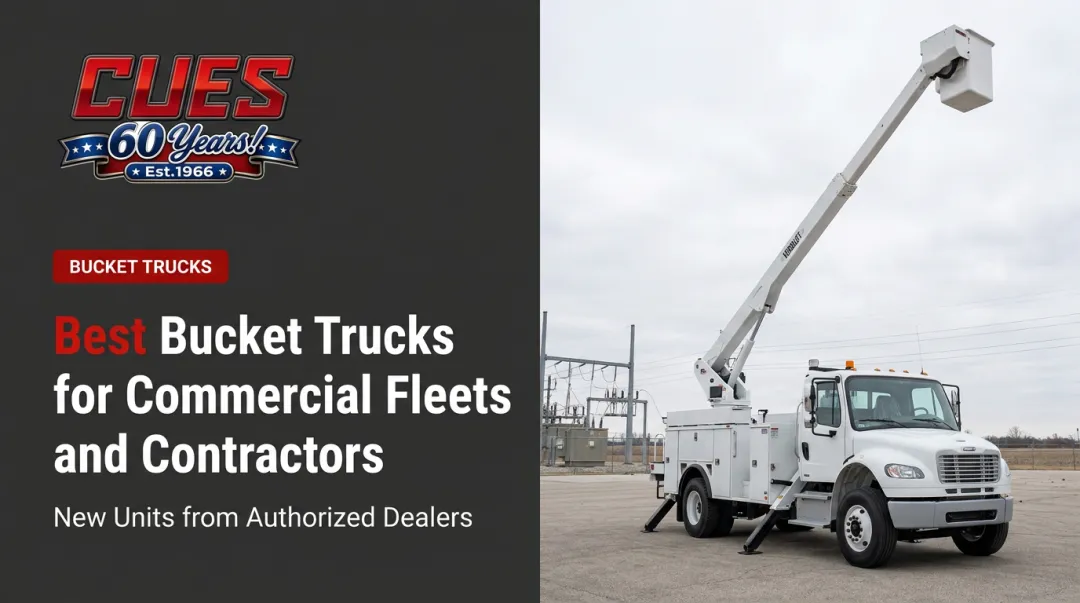
- Elliott® boom trucks reach working heights from 50 to 87 feet, with platform capacities up to 600 lbs, continuous 360-degree rotation, and lifetime structural warranties—suited for sign and lighting installation, electrical work, and overhead utility construction
- Auto Crane® service cranes cover 2,000 to 6,000 lb lifting capacities on cab-chassis units, making them the practical choice for service trucks, mechanic trucks, and construction support vehicles requiring on-site material handling
Limitations: Crane and boom truck operators require certification under OSHA 29 CFR 1926.1427 for covered cranes—separate from CDL requirements for driving. Lift capacity is constrained by chassis class and outrigger footprint.
How to Choose the Right Construction Truck
Define the Task First
Before evaluating any specific truck, identify the primary function:
- Haul loose material → dump truck or ADT
- Transport equipment or oversized loads → flatbed
- Deliver ready-mix concrete → mixer truck
- Suppress dust or condition soil → water truck
- Lift loads or access height → crane or boom truck
- Move crews and tools → pickup or service truck
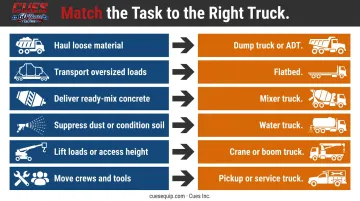
Mismatching truck to task typically means slower cycle times, damaged equipment, or a safety incident — none of which are cheap to fix.
Assess Terrain and Site Access
This single factor separates on-road trucks from off-road haulers:
- Paved roads and maintained site access → standard dump, flatbed, concrete mixer
- Unmaintained haul roads, soft or muddy ground, steep grades → ADT
Using a standard dump truck where an ADT belongs results in equipment stuck in the mud, or worse.
Match Payload and Capacity to the Truck Class
Verify the Gross Vehicle Weight Rating (GVWR) or Gross Combined Weight Rating (GCWR) covers the actual load with a safety margin. Federal Interstate limits generally cap gross vehicle weight at 80,000 lbs, with 20,000 lbs per single axle and 34,000 lbs per tandem axle—but state rules and permits also apply.
Don't confuse towing capacity (what the truck pulls) with payload capacity (what it carries). They're different ratings with different consequences when exceeded.
Verify Licensing and Operator Certification
| Truck Type | Licensing Requirement |
|---|---|
| Pickup / light service truck | Standard driver's license |
| Heavy dump truck (GVWR 26,001+ lbs) | Class B CDL (or Class A for combinations) |
| Concrete mixer, water truck (GVWR 26,001+ lbs) | Class B CDL |
| Crane truck (covered crane) | CDL for driving + OSHA 1926.1427 operator certification |
| Aerial boom truck | CDL for driving + employer-authorized training under 1926.453 |
CDL class is determined by GVWR and GCWR thresholds under 49 CFR 383.91, not vehicle type alone.
Run the Numbers Beyond Purchase Price
The sticker price is just the starting point. These factors drive the real cost over a truck's service life:
- Fuel consumption relative to actual duty cycle
- Maintenance intervals and parts availability for specialized upfits
- Downtime from using an underspecified truck in demanding conditions
- Transportation costs for non-road-legal equipment like ADTs
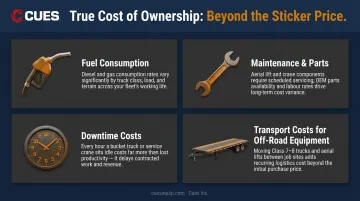
For standing fleet additions, the purchase decision comes down to utilization rate and service access. A truck that sits idle half the year rarely justifies full ownership costs. One running five days a week on active jobsites usually does — especially when bought through a dealer with road service support to keep downtime short.
Common Mistakes to Avoid
Even experienced fleet managers make specification errors that show up later as downtime, overruns, or safety incidents. Watch for these:
- Defaulting to familiarity over fit — using a standard dump truck on an off-road site because "that's what we always use" ignores site realities and creates preventable hazards
- Overlooking operating costs — an underpowered or poorly configured truck costs more over its life than one specified correctly from the start
- Oversizing for worst-case scenarios — deploying an ADT on a project with paved road access adds fuel, transport, and operating costs without any productivity gain
Frequently Asked Questions
What trucks are used in construction?
The main types are pickup and service trucks, standard dump trucks, articulated dump trucks, flatbeds, concrete mixer trucks, water trucks, and crane/boom trucks. Each serves a specific function—from hauling loose material to delivering ready-mix concrete to lifting workers and loads to height.
What vehicles are used for excavation?
Excavation itself is done by earthmoving equipment: excavators, backhoes, and bulldozers. Trucks play a support role: standard dump trucks and ADTs haul the excavated material away, with ADTs preferred on sites that lack paved haul road access.
What is the difference between a standard dump truck and an articulated dump truck?
Standard dump trucks are road-legal vehicles suited for paved roads and maintained site access. ADTs are off-road haulers with a pivot joint and all-wheel drive, built for rough, soft, or uneven terrain. ADTs are the preferred choice on large earthmoving projects without established haul roads.
Do construction trucks require a special license to operate?
Lighter trucks like pickups typically require only a standard driver's license. Heavy dump trucks and most specialized vehicles with a GVWR of 26,001 lbs or more require a CDL; crane truck operators must additionally meet OSHA certification requirements under 29 CFR 1926.1427.
What is a service truck used for in construction?
Service trucks are upfitted cab-chassis units equipped with tool storage bodies, mounted cranes, or repair equipment. They function as mobile field workshops, allowing technicians to perform maintenance and repairs directly on the job site.