The challenge is that "aerial lift" covers a broad range of equipment — scissor lifts, boom lifts, truck-mounted cherry pickers — each governed by different OSHA standards and suited to different applications. They go by many names: man lifts, aerial work platforms (AWPs), mobile elevating work platforms (MEWPs). Understanding the differences is the first step to making the right call.
This guide breaks down the main aerial lift types used in construction, what factors should drive your selection, and what OSHA requires from operators and employers.
Key Takeaways
- Aerial lifts include scissor lifts, boom lifts, and truck-mounted platforms — each suited to different heights, terrain types, and work geometries
- Selection hinges on working height, horizontal reach, terrain, platform capacity, and power source
- OSHA 29 CFR 1926.453 covers vehicle-mounted aerial devices; scissor lifts fall under a separate standard (1926.452(w)) as mobile scaffolds
- Scissor lifts work best for vertical elevation on level ground; boom lifts add horizontal reach; truck-mounted lifts offer rapid repositioning for roadside and utility-adjacent work
- The wrong lift choice — or an overloaded platform — increases tip-over risk and OSHA liability
What Is an Aerial Lift in Construction?
In everyday construction use, "aerial lift" refers to any powered, mobile device that elevates workers to a height. The term loosely covers scissor lifts, boom lifts, and vehicle-mounted platforms.
OSHA draws a more precise line. Under 29 CFR 1926.453, aerial lifts are defined specifically as vehicle-mounted aerial devices, including:
- Extensible boom platforms
- Aerial ladders
- Articulating boom platforms
- Vertical towers
- Any combination of the above
Scissor lifts are not included in this definition. OSHA's August 2000 interpretation letter explicitly states that scissor lifts fall outside the aerial lift provisions of Subpart L. They are classified as mobile scaffolds and must comply with 1926.452(w) and the general scaffold provisions under 1926.451.
That distinction has real consequences. Classification determines which OSHA standard applies, what fall protection is required, and what training workers must complete — and misclassification carries enforcement risk, not just paperwork.
Types of Construction Aerial Lifts
Scissor Lifts
Scissor lifts raise a platform straight up using a crisscross metal support mechanism. The result is a large, stable work surface — but movement is vertical only, with no horizontal reach.
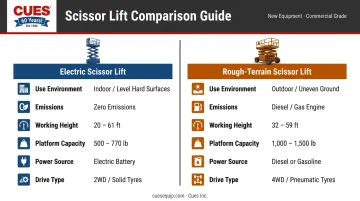
Electric scissor lifts are the standard choice for indoor work:
- Zero emissions and minimal noise — essential for enclosed or poorly ventilated spaces
- Best on level, hard surfaces such as concrete slabs
- Working heights range from roughly 20 feet (Genie GS-1432m at 20 ft 1 in) up to 61 feet (Skyjack SJ5545 E)
- Platform capacities typically run 500–770 lbs on electric models
Rough-terrain scissor lifts handle outdoor conditions:
- Four-wheel drive, heavy-duty tires, and higher ground clearance
- Diesel or gas powered for extended outdoor runtime
- Working heights from approximately 32 feet (Skyjack SJ6826 RT) to 59 feet (Genie GS-5390 RT)
- Capacities run 1,000–1,500 lbs, reflecting their heavier construction and multi-person use cases
The trade-off for both variants is the same: if horizontal outreach is required, a scissor lift won't do the job.
Boom Lifts
Boom lifts use a hydraulic arm to lift workers up and out, providing both vertical height and horizontal reach. That combination makes them the right tool for complex job sites — though it also means greater operational complexity and stricter training requirements.
Articulating boom lifts (knuckle booms) have multiple joints that allow the arm to bend and maneuver around obstacles. They're well-suited for:
- Congested job sites with overhead obstructions
- Interior finishing work at height
- Applications where workers need to reach over structural elements
Working heights on articulating models span a wide range — from compact 36-foot units (Genie Z-30/20 N) to 141 feet (Genie ZX-135/70).
Telescoping (straight) boom lifts use a single extending arm for maximum vertical reach with strong horizontal outreach. Best applications:
- Steel erection and exterior façade work
- Bridge construction
- High-rise projects on open outdoor sites
Current telescoping models range from under 100 feet up to 186 feet working height (Genie SX-180), making them the go-to for projects where elevation requirements push past what any scissor lift can reach.
One important safety note: IPAF's 2025 Global Safety Report found that mobile booms accounted for 38% of falls-from-platform reports and 29% of electrical incident reports in 2024. Proper equipment selection and operator training aren't optional — they're the difference between a productive lift and a fatality investigation.
Truck-Mounted Aerial Lifts (Cherry Pickers)
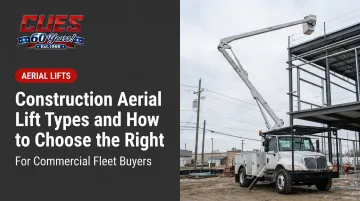
Truck-mounted aerial lifts, commonly called cherry pickers or bucket trucks, mount an articulating or telescoping boom directly onto a truck chassis. OSHA addresses these specifically under 1926.453, and they serve a fundamentally different purpose than ground-based self-propelled lifts.
Key construction applications:
- Roadside construction and utility line work adjacent to build sites
- Streetlight and traffic signal installation
- Bridge and overhead infrastructure work
- Any project requiring the lift to be driven between locations rapidly
The defining advantage is mobility. A bucket truck repositions by driving to the next work point, which no self-propelled scissor or boom lift can match. On linear projects or sites spread across large areas, that speed directly affects how much ground a crew can cover in a shift.
For contractors evaluating truck-mounted options, CUES, Inc. is an authorized dealer for Versalift® and Elliott® serving New England and New York. Their inventory covers:
- Working heights from 34 feet (telecom and fiber work) up to 87 feet for heavy-duty elevated access
- Platform capacities up to 600 lbs for two-person crews (Elliott L65R HiReach)
- Chassis options on Ford F-550, F-600, and Ram 5500 keeping many units under 26,000 lbs GVWR, with no CDL required
How to Choose the Right Aerial Lift for Your Construction Job
Working Height and Horizontal Reach
Working height is the first filter. Operators must calculate the height of the work surface plus the height of the worker standing in the platform — not just the structure's elevation.
A practical decision framework:
| Scenario | Best Lift Type |
|---|---|
| Vertical-only elevation under ~50 ft on level ground | Electric or rough-terrain scissor lift |
| Reaching over obstacles or around structural elements | Articulating boom lift |
| Maximum height on open outdoor site | Telescoping boom lift |
| Rapid repositioning across large or linear sites | Truck-mounted aerial lift |
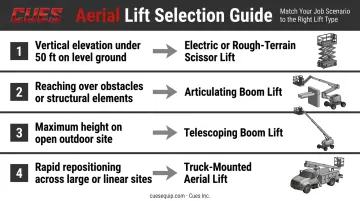
If horizontal outreach is required at any point, a scissor lift is not the answer — regardless of height.
Terrain and Ground Conditions
Ground conditions eliminate options quickly:
- Level, hard indoor surfaces — electric scissor lifts perform well
- Outdoor sites with uneven terrain, mud, or slopes — require rough-terrain models with four-wheel drive, heavy-duty tires, and outriggers
- Highly unstable or unprepared ground — boom lifts with outrigger systems or truck-mounted lifts with stabilizers are safer choices
IPAF's 2025 report recorded 21 global overturn incidents in 2024, with nearly 60% occurring in construction. Ground condition mismatches are a leading contributing factor.
Weight Capacity and Platform Size
Total platform load includes every person, every tool, and every piece of material on the platform simultaneously. That number must fall within the manufacturer's rated capacity — no exceptions.
Overloading is a direct OSHA violation under 1926.453(b)(2)(vi) and a primary cause of tip-overs. Always verify load limits before choosing a model, not after.
Power Source and Work Environment
| Environment | Recommended Power Source |
|---|---|
| Enclosed/poorly ventilated spaces | Electric only (no exhaust) |
| Open outdoor construction | Diesel or dual-fuel |
| Mixed indoor/outdoor | Electric or hybrid where available |
Diesel lifts produce exhaust that makes them unsafe indoors without forced ventilation. In any enclosed or semi-enclosed space, electric is the only appropriate choice.
Buying Considerations for Construction Contractors
Ownership makes financial sense when aerial work is a recurring part of operations — not a one-off project need. For contractors reaching that threshold, CUES, Inc. offers:
- New truck-mounted aerial devices from authorized brands Versalift® and Elliott®
- Flexible financing options to spread costs without a large upfront investment
- Configurations matched to specific project requirements across New England and New York
Contact CUES, Inc. at (800) 258-1010 or visit cuesequip.com to discuss which setup fits your operation.
Aerial Lift Safety and OSHA Compliance
Key OSHA Requirements Under 1926.453
| Requirement | Rule |
|---|---|
| Authorized operators only | Only personnel authorized by the employer may operate the lift |
| Fall protection | Body harness or restraining belt with lanyard attached to the boom or basket — never to an adjacent structure |
| Daily control test | Lift controls must be tested each day before use |
| Load limits | Manufacturer boom and basket load limits may not be exceeded |
One note on fall protection: The actual CFR text at 1926.453(b)(2)(v) references a body belt and lanyard. OSHA's current guidance recommends a body harness — not just a belt — with the lanyard attached to the boom or bucket, not to any adjacent structure or fixed point.
Top Aerial Lift Hazard Categories
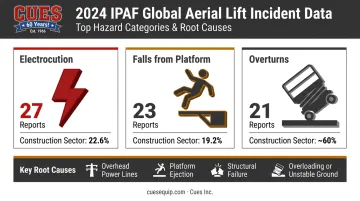
These OSHA rules exist for good reason. Based on IPAF's 2025 global safety data for 2024 incidents, the most common on-site incidents were:
- Electrocution — 27 reports of electrical shock/electrocution; construction represented 22.6% of these
- Falls from platform — 23 reports; construction represented 19.2%
- Overturns — 21 reports; construction accounted for nearly 60%
Four root causes drive most of these incidents: proximity to overhead power lines, ejection from sudden platform movement, structural failure, and tip-over from overloading or unstable ground.
Pre-Use Inspection Requirements
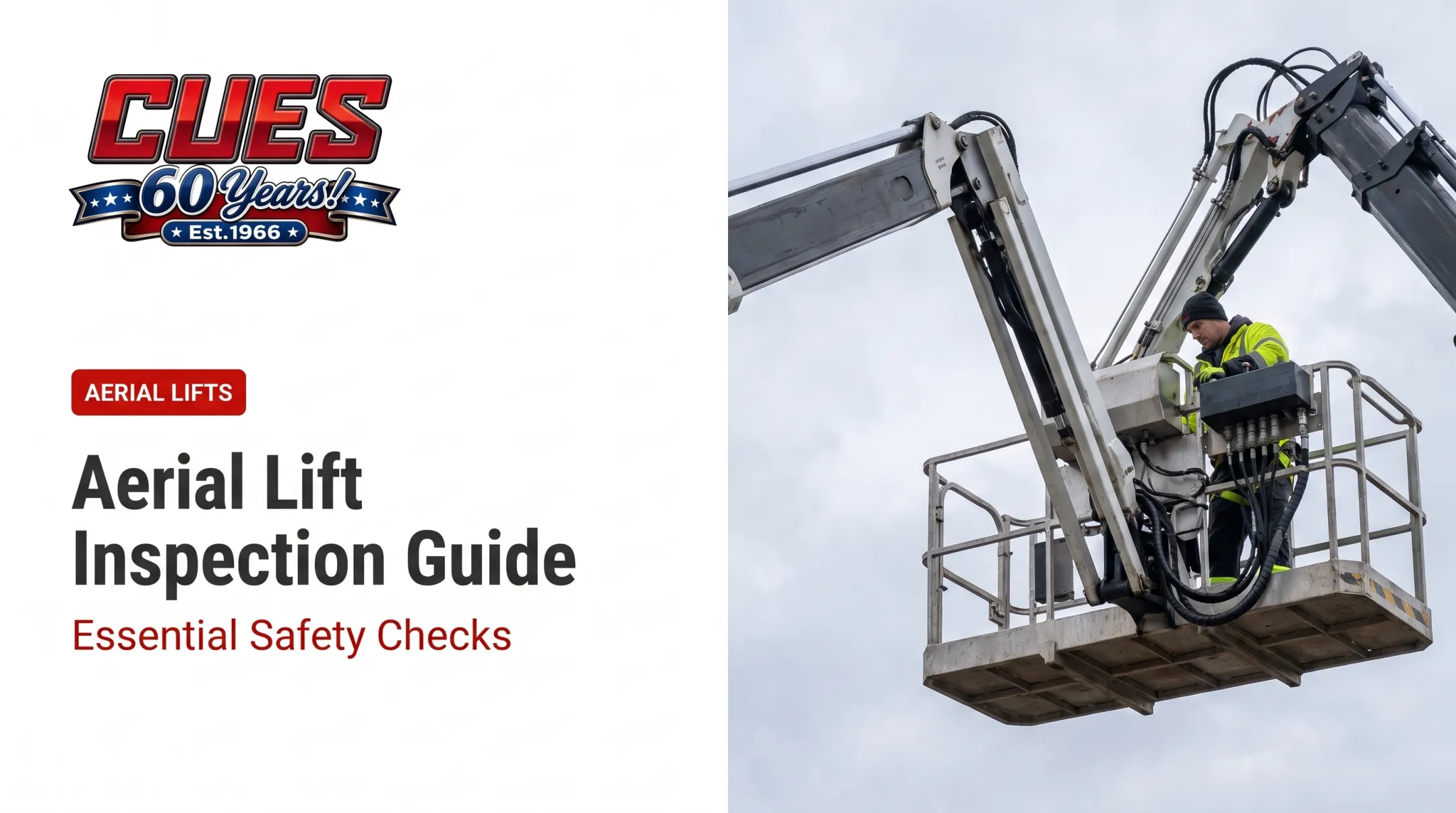
Before each shift, operators must conduct a visual and functional inspection covering:
- Fluid levels (hydraulic, fuel, battery charge)
- Boom and basket operation
- Guardrail integrity
- Brake function
- Loose or missing parts
- Any visible damage to structural components
If a defect is identified, the lift must be taken out of service until repaired. OSHA does not allow operators to continue using equipment with known defects — doing so exposes both the operator and the employer to liability.
Aerial Lift Operator Training and Certification
What OSHA Requires
OSHA does not issue a standardized federal aerial lift operator credential. Training is employer-issued — and OSHA's 1992 interpretation explicitly states there are no specific regulations requiring operators to be certified or qualified through a government-sanctioned program.
What is required:
- Employers must instruct workers in recognizing and avoiding unsafe conditions under 1926.21(b)(2)
- Only authorized persons — those approved or assigned by the employer — may operate a lift under 1926.453(b)(2)(ii)
- Training must be equipment-specific: switching from a scissor lift to a boom lift requires separate training for the new equipment type
Core training topics, per OSHA's fact sheet, include:
- Electrical, fall, and falling-object hazards
- Correct operation and maximum intended load
- Emergency procedures
- Inspection requirements
- Manufacturer-specific requirements
Certification Timeline
There is no single mandatory duration. Training formats and timelines vary based on program type:
- Employer-issued programs: A few hours to a full day, typically combining online theory with a hands-on practical evaluation
- IPAF operator course: 1–3 days (one day equals at least 7 hours); results in a PAL Card, an industry-recognized credential that is not OSHA-mandated
If a worker changes equipment types, retraining is required before operating the new lift. Keep this in mind when building out a fleet that spans multiple lift categories.
Frequently Asked Questions
What is an aerial lift in construction?
An aerial lift is any powered, mobile device used to elevate workers to height on a job site — including scissor lifts, boom lifts, and truck-mounted platforms. OSHA's formal definition under 1926.453 applies specifically to vehicle-mounted aerial devices; scissor lifts fall under a separate mobile scaffold classification.
What does OSHA consider an aerial lift?
Under 29 CFR 1926.453, OSHA's aerial lift definition covers vehicle-mounted devices: extensible boom platforms, aerial ladders, articulating boom platforms, vertical towers, and combinations thereof. Scissor lifts are governed separately under the mobile scaffold standard at 1926.452(w).
What are the three types of aerial lifts?
The three broadly recognized categories used in construction are: scissor lifts (vertical elevation on level ground), boom lifts — both articulating and telescoping — for height and horizontal reach, and truck-mounted lifts (cherry pickers) for mobile roadside and utility-adjacent work requiring rapid repositioning.
How long does it take to get aerial lift certification?
Aerial lift certification is employer-issued, not a standardized government credential. Training typically takes a few hours to one full day, combining online theory with a hands-on equipment evaluation. Duration varies by provider and the specific equipment type being trained on.
What is the difference between a boom lift and a scissor lift?
Scissor lifts raise a platform straight up via a crisscross mechanism and are limited to vertical elevation on level surfaces. Boom lifts use an extendable arm to provide both vertical height and horizontal outreach — useful when you need to reach over obstacles or work at angles a scissor lift can't accommodate.
Can you drive an aerial lift with the platform raised?
Some self-propelled scissor and boom lifts are designed for repositioning with the platform elevated, but this depends entirely on the specific model and manufacturer specifications — always verify before attempting. Truck-mounted lifts must have the boom properly stowed before highway travel per OSHA requirements.