Introduction
For a utility contractor or municipal fleet manager, the wrong bucket truck spec can ground an entire crew for weeks. A unit that's 10 feet short on working height, missing the required insulation rating, or sitting outside any authorized dealer's service area isn't just an inconvenience — it's lost revenue and failed job eligibility.
Commercial fleet buyers face pressures that individual purchasers don't. Standardization across a vehicle pool, CDL licensing constraints, and total cost of ownership over a 10–20 year service life all factor into the decision — as does authorized dealer coverage close enough to matter when something breaks.
This guide covers the top bucket truck brands for commercial fleets and contractors, including verified specs, industry fit, and the key questions to answer before you sign a purchase order.
Key Takeaways
- Bucket trucks are governed by ANSI/SAIA A92.2-2021 and OSHA 1910.67 — specifying the wrong configuration creates compliance liability
- Top brands for commercial fleets include Versalift®, Altec Industries, Terex Utilities (Hi-Ranger), Elliott® Equipment, and Dur-A-Lift
- Working height, insulation rating, boom configuration, and CDL threshold are the four specs most likely to cause costly errors
- Fleet buyers in New England and New York should verify regional dealer coverage before committing to any brand
What Bucket Trucks Are and Why Configuration Matters
A bucket truck is a vehicle-mounted aerial device with a hydraulic boom and personnel platform, used to lift workers safely to elevated work areas. Under OSHA 29 CFR 1910.67, covered types include extensible-boom platforms, articulating-boom platforms, vertical towers, and combinations. The governing design standard is ANSI/SAIA A92.2-2021, effective August 2022.
Bucket trucks are distinct from boom trucks (which are cranes that lift loads, not people) and scissor lifts (which are not vehicle-mounted in the same configuration) — a difference that directly affects OSHA compliance requirements and the operator training your fleet will need.
The Main Configurations for Fleet Use
| Configuration | How It Works | Best Fleet Application |
|---|---|---|
| Articulated overcenter | Upper boom travels past vertical center | Electric utility, forestry, telecom |
| Non-overcenter | Upper boom stops before vertical | Building maintenance, fixed-access sites |
| Telescopic articulated | Articulating lower boom + extending upper boom | Urban corridors, confined job sites |
| Van-mounted | Compact unit integrated with van chassis | Telecom, sign/lighting, low-clearance environments |
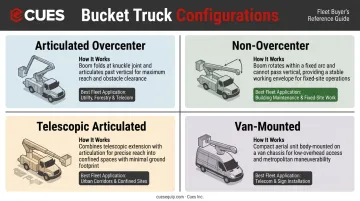
According to Fact.MR's August 2025 bucket truck market report, articulated units account for 58% of 2025 global demand — driven largely by their versatility across utility, telecom, and contractor fleets. That versatility also explains why configuration is the first decision to get right before evaluating any specific model or spec.
Best Bucket Truck Brands for Commercial Fleets and Contractors
These five brands were selected based on product range across multiple working heights, track record in commercial fleet applications, ANSI/OSHA compliance support, and dealer/parts network strength. They are presented alphabetically.
Altec Industries
Altec is one of the most widely deployed bucket truck manufacturers in North America, with deep roots in electric utility and telecom. Their product range spans non-insulated aerial devices through high-voltage insulated platforms.
Verified working heights: Telescopic-articulating models reach up to 64.8 ft; non-overcenter configurations reach up to 150 ft. Note that the AT37G and AA755 are discontinued — current buyers should reference the AT40G and current non-overcenter line.
| Spec | Details |
|---|---|
| Working Height Range | ~40 ft (AT40G) to 150 ft (non-overcenter line) |
| Key Industries | Electric utility, telecom, tree service, sign/lighting |
| Notable Features | Fiberglass boom insulation, broad chassis compatibility (Ford, Freightliner, International, Peterbilt), nationwide dealer network |
Altec's nationwide service footprint simplifies fleet replacement and supports used-market resale — practical advantages for fleet managers running multi-year procurement cycles.
Dur-A-Lift
Dur-A-Lift is a U.S.-based manufacturer specializing in telescopic articulating bucket trucks with compact footprints and strong working heights. Their lineup runs from 34 ft bucket vans to the 67 ft DLT2-60DU, making them a strong fit for contractors in urban and suburban environments.
| Spec | Details |
|---|---|
| Working Height Range | ~41 ft (DTA2-35) to 67 ft (DLT2-60DU, with 39 ft 2 in side reach) |
| Key Industries | Electric utility, tree care, telecom, sign and lighting |
| Notable Features | Outrigger-free models (DTAX2-42 at 47 ft without outriggers), top-mounted jib/winch up to 1,000 lbs on select DLT2 and DPM models |
The outrigger-free configurations reduce setup time significantly on tight urban job sites — a practical advantage for telecom and sign crews working in traffic.
Elliott® Equipment
Elliott manufactures aerial work platforms with a focus on high-reach and heavy-duty contractor applications. Their HiReach and E-Line lineups serve contractors, municipal fleets, and transmission utility operators.
| Model | Working Height | Platform Capacity | Primary Use |
|---|---|---|---|
| G40F HiReach | 45 ft | 1,000 lb | Contractor/service |
| L50 HiReach | 50 ft | 600 lb | Sign/lighting, municipal |
| L65 HiReach | 65 ft | 600 lb | Utility, construction, maintenance |
| L140 HiReach | 140 ft | 600 lb | High-reach infrastructure |
| E145 E-Line | 145 ft | 1,200 lb | Electric transmission |
| E160 E-Line | 160 ft (215 ft with jib) | 1,200 lb | Electric transmission |
Elliott is particularly relevant for contractors handling bridge inspection, large-scale infrastructure, or industrial facility work where standard utility-class trucks fall short. The L65 HiReach, for example, puts a 65 ft, 600 lb two-man platform on a 25,999 lb GVWR chassis — keeping most configurations below the CDL threshold. CUES, Inc. carries the L65 HiReach and other Elliott® models for buyers in the Northeast.
Terex Utilities (Hi-Ranger)
Terex Utilities, sold under the Hi-Ranger brand, produces a broad range covering telescopic, overcenter, and non-overcenter aerial devices. Their current lineup spans from the 42 ft 8 in HR37 to 112 ft TL transmission models, covering light contractor work through full transmission utility operations.
| Spec | Details |
|---|---|
| Working Height Range | ~42 ft 8 in to 112 ft depending on model |
| Key Industries | Electric utility, construction, forestry, municipal maintenance |
| Notable Features | High side reach relative to platform height (HRX55: 60 ft working height with 48 ft 2 in side reach), insulated and non-insulated configurations, 700 lb platform capacity on HRX55 |
The HRX55 Optima stands out for side reach — 48 ft 2 in is among the widest available in the 60 ft working height class, useful for utility work requiring positioning across right-of-way without repositioning the truck.
Versalift®
Versalift®, manufactured by Time Manufacturing Company, offers one of the broadest product lines available: van-mounted units starting near 34.75 ft, truck-mounted configurations reaching 75.83 ft in the standard lineup, and a separate high-access line reaching 217 ft.
| Model | Working Height | Key Notes |
|---|---|---|
| TEL-29-N | 34 ft 9 in | Van-mounted; telecom and sign/lighting |
| SST-40-EIH | 45.6 ft | No CDL required on most chassis; insulated |
| VST-55-HDI | 59 ft | 600 lb platform; TruGuard insulated controls; Ford F-600 4x4 |
| VO-270-E | ~75 ft 10 in | 33,000 lb GVWR Ford F-750 build |
Two safety systems distinguish Versalift® in fleet applications:
- TruGuard™: electrically isolates the upper control system (including handles and tool outlets) from the energized boom tip; standard on every insulated Versalift® unit
- SlopeMax: uses angular sensors on the aerial base and lower boom to limit movement and horizontal reach on slopes, constraining overturning moment (the tipping force on uneven terrain)
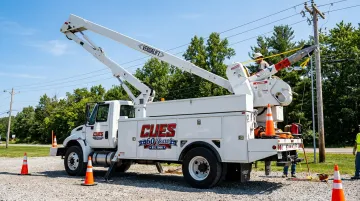
CUES, Inc. is an authorized Versalift® dealer serving New England and New York, stocking models including the VST-55-HDI and VO260 with configurations suited to utility, forestry, and telecom applications.
Key Factors When Choosing a Bucket Truck for Your Fleet
Working Height and Side Reach
Size for your most demanding recurring job — not your average job. Crews consistently underspec working height, then lose job eligibility when a contract requires 5 more feet than the truck can reach.
Tiers based on official manufacturer application examples:
- Under 50 ft — urban maintenance, sign installation, lighting work
- 50–60 ft — distribution line work, fiber splicing, telecom
- 60+ ft — transmission lines, large-scale construction, tall forestry
Side reach matters as much as height for many utility applications. The Terex HRX55's 48 ft 2 in reach at 60 ft working height, for example, is purpose-built for work requiring horizontal positioning across wide spans.
Insulation Requirements
This is where fleets make their most expensive specification mistake. Under OSHA 1910.269 and the ANSI A92.2 standard, insulated aerial devices are mandatory for any work within minimum approach distances of energized conductors.
- Insulated required: Electric utility crews, any work near live distribution or transmission lines
- Non-insulated acceptable: Telecom, sign installation, tree care away from live lines
ANSI A92.2 uses specific categories — Category A (bare-hand work) and Category B (gloving/tool work, generally associated with 46 kV or below) — not generic "insulation classes." Verify the specific category designation, not just whether a unit is marketed as insulated.
CDL Requirements and Fleet Licensing
Bucket trucks with a GVWR of 26,001 lbs or more require a Class B Commercial Driver's License under FMCSA rules. This is a hard federal threshold. There is no separate CDL class boundary at 33,001 lbs for single vehicles.
Several manufacturers offer models on medium-duty chassis below this threshold. CUES stocks the Versalift VST-55-HDI (59 ft, Ford F-600, non-CDL) and Elliott L65 (65 ft, 25,999 lb GVWR, non-CDL) specifically for buyers who want to expand their eligible driver pool without CDL overhead.
Boom Configuration
Match configuration to your job mix before standardizing a fleet:
- Overcenter — maximum flexibility; repositions around and beneath conductors without moving the truck
- Non-overcenter — simpler operation for fixed-access environments with less job-site variation
- Telescopic articulated — best for confined spaces, urban corridors, and wooded terrain
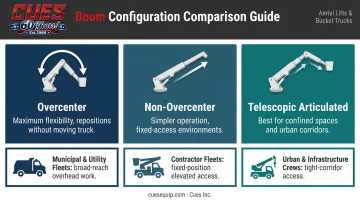
Fleet managers running mixed-job crews often standardize on overcenter or telescopic articulated units to cover more work types with fewer truck classes.
Dealer Support and Parts Availability
Once specs are locked, dealer proximity is the last variable most buyers underestimate — and the one that hits hardest when a truck goes down mid-contract. Evaluate support coverage before committing to a brand:
- Does the manufacturer have authorized service locations within your operational territory?
- Can the dealer provide road service (not just depot repair)?
- Are parts stocked locally, or are lead times measured in weeks?
For fleets and contractors operating in New England and New York, CUES, Inc. operates locations in Amherst, NH and North Franklin, CT, providing sales and support for Versalift® and Elliott® equipment across the region.
How to Evaluate a Bucket Truck Brand Before Buying
Most costly procurement mistakes happen when buyers evaluate on brand name or sticker price alone. A lifecycle-focused framework asks different questions:
What to verify before purchase:
- ANSI A92.2 design and testing documentation for the specific model and configuration
- Completed-vehicle GVWR (not just chassis rating) to confirm CDL classification
- Dielectric category where insulation is required — confirm the specific category, not just marketing language
- Chassis compatibility with your preferred truck manufacturers for standardization
- Manufacturer's inspection and testing support documentation
What determines real-world fleet performance:
- Mean time between failures and typical service interval requirements
- Operator training complexity — simpler systems reduce onboarding time across large crews
- Parts availability in your region — lead times for common components matter more than how large the catalog is
- Manufacturer responsiveness when warranty or compliance issues arise
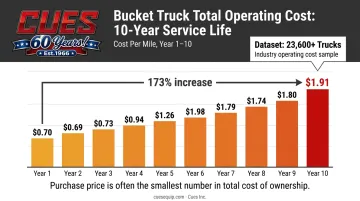
Those evaluation criteria carry more weight once you factor in the full ownership window. Bucket trucks typically stay in service for 10–20 years, and Government Fleet/Utilimarc data tracking more than 23,600 heavy-duty bucket trucks showed operating costs rising from $0.70/mile in year one to $1.91/mile by year ten — a 173% increase. For high-utilization fleets, the purchase price is often the smallest number in the total cost equation.
Conclusion
Choosing the right bucket truck comes down to fit: the right working height for your job profiles, a CDL configuration your crew can operate, terrain capability for your region, and a dealer close enough to keep you running when something needs attention.
Prioritize total cost of ownership — purchase price plus maintenance, parts, and downtime risk — over initial cost comparisons. And confirm regional dealer coverage before committing to a purchase.
For fleets and contractors in New England and New York, CUES, Inc. has specialized in aerial equipment sales since 1966. As an authorized dealer for Versalift® and Elliott®, CUES provides:
- New bucket truck sales across a full range of working heights and configurations
- Flexible financing options to fit commercial fleet budgets
- Expert guidance from experienced staff at locations in Amherst, NH and North Franklin, CT
Call 800-258-1010 to discuss the right bucket truck configuration for your fleet.
Frequently Asked Questions
What is the most reliable bucket truck?
Versalift® and Altec consistently earn strong marks for uptime in utility and contractor fleets. That said, application fit and maintenance practices matter just as much as the nameplate. Dealer service proximity and parts availability have a direct impact on real-world reliability.
What are the best brands of bucket trucks?
The most widely adopted brands across commercial fleets include:
- Versalift® and Altec — broad utility and telecom coverage across most working heights
- Elliott® Equipment — high-reach contractor and specialty applications
- Terex Utilities (Hi-Ranger) — strong presence in utility and municipal work
- Dur-A-Lift — compact configurations for urban and tight-access jobs
Each brand has distinct strengths by height range and industry — the right fit depends on your most common applications.
Do I need a CDL to operate a bucket truck?
Any bucket truck with a GVWR of 26,001 lbs or more requires a Class B CDL under federal FMCSA rules. Many mid-duty models — including several Versalift® and Elliott® configurations — are available on chassis at or below 25,999 lbs GVWR, making them operable without a CDL on most applications.
What working height do I need for utility or contractor work?
Under 50 ft covers most sign, lighting, and urban maintenance work. The 50–60 ft range suits distribution line and telecom applications. 60 ft and above is required for transmission line work, large-scale construction, and tall forestry — verify your most demanding recurring job, not just the typical workload.
Should I buy or rent a bucket truck for my fleet?
Buying makes financial sense for fleets with consistent year-round utilization. At high annual hours, ownership is more economical than alternatives — and financing options can make the upfront cost manageable. Contact CUES at 800-258-1010 to discuss purchase and financing for your specific fleet requirements.
What does a new bucket truck cost for commercial use?
New mid-duty bucket trucks in the 40–65 ft range typically start well above $100,000, with specialty or high-reach configurations running considerably higher. Industry cost data from prior years put average heavy-duty purchase prices near $200,000 — and costs have increased since. Contact CUES for current pricing on specific configurations.