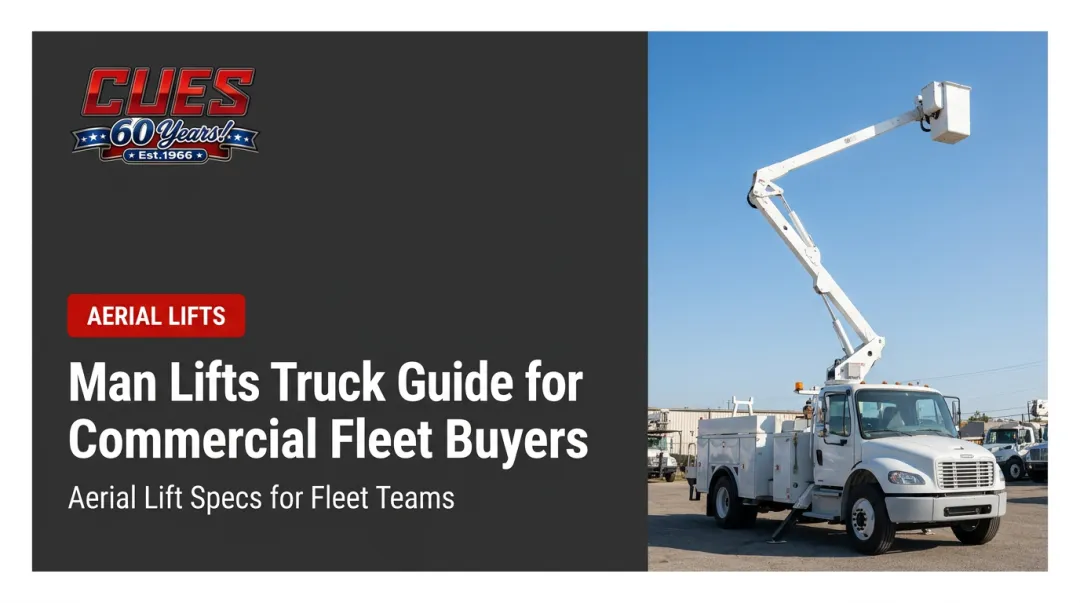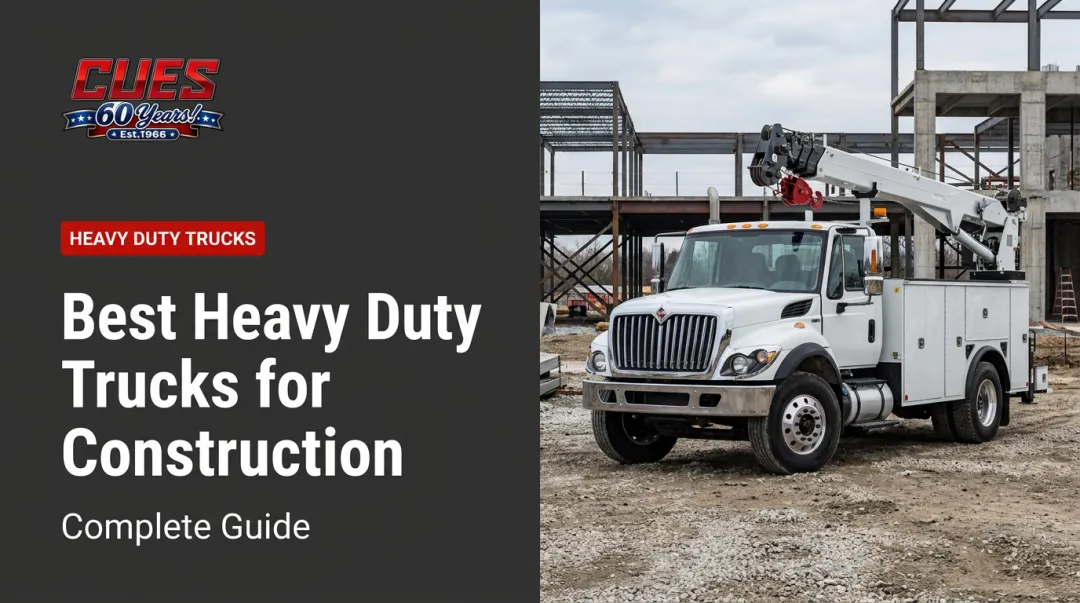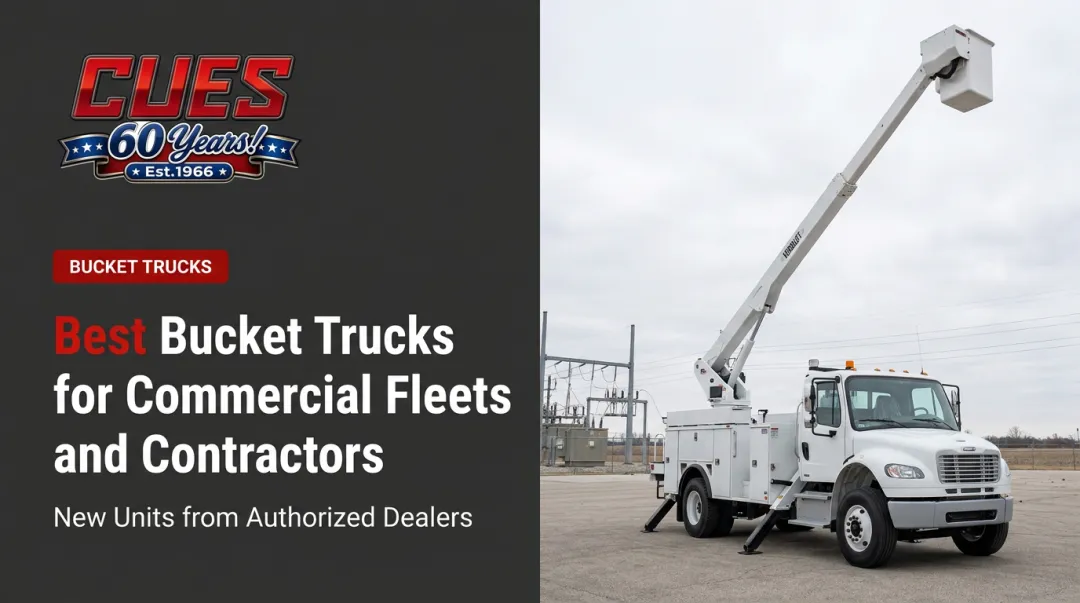
Unlike standard pickups, utility trucks are purpose-built or upfitted chassis-cab vehicles carrying aerial devices, crane systems, or service bodies. The base vehicle matters, but so does whether that vehicle is actually rated and configured to accept the upfit you need.
This guide covers the top utility truck platforms for commercial fleets — plus what to evaluate before you buy.
Key Takeaways
- Utility trucks are chassis-cab vehicles upfitted for vocational use — not standard pickups
- GVWR, payload headroom, and upfit compatibility should drive chassis selection, not brand preference
- Class 5 platforms (Ford F-550, RAM 5500) dominate bucket truck and aerial lift applications
- Class 7 trucks (International HV, Freightliner M2) support larger aerial devices and greater working heights for utility construction
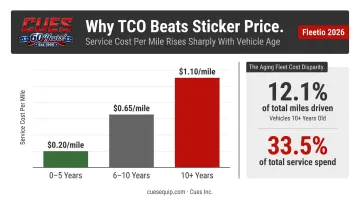
- Service costs climb from $0.20/mile to $1.10/mile past the 10-year mark, making TCO a more reliable buying criterion than sticker price
What Is a Utility Truck and Why Does It Matter for Commercial Fleets?
A utility truck, in the commercial context, is a chassis-cab vehicle upfitted with a specialized vocational body. That might be a service body with open compartments for tools, an aerial lift for elevated work, a crane body for material handling, or an enclosed body for weather-sensitive equipment. What it isn't is a standard light-duty pickup pressed into service with a toolbox in the bed.
The distinction matters because utility upfits add significant weight and impose structural requirements on the chassis. Getting that wrong, whether by undersizing the chassis or mismatching the upfit, creates compliance problems and safety risk.
Truck Classification and Why Class Matters
The federal truck classification system, derived from FHWA guidelines, defines classes by Gross Vehicle Weight Rating:
| Class | GVWR Range | Typical Utility Application |
|---|---|---|
| Class 3 | 10,001–14,000 lbs | Light service bodies, small crane units |
| Class 4 | 14,001–16,000 lbs | Medium service bodies, light aerial |
| Class 5 | 16,001–19,500 lbs | Bucket trucks, aerial lifts, crane bodies |
| Class 6 | 19,501–26,000 lbs | Larger aerial devices, utility bodies |
| Class 7 | 26,001–33,000 lbs | High-reach aerial, digger derricks, utility construction |
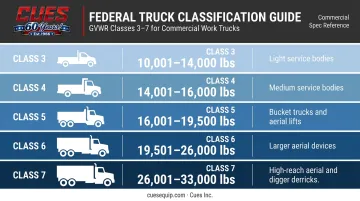
Class determines more than just what a truck can carry. It affects driver licensing requirements, DOT compliance, and whether a given aerial device or crane body can legally be mounted on that chassis. Specifying a Class 3 chassis for an upfit that belongs on a Class 5 is both a performance error and a compliance liability.
Key Considerations When Selecting a Utility Truck for Your Fleet
Payload and GVWR
The most common spec mistake is underestimating combined weight. Available payload isn't just the tools and materials — it includes the upfit body itself, the crew, fuel, and any additional equipment mounted on the vehicle.
To calculate usable payload: subtract the chassis curb weight plus the upfit body weight from the GVWR. What remains is what you can actually load. Spec one class higher than your minimum estimate to protect long-term safety and gives you room as operational needs evolve.
Upfit Compatibility
Not every chassis accepts every upfit. Before purchasing a chassis, verify:
- Upfit body weight stays within available payload after accounting for crew and equipment
- Mounting requirements match the chassis frame dimensions and rail configuration
- PTO (power take-off) compatibility for hydraulic systems on aerial devices and cranes
- Manufacturer body builder guidelines for the specific chassis you're considering
Cab and Wheelbase Configuration
Regular cab, extended cab, and crew cab configurations affect more than interior space. Each cab type determines wheelbase options, which governs available body length and overall vehicle length:
- Regular cab: Maximum body length and maneuverability; limited interior crew space
- Extended cab: Middle ground for smaller crews needing extra cab storage
- Crew cab: Required for four-person crews, but sacrifices some rear body mounting space
Fuel Type
Diesel engines are the standard for heavier utility upfits and high-cycle aerial or crane operations. The torque advantage is significant: the 6.7L Cummins in the RAM 5500 produces 800 lb-ft versus 429 lb-ft from the gas HEMI. That difference is felt when you're running a hydraulic aerial device repeatedly through an eight-hour shift.
Fuel cost cuts the other way. EIA data from March 2026 shows on-highway diesel at $4.92/gallon versus $3.64/gallon for regular gasoline — a gap that compounds quickly in high-mileage fleet operations. For lighter Class 3 applications, gas may be the better economic choice. For Class 5 and above, diesel typically wins on total operating cost.
Total Cost of Ownership
Purchase price is the wrong number to optimize. According to Fleetio's 2026 Fleet Benchmark Report, vehicles over 10 years old accounted for just 12.1% of miles driven but 33.5% of total service spend across 1.2 million vehicles and $7 billion in fleet maintenance. Service cost per mile rises from $0.20 at 0–5 years to $1.10 past 10 years.
For utility trucks, add upfit durability, parts availability for the aerial or crane system, and downtime cost when that upfit fails in the field. Factor those costs into your decision before committing to a chassis or upfit package.
Best Utility Trucks for Commercial Fleets and Contractors
These five platforms were selected based on chassis-class capability, upfit compatibility, vocational track record, and fleet reliability relevant to electric utility, telecom, construction, and contractor operations.
Ford F-550 Super Duty Chassis Cab
The F-550 is the most widely deployed utility truck chassis in North America. Its Class 5 GVWR of 19,500 lbs, broad body builder support, and availability of the 6.7L Power Stroke diesel make it the default platform for bucket trucks in the 35–50 ft. working height range.
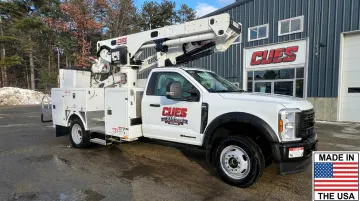
CUES, Inc. carries the Versalift VST-47-MHI on the Ford F-550 4x4, delivering 52 ft. 4 in. working height with a 400 lb. platform capacity and full insulation for electric utility and telecom applications. The F-550's dealer network is the widest of any chassis-cab in this class, which means parts and field service are rarely hard to find.
| Specification | Detail |
|---|---|
| Truck Class / GVWR | Class 5 / up to 19,500 lbs |
| Powertrain Options | 7.3L V8 gas or 6.7L Power Stroke Turbo Diesel V8 |
| Ideal Upfit Applications | Aerial lift / bucket truck, service body, crane body, digger derrick |
RAM 5500 Chassis Cab
The RAM 5500 competes directly with the F-550 at Class 5, with its own strengths. The 6.7L Cummins Turbo Diesel produces 800 lb-ft of torque — the highest in this segment — and has a well-established reputation for longevity in high-cycle vocational use. The flat frame design is frequently cited by upfitters as an advantage for mounting service bodies and crane units with less fabrication complexity.
At 19,500 lbs GVWR, the RAM 5500 supports the same range of aerial and service body upfits as the F-550. For many fleet managers, chassis preference and dealer relationship end up being the deciding factors between these two platforms.
| Specification | Detail |
|---|---|
| Truck Class / GVWR | Class 5 / up to 19,500 lbs |
| Powertrain Options | 6.4L HEMI V8 gas (375 hp / 429 lb-ft) or 6.7L Cummins Turbo Diesel I6 (360 hp / 800 lb-ft) |
| Ideal Upfit Applications | Service body, aerial device, crane body, utility body |
Chevrolet Silverado 3500HD Chassis Cab
The Silverado 3500HD operates at Class 3 with a 14,000 lb. GVWR, which positions it as a platform for lighter utility upfits. It's not competing with the F-550 for bucket truck applications — but for contractors and smaller utility fleets that need a service body, an Auto Crane hydraulic crane unit, or an enclosed utility body, it covers a wide range of needs at lower chassis cost.
The available Duramax 6.6L Turbo Diesel (470 hp / 975 lb-ft) is strong for its class, and multiple wheelbase options give upfitters flexibility. Broad dealer coverage across New England and the Northeast means fleets can source service without managing a complex parts supply chain.
| Specification | Detail |
|---|---|
| Truck Class / GVWR | Class 3 / up to 14,000 lbs |
| Powertrain Options | 6.6L V8 gas (401 hp / 464 lb-ft) or Duramax 6.6L Turbo Diesel V8 (470 hp / 975 lb-ft) |
| Ideal Upfit Applications | Service body, light crane body, enclosed utility body, BrandFX® composite bodies |
Ford F-750
When Class 5 platforms reach their limits, the F-750 is the next step. As a Class 7 chassis, it opens up larger aerial devices, high-reach bucket trucks, and digger derricks used in electric utility construction where working heights and load capacities exceed what a 19,500 lb. GVWR chassis can support.
The F-750's available 6.7L Power Stroke diesel (up to 330 hp / 850 lb-ft) provides the power needed for larger Versalift and Elliott aerial platforms.
One configuration note: the F-750's maximum GVWR can reach 37,000 lbs in certain builds, crossing into Class 8 territory. Fleet managers should verify their specific configuration's GVWR against applicable licensing and DOT requirements before spec'ing.
| Specification | Detail |
|---|---|
| Truck Class / GVWR | Class 7 / GVWR 26,001–33,000 lbs (confirm configuration) |
| Powertrain Options | 7.3L V8 gas (335 hp / 468 lb-ft) or 6.7L Power Stroke Turbo Diesel V8 (up to 330 hp / 850 lb-ft) |
| Ideal Upfit Applications | High-reach aerial devices, digger derricks, large crane bodies, utility construction |
International CV Series (CV515)
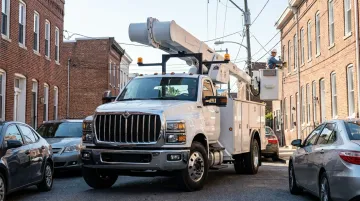
The CV515 takes a different approach to the utility truck problem. Its cab-over (cab-forward) design reduces overall vehicle length compared to conventional chassis cabs at similar GVWR ratings, which matters in urban and suburban jobsite environments where maneuvering space is limited.
With a Class 6 GVWR up to 23,500 lbs on 4x2 configurations, the CV515 supports aerial devices and utility service bodies while offering better site visibility and tighter turning radius than a conventional chassis cab. It runs a diesel-only powertrain (International 6.6L, rated at 350 hp and approximately 700–750 lb-ft torque). For telecom and municipal utility fleets working in dense urban corridors, it's worth serious consideration.
| Specification | Detail |
|---|---|
| Truck Class / GVWR | Class 6 / up to 23,500 lbs (4x2) or 23,000 lbs (4x4) |
| Powertrain Options | International 6.6L diesel (350 hp / ~700–750 lb-ft) |
| Ideal Upfit Applications | Aerial devices, service bodies, utility bodies in urban/suburban operations |
How We Chose the Best Utility Trucks
Selecting the right platform goes beyond horsepower or brand recognition. The most common fleet mistake is choosing a chassis without first verifying that the upfit body's weight, mounting requirements, and hydraulic needs are actually compatible. Overloading a chassis or mismatching an aerial device to a chassis rating is one of the primary causes of compliance failures and safety incidents in vocational truck operations.
The evaluation criteria applied here covered:
- Chassis class and GVWR headroom relative to typical upfit weight requirements
- Diesel engine torque output for vocational duty cycles (aerial, crane, service body)
- Body builder compatibility documentation from the OEM
- Parts availability and dealer network in the regions where these trucks operate
- Proven deployment history in electric utility, telecom, and contractor applications
Working with an authorized dealer who understands both the chassis and the upfit ensures the final configuration is compliant before it ever leaves the lot. CUES, Inc. has served New England and New York utility and contractor fleets since 1966 as an authorized dealer for Versalift®, Elliott®, Auto Crane®, and BrandFX®. That depth of experience means chassis-to-upfit compatibility gets evaluated at the spec stage, not discovered as a problem in the field.
Conclusion
The best utility truck for a commercial fleet is the one where chassis capability, upfit compatibility, and total lifecycle cost all align — not the one with the lowest sticker price or the most recognizable name. Decisions made at the spec stage directly affect safety, productivity, and what that truck actually costs you over its service life.
If you're ready to work through those decisions, contractors and fleet managers in New England and New York can contact CUES, Inc. at 800-258-1010 to discuss utility truck sales, aerial device options, and the right chassis-and-upfit combination for their specific application. With over 60 years of experience and authorized dealer relationships with Versalift, Elliott, Auto Crane, BrandFX, and other commercial equipment manufacturers, their team can help you get the spec right from the start.
Frequently Asked Questions
What are the top rated pickup trucks?
For general reliability, the Ford F-150, Ram 1500, and Toyota Tundra consistently rank highly — the Ram 1500 earned the top spot in J.D. Power's 2026 Vehicle Dependability Study for large light-duty pickups. For commercial utility applications, however, fleet managers should focus on Class 3–7 chassis-cab trucks, since utility upfits require higher GVWR and structural ratings than light-duty pickups provide.
What is a utility truck and how is it different from a standard work truck?
A utility truck is a chassis-cab vehicle upfitted with a purpose-built vocational body — such as a service body, aerial lift, or crane unit — designed for a specific commercial task. A standard work truck is a light-duty pickup used for general hauling, without the specialized upfit or structural ratings required for aerial and crane equipment.
What truck class is best for aerial lift or bucket truck applications?
Class 5 chassis (GVWR 16,001–19,500 lbs) — such as the Ford F-550 and RAM 5500 — are the most common platforms for mid-reach bucket trucks in the 35–55 ft. working height range. Class 7 is required for larger aerial devices in electric utility construction where heights and load demands exceed Class 5 capacity.
What should fleet managers look for when upfitting a utility truck?
Confirm the upfit body weight stays within available payload after accounting for crew and equipment, verify PTO and hydraulic system compatibility, and work with an authorized upfit dealer to ensure the completed vehicle meets applicable safety standards and manufacturer body builder guidelines.
How long do utility trucks typically last in a commercial fleet?
Class 4–7 diesel-powered utility trucks are generally rated for usable engine life above 300,000 miles when properly maintained. Consistent preventive maintenance, timely parts replacement, and correct loading practices are the primary drivers of long service life — not the chassis brand.
What are the main types of utility truck body configurations?
The primary configurations include:
- Service/utility bodies — open compartments for tools and equipment
- Aerial/bucket bodies — for elevated work at height
- Crane bodies — for load lifting applications
- Enclosed bodies — weather-protected storage
- Combination units — crane or aerial device paired with integrated storage