NIOSH reports 161 ladder-related workplace fatalities and 22,710 injuries in 2020, which gives context for why purpose-built aerial platforms matter. But getting value from that investment requires understanding what each truck type actually does — and where it falls short.
This guide covers the three primary aerial truck configurations used in commercial lift operations, how to evaluate them against your specific needs, and the mistakes worth avoiding before you sign anything.
Key Takeaways
- An aerial truck is a vehicle fitted with a hydraulic boom that lifts workers to height for jobs that can't be done safely from the ground
- The three main types (telescopic, articulating, and articulating-telescopic) each serve distinct reach profiles and job conditions
- Selection depends on working height, side reach requirements, site obstructions, electrical hazard exposure, and budget
- Consulting an authorized dealer before purchase helps verify the right configuration before committing
What Is an Aerial Truck and Why Does the Right Type Matter?
An aerial truck is a work vehicle equipped with a hydraulic boom and an elevated platform or bucket that safely positions a worker at height. Applications range from utility line repair and telecom equipment installation to tree trimming and signage maintenance.
One common source of confusion: aerial trucks used in commercial lift operations (bucket trucks, aerial work platforms) are entirely different from fire apparatus aerial devices like ladder trucks and tower ladders. Fire apparatus is designed for emergency rescue and firefighting — not worksite production.
Commercial aerial trucks are work platforms built to a separate standard: ANSI/SAIA A92.2-2021, which governs design, testing, inspection, maintenance, and use of vehicle-mounted aerial devices.
Choosing the wrong truck type creates real operational problems:
- Insufficient reach forces crews to abandon a setup and reposition
- Poor obstacle clearance turns a one-hour job into a half-day ordeal
- Compliance gaps arise when non-insulated trucks are used near energized lines
- Over-specification means paying for capabilities that never get used
The right choice comes down to three factors: the nature of the work, the site environment, and the operator's safety requirements.
Types of Aerial Trucks for Commercial Lift Operations
Aerial trucks are not interchangeable. Different boom configurations address different reach requirements, site limitations, and industry applications. Here's how the three primary types compare.
Telescopic (Straight) Boom Truck
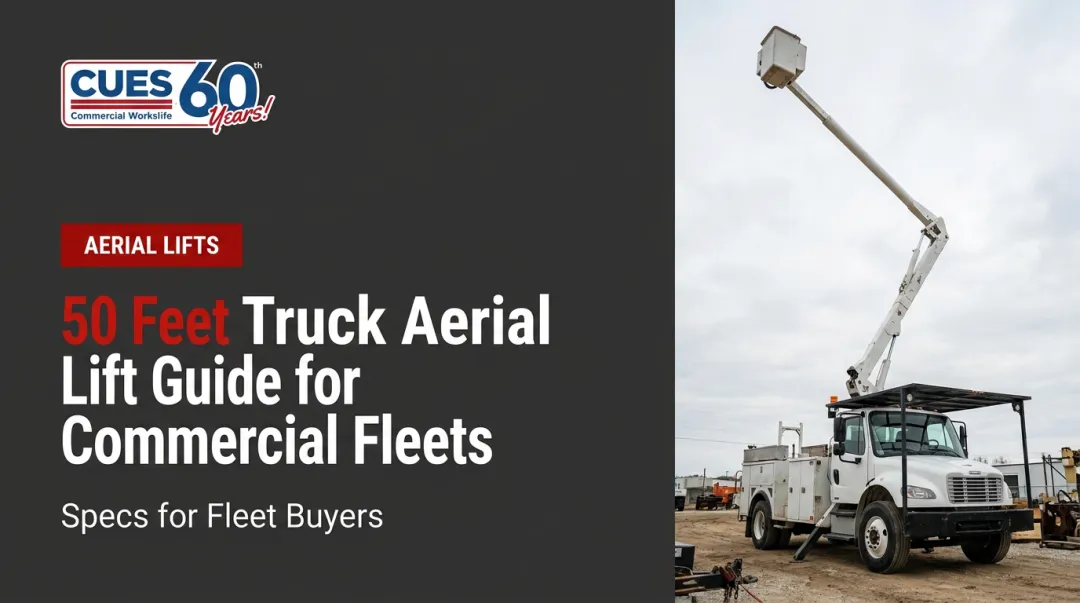
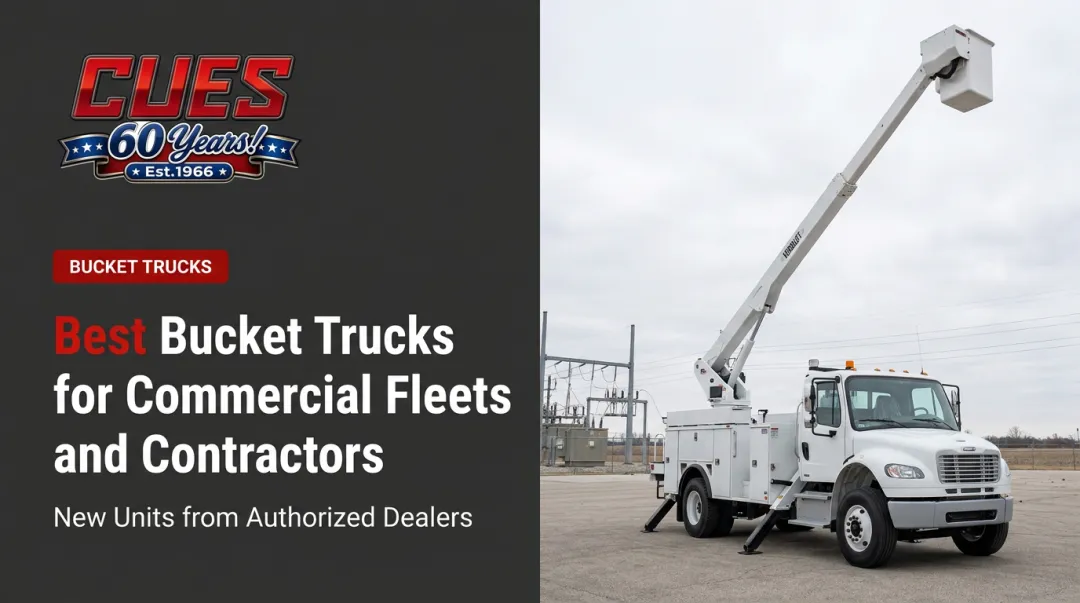
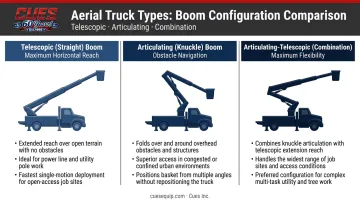
Telescopic boom trucks — sometimes called "stick booms" or "squirt booms" — feature a straight boom that extends outward in a single linear path without joints or articulation. The boom extends from the base at a fixed angle, delivering maximum horizontal reach from a single setup point. No folding, no joints — just direct extension to the target. For straightforward vertical tasks in open environments, that simplicity translates directly into faster deployment.
Best suited for:
- Open utility corridor work with clear positioning access
- Highway signage and traffic signal installation
- Road lighting maintenance
- Telecom work where the truck can park directly below or adjacent to the work point
Documented working heights range from 34 ft on compact models to over 140 ft on heavy-duty configurations. Terex's TL80, for example, delivers 80 ft of working height with 47 ft 2 in of side reach — useful for transmission-level utility work.
Key strengths:
- Maximum direct horizontal reach of any aerial truck type
- Simpler mechanical system with fewer potential failure points
- Faster to deploy for straightforward vertical tasks
Limitations:
- Cannot work around obstacles — trees, roof overhangs, parked vehicles block the path
- Requires relatively level, unobstructed ground near the work point
- Limited side-reach flexibility compared to articulating configurations
Crews with consistent access to open positioning benefit most from this configuration.
Articulating (Knuckle) Boom Truck
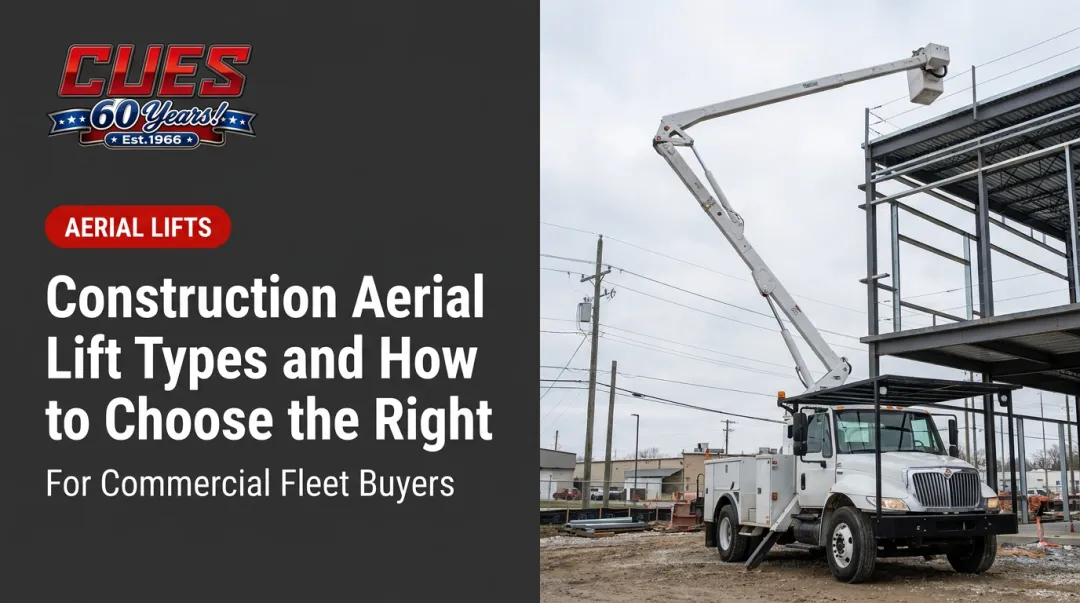
Articulating boom trucks feature one or more hinged "knuckle" joints that allow the boom to fold and unfold. The joints allow the operator to position the bucket over, under, or around obstacles without moving the truck — clearing tree canopies, building eaves, or electrical infrastructure that a straight boom cannot navigate. On congested job sites, that capability changes the operational math entirely.
Best suited for:
- Tree service operations requiring navigation around branches
- Urban utility and telecom work on tight streets
- Construction sites with physical obstructions between the truck and the work point
- Overcenter models, which allow the upper boom to swing past the vehicle's center for extended side reach
Versalift® — carried by CUES, Inc. — offers articulating configurations purpose-built for utility and telecom applications. The Versalift SST-40-EIH, for instance, provides 45 ft of working height on a Ford F-550 4x4 chassis, with 180° platform rotation and insulated boom construction for energized line work.
Key strengths:
- High versatility on obstructed or congested sites
- Allows the operator to approach work from multiple angles without repositioning
- Overcenter models provide extended side reach when needed
Limitations:
- Generally delivers less maximum horizontal reach than a telescopic boom of equivalent length
- Articulating joints add mechanical complexity
- Tail swing on the opposite side of the bucket requires careful management in tight spaces
For tree service and urban utility crews, cutting out repositioning stops is the most direct path to more completed jobs per day.
Articulating-Telescopic (Combination) Boom Truck
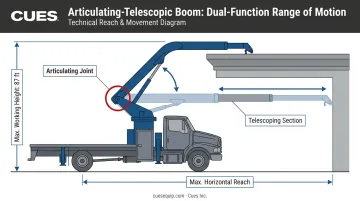
Combination trucks merge both capabilities: a knuckle joint for obstacle navigation and a telescoping section for extended reach. The articulating joint lets the boom bend around obstacles, while the telescoping section extends the working envelope beyond what the knuckle alone could reach. The result is the broadest operational range of any single aerial truck configuration.
Best suited for:
- Operations that regularly require both reach and obstacle navigation
- Utility transmission and distribution work
- Telecommunications and fiber installation in varied terrain
- Fleet operators who need one truck to handle diverse job types
CUES, Inc. carries several combination units from Versalift®. The VST-47-MHI delivers 52 ft 4 in of working height and 30 ft 9 in of horizontal reach on a Ford F-550 4x4, with a 1,000 lb jib and 360° continuous rotation. The VST-55-HDI steps up to 59 ft 7 in of working height and 600 lb platform capacity on a Ford F-600 4x4, with Category C 46kV insulation via the TruGuard™ system.
Key strengths:
- Broadest documented work envelope of the three types
- Reduces the need for multiple truck types in a fleet
- Handles variable terrain and overhead obstacles in a single setup
Limitations:
- Higher upfront cost and greater maintenance complexity than single-configuration trucks
- Larger footprint on job sites
- May exceed weight or size limits on certain routes — federal Interstate baselines set gross vehicle weight limits at 80,000 lbs, with state routes often imposing stricter thresholds
Verify axle loads and permitting requirements for every jurisdiction the truck will operate in before finalizing a purchase.
A Note on Insulated vs. Non-Insulated Aerial Trucks
Configuration is only part of the selection decision. Across all three types, aerial trucks can be built with or without dielectric insulation — and that distinction carries real regulatory and safety weight.
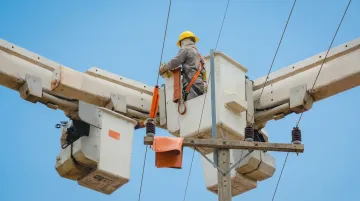
OSHA's interpretation of 29 CFR 1910.269 clarifies that non-insulated bucket trucks may be used near energized lines only when required minimum approach distances are strictly maintained. For most utility and telecom work near live infrastructure, an insulated boom and bucket meeting ANSI/SAIA A92.2 insulation categories is the practical and regulatory standard.
Non-insulated trucks are appropriate for:
- General construction away from power lines
- Tree trimming with no electrical hazard
- Signage and lighting maintenance in safe zones
Insulated trucks are required when:
- Operators work on or near energized electrical lines
- Utility crews perform distribution or transmission maintenance
- Telecom workers install or maintain infrastructure near live conductors
Insulated models require daily visual inspection and annual dielectric testing to maintain their rating — a maintenance requirement worth building into total cost of ownership calculations.
How to Choose the Right Aerial Truck for Your Operation
Start with the work itself, not the truck. Define the primary task the unit will perform most often, then work outward from there.
Working Height
Identify the maximum height where work will consistently occur. CUES, Inc.'s inventory spans working heights from 34 ft to 87 ft across its lineup — matching that range to your actual job requirements avoids paying for height capacity that rarely gets used.
Side Reach and Site Access
If obstructions are common, prioritize articulating or combination configurations. If your sites are predominantly open with direct truck positioning, telescopic units offer more reach per dollar.
Electrical Hazard Exposure
Determine whether operators will work near energized lines. If yes, only consider insulated models that meet OSHA requirements and the current ANSI/SAIA A92.2-2021 standard. Specify the required insulation category based on the voltage exposure, not just the job title.
Frequency and Terrain
Daily use typically justifies purchase. Less frequent deployment may warrant a conversation about alternative procurement. CUES, Inc. offers financing options through its credit program at cuesequip.com — useful for fleet operators managing capital budgets across multiple units.
Terrain is equally worth pinning down before you spec a unit. Paved, level sites support standard chassis configurations, while rough or off-road conditions require a 4x4 drivetrain. CUES, Inc. carries both Ford F-550 and Ford F-600 4x4 configurations across its Versalift® lineup to address this.
Total Cost of Ownership
Factor in more than the purchase price. NTEA identifies four core components of commercial vehicle TCO: acquisition, maintenance, fuel, and resale value. Parts availability and access to authorized service matter more than buyers often expect — a unit that sits waiting for parts costs more than its sticker price suggests.
Common Mistakes to Avoid When Selecting an Aerial Truck
Three selection errors show up repeatedly across utility, telecom, and tree care fleets:
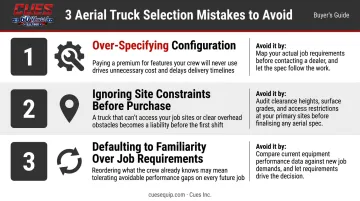
Over-specifying the configuration. Operators frequently select combination articulating-telescopic trucks for work a standard telescopic unit would handle efficiently. The more complex the truck, the higher the maintenance burden and the operating cost.
Ignoring site constraints until after purchase. Road access, ground conditions, overhead clearances, and local weight restrictions need to be assessed before a truck is ordered — not after it arrives on site and won't fit through the access gate. A pre-purchase site walk takes an hour; fixing a wrong-spec purchase takes months.
Defaulting to familiarity. Crews experienced with one truck type often spec the same configuration out of habit. A team comfortable with telescopic trucks may resist an articulating unit even when the site clearly calls for it. Run each project's requirements against the actual job conditions — not against what the crew already knows.
Conclusion
Aerial trucks are essential tools across utility, telecom, tree service, and construction industries — and each of the three main configurations serves a distinct set of conditions. Telescopic booms provide the most direct reach at height, articulating booms navigate around obstacles, and combination units offer both capabilities where the job demands it.
The right choice comes down to an honest assessment of working height, side reach needs, electrical hazard exposure, terrain, and budget. CUES, Inc. has been working through these decisions with contractors, utilities, and municipalities across New England and New York since 1966 — and as an authorized Versalift® dealer, the team can match buyers to the right configuration from current inventory. Reach out at 800-258-1010 or visit cuesequip.com.
Frequently Asked Questions
What is an aerial truck?
An aerial truck is a vehicle equipped with a hydraulic boom and a worker-carrying platform or bucket, designed to safely elevate personnel for tasks like utility line maintenance, telecom work, tree trimming, and construction. Commercial aerial trucks are work platforms built to ANSI/SAIA A92.2 standards for occupational use.
What are the three types of aerial devices?
The three main commercial configurations are telescopic (straight boom for maximum horizontal reach), articulating (knuckle boom for positioning around obstacles), and articulating-telescopic (combination boom for maximum flexibility in both reach and obstacle navigation).
What is the difference between a ladder truck and an aerial fire truck?
Aerial fire trucks — including ladder trucks and tower ladders — are emergency apparatus designed for firefighting and rescue operations. Commercial aerial trucks (bucket trucks) are work platforms built to elevate personnel for utility, telecom, or construction tasks. Both elevate people, but they are engineered to entirely different standards and serve entirely different purposes.
What is the difference between an overcenter and non-overcenter bucket truck?
Overcenter bucket trucks allow the boom to swing the bucket past the truck's centerline, extending side reach significantly. Non-overcenter units cannot cross that centerline. Overcenter models are preferred when maximum horizontal flexibility is needed, such as in forestry or utility work where the truck cannot always be positioned directly below the work point.
Do I need an insulated aerial truck for electrical utility work?
Any aerial work near energized electrical lines requires an insulated (dielectric) boom and bucket to protect operators from electrocution. Non-insulated trucks are only permissible where required approach distances to energized conductors can be maintained.