
Introduction
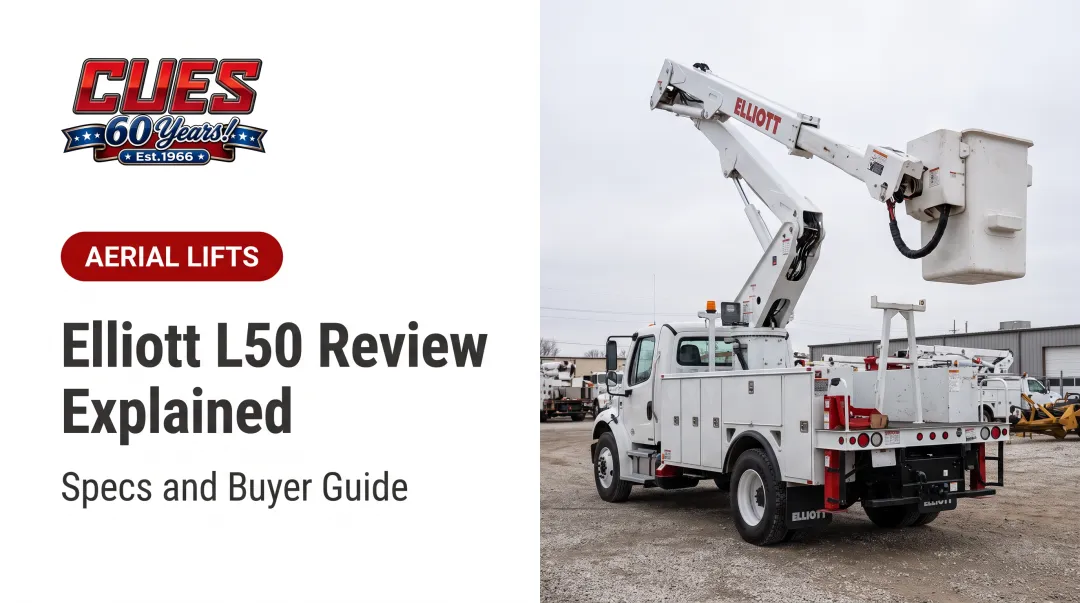
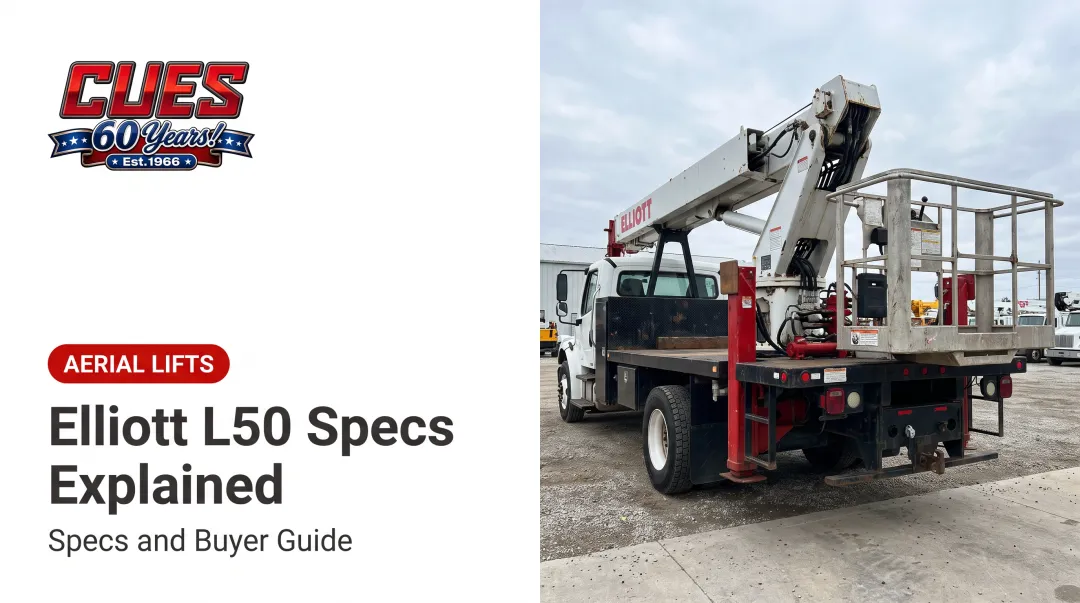
If you're evaluating a truck-mounted aerial device like the Elliott L50, working height is the spec that decides whether the unit can reach the job. Utility line work, sign maintenance, and telecom installs all hinge on that number.
Working height isn't as simple as it looks on a spec sheet. Buyers often misread how it's measured, what reduces it in the field, and how it trades off against platform capacity and side reach.
This guide breaks down the L50's rated working height, the engineering behind it, and what to verify before you buy or rent.
Key Takeaways
- The Elliott L50 has a rated 50-foot working height paired with 40 feet of side reach
- Working height is a fixed engineering figure, not something adjustable in the field
- Chassis GVWR, outrigger setup, and platform load all affect what height is achievable on site
- Misreading capacity-vs-height charts is the most common specification mistake buyers make
- An authorized Elliott dealer can help match the correct L50 configuration to your application
What Working Height Represents on the Elliott L50
Working height is measured as the vertical distance from ground level up to the platform floor, plus an allowance for operator reach above it. It's a convention used across the aerial work platform industry to describe how high a worker can actually access, not just how high the platform itself travels.
For the L50, Elliott's current spec sheet lists this figure at 50 feet, alongside a 40-foot working side reach. These are the two headline dimensions that define the unit's operating envelope.
Working Height vs. Platform Height and Side Reach
Working height and platform height are not the same measurement, and mixing them up is one of the fastest ways to misjudge a unit's capability.
- Platform height measures only to the floor of the bucket or platform itself
- Working height adds an assumed reach above that floor to represent what a worker standing in the platform can actually touch
- Side reach measures horizontal distance the boom can extend outward from the truck's centerline, separate from vertical height entirely
Elliott's L50 documentation doesn't publish a separate platform-height figure, so if platform height matters for your application, confirm it directly with your dealer rather than estimating it from working height.
That published working height comes from the L50's boom geometry and chassis mounting height. Operators work within that envelope; they don't adjust it on the job.
Factors That Reduce Usable Working Height on the Job Site
The catalog number and the achievable number on a given job are rarely identical. Several site factors cut into usable height:
- Chassis mounting height — the truck's frame height and the L50's 19,500 lb. GVWR configuration set the baseline from which the boom operates
- Outrigger deployment — the L50 requires roughly 10 feet of spread front and rear; tight sites can prevent full outrigger extension, which limits boom movement
- Ground slope — uneven or sloped surfaces reduce how far outriggers can level the chassis, which affects both height and reach simultaneously
- Platform loading, wind, and obstructions — heavier loads, high wind, and nearby structures all restrict how much of the rated working height can be safely used at once

The rated figure reflects best-case conditions. Job planning still has to match boom use to the site's real constraints.
Elliott L50 Working Height Range and Specifications
The Elliott L50 is rated for a 50 ft (15.2 m) working height. That figure comes from Elliott's published design limits for the model, not from an absolute mechanical ceiling operators can push past.
Nominal Operating Range
Here's how the L50's core specs line up according to Elliott's current L50 HiReach spec sheet:
| Spec | Rated Value |
|---|---|
| Working height | 50 ft / 15.2 m |
| Working side reach | 40 ft / 12.2 m |
| Platform capacity | 600 lb / 272 kg |
| Platform jib winch | 500 lb / 227 kg |
| Main winch | 2,000 lb / 907 kg |
| Chassis GVWR | 19,500 lb minimum |
| Outrigger spread (front/rear) | 10 ft each |
The 2,000 lb figure is the main winch rating, not the platform's material handling capacity. The occupied platform itself is rated for 600 lb, with a separate 500 lb jib winch mounted at the platform. Treating these as one number is a common and costly mix-up.
Allowable Tolerance and Boundary Limits
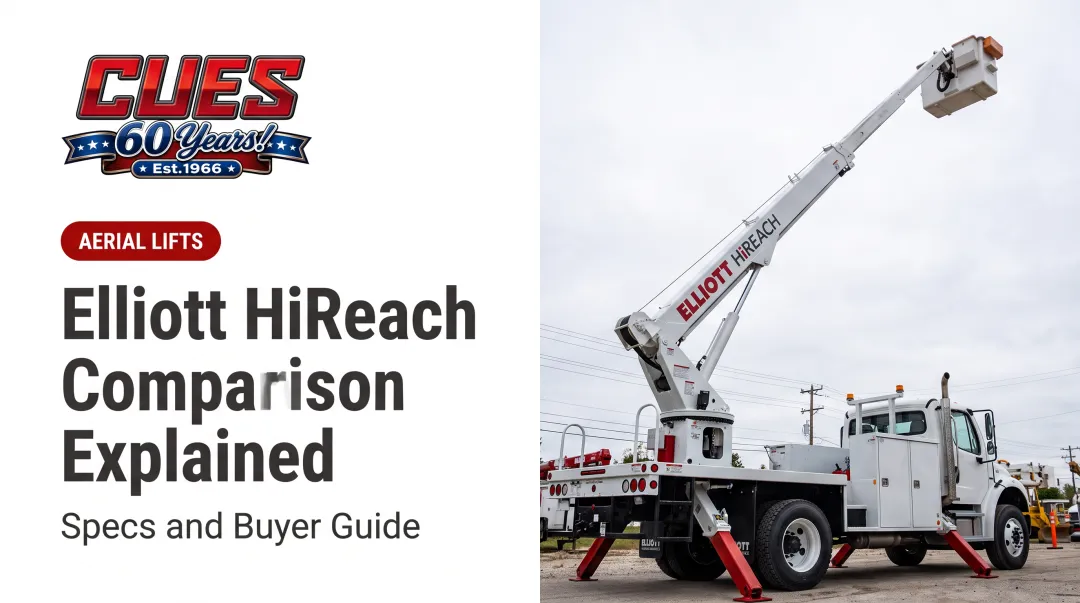
The rated working height reflects Elliott's engineered operating limit for the L50, sitting within the broader HiReach model family that spans roughly 45 to 140 feet. The structural and tested limits built into the boom sit above this rated figure as engineering margin, not as usable additional height for daily operation.
Positioning near maximum height briefly during setup or repositioning is different from sustained operation at that height under load. Elliott's current documentation doesn't publish a separate time-based duty-cycle restriction for the L50, so operators should default to the load chart and manual supplied with their specific unit.
Safe Operating Margin and Verification
Elliott rates working height below the boom's absolute structural limit so daily use stays clear of failure conditions. Near that ceiling, stress on hydraulic cylinders and structural members rises sharply.
In practice, working height is verified through:
- Spec sheet documentation matched to the unit's serial number
- Boom angle indicators in the cab or platform controls
- Periodic ANSI A92.2 inspections, which cover design, testing, and ongoing maintenance requirements for vehicle-mounted aerial devices
Field-measured height can differ slightly from factory-rated figures due to chassis variance, tire pressure, or ground conditions. That's normal, and it's exactly why periodic inspection matters more than a one-time factory check.
Key Technical Properties and Trade-Offs of L50 Working Height
Working height on the L50 doesn't operate in isolation. It's one variable in a coupled system with side reach and platform capacity, and changing one affects what's available from the others.
Three couplings matter most when you size an L50 for real jobs:
- Height plus side reach reduces available platform capacity
- Narrow outriggers open tight sites but trim lateral stability margin
- 19,500 lb. GVWR keeps many units under the federal Class B CDL threshold
Stability and Coupling with Side Reach and Capacity
Push the boom toward maximum working height and maximum side reach at the same time, and available material handling capacity drops. This is standard behavior across boom lift design, and it's why Elliott's guide to reading a HiReach load chart stresses that capacity varies with boom angle.

A chart showing full 600 lb platform capacity at 50 feet of height doesn't necessarily hold once you extend to 40 feet of side reach at the same time.
The working height figure itself, though, is highly repeatable. It's governed by mechanical boom stops rather than variable field conditions, so unit-to-unit variance in maximum height is minimal. What varies is what you can safely carry once you're up there.
Trade-Offs from Chassis and Configuration Choices
The L50's narrow outrigger footprint, at roughly 10 feet front and rear, is what lets it deploy its full working height and side reach on tight urban or residential sites where wider-footprint competitors can't set up at all.
That compactness helps on confined-space work, though it comes with less lateral stability margin than a wider-stance unit at full extension.
Chassis GVWR selection carries its own trade-off. The L50's 19,500 lb. GVWR pairing sits below the federal threshold that triggers a Class B commercial driver's license requirement, which starts at 26,001 lb. GVWR under FMCSA rules.
That doesn't automatically mean every driver is CDL-exempt. State rules or hazardous materials placarding can still apply. For many fleets, though, it widens the pool of operators who can legally drive the truck.
Buyer's Guide: Avoiding Misapplication and Choosing the Right L50 Configuration
Most working height specification errors happen at the buying stage, not in the field. Job requirements get compared loosely against a catalog sheet instead of the actual capacity-height-reach combination the unit delivers.
Two misreadings show up repeatedly:
- Full height ≠ full capacity at every position. The L50's 600 lb platform, 500 lb jib, and 2,000 lb main winch ratings are separate figures. None apply automatically at every boom position with 50 feet of height.
- Working height ≠ platform height. Confirm which term quotes and spec sheets use. Platform height alone understates what working height typically means.
On chassis compatibility: CUES currently stocks L50 configurations on a 2025 Ford F-600 chassis (stock #41396) and a 2026 Ram 5500 chassis (stock #41456). Both sit on the standard 19,500 lb GVWR platform.
That consistency simplifies licensing conversations and keeps the operator pool wider than it would be on a heavier chassis.
Before finalizing a purchase, verify these against the unit-specific chart:
- Model designation (L50 vs. L50R)
- Serial-number-matched load chart, not a generic catalog page
- Working height and working side reach figures
- Platform, jib, and main winch capacities individually
- Chassis GVWR and any state licensing implications

An authorized dealer helps you match those figures to the job, not just the catalog page. CUES, Inc., an authorized Elliott dealer across New England and New York, supports configuration selection, sales, and financing for the right L50 setup.
After the sale, Elliott's Lifetime Structural Warranty and CUES's fully stocked parts department keep the unit supported in the field.
Conclusion
Working height on the Elliott L50 is a governing, engineered specification. You can't treat it apart from side reach and capacity. The 50-foot rating means something different depending on how much load you're carrying and how far you're reaching out at the same time.
Understanding the nominal range, tolerance limits, and built-in safety margin determines whether you get full, safe value from the equipment on the jobs you actually run.
The spec sheet gives you the numbers. A knowledgeable dealer helps you apply engineering judgment to those numbers for your specific fleet and application. That judgment matters as much as the published figures themselves.
Frequently Asked Questions
What is the working height of the Elliott L50?
The L50 is rated at 50 feet of working height according to Elliott's current spec sheet. Some older product pages reference 55 feet, so always confirm the figure against your specific unit's documentation.
How is working height different from platform height on an aerial device?
Working height includes about 6 feet of assumed operator reach above the platform floor; platform height measures only to the floor. Elliott doesn't publish a separate platform height for the L50, so ask your dealer if you need that figure.
What factors can reduce the Elliott L50's usable working height on a job site?
Limited outrigger deployment space, ground slope, chassis setup, wind conditions, and platform loading can all restrict how much of the rated 50-foot height is safely usable on a given site.
What is the material handling capacity of the Elliott L50 at full working height?
Capacity varies with boom angle and side reach, so full 600 lb platform capacity isn't guaranteed at every boom position. Always check the load chart specific to your unit's serial number before planning a lift.
What chassis is required for the Elliott L50?
The L50 pairs with a 19,500 lb GVWR chassis, such as the Ford F-600 or Ram 5500 configurations. This weight class sits below the federal Class B CDL threshold, which can simplify operator licensing depending on state rules.
How often should an aerial device's working height and related specs be inspected or verified?
Vehicle-mounted aerial devices require periodic inspection under ANSI A92.2, covering design, testing, and maintenance checkpoints. Schedule service with an authorized dealer so rated working height and related specs stay verified over the unit's life.