Forestry bucket trucks aren't interchangeable with general aerial lifts. They're purpose-built for canopy access, debris handling, and work near energized lines — and the right configuration depends heavily on your specific service area, crew size, and job mix.
This guide breaks down what separates a forestry bucket truck from other aerial lifts, which specs actually drive buying decisions, and how to choose between a forestry unit with chip box versus a rear mount setup.
Key Takeaways
- A forestry bucket truck combines aerial access with an integrated chip box — trim, chip, and haul in one unit
- Working height should match the tallest trees you regularly service; residential work typically falls in the 45–65 ft range
- Overcenter booms reach beyond vertical, providing side access without repositioning the truck — critical near structures and power lines
- Chassis type (2WD vs. 4×4), GVWR, and outrigger design determine where you can safely deploy
- For a first purchase, a forestry bucket truck with chip box is the practical starting point
- Rear-mount configurations make more sense when scaling to a two-truck operation
What Is a Forestry Bucket Truck?
A forestry bucket truck is an aerial lift vehicle built specifically for tree trimming, pruning, and removal. Unlike a standard utility bucket truck, it's designed around the demands of canopy work: extended articulation, terrain adaptability, and integrated debris handling.
Two primary configurations exist:
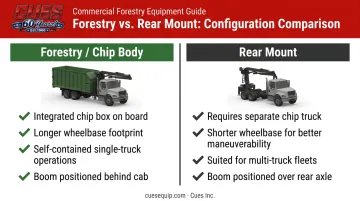
- Forestry bucket truck — boom mounted behind the cab with an integrated chip box; a self-contained work unit
- Rear mount bucket truck — boom positioned over the rear axle without a chip box; typically paired with a separate chip truck
Core Components
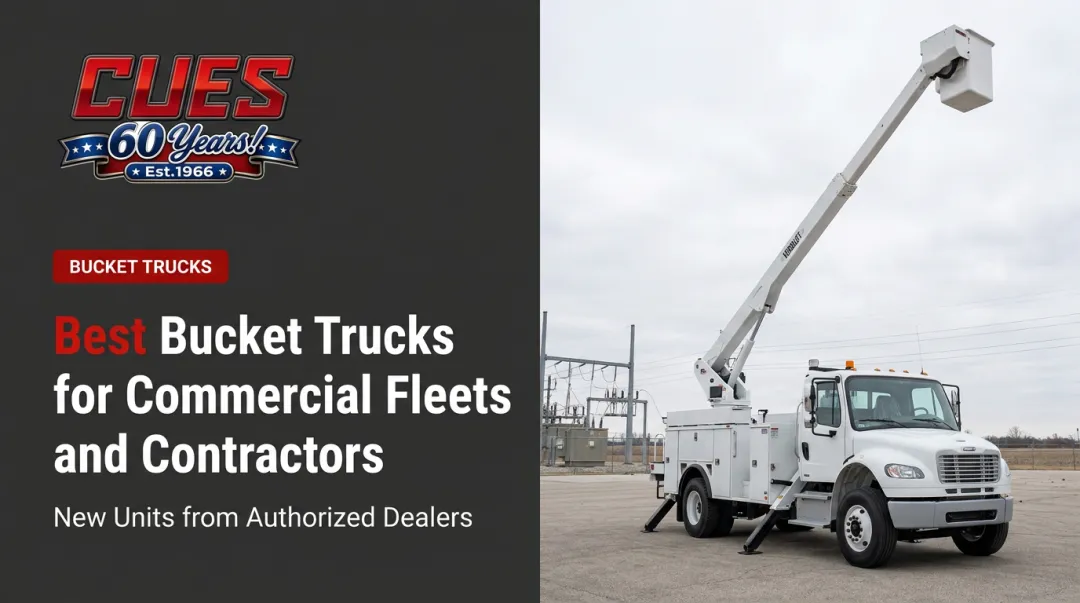
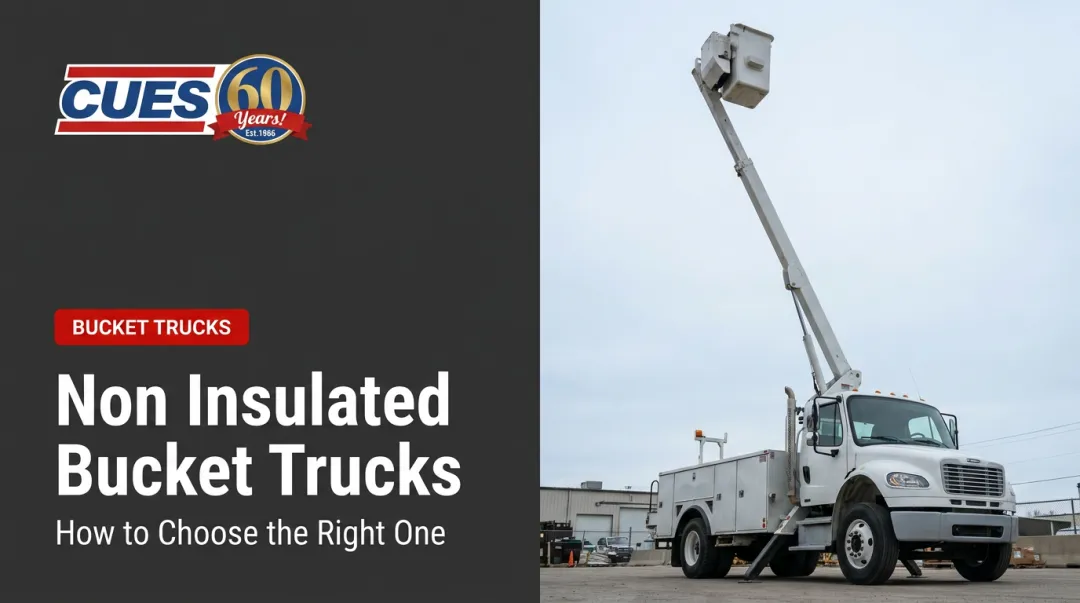
- Boom and bucket — The articulated or telescopic arm that positions the operator. Forestry booms are commonly overcenter-rated, meaning the upper boom travels beyond vertical (more than 180 degrees from stowed), giving operators access to limbs on the far side of a tree without repositioning the truck.
- Chip box — A rear-mounted enclosed container that collects branches and wood chips fed through a tow-behind chipper. One vehicle trims, collects, and hauls debris in a single pass.
- Outriggers and stabilizers — Hydraulically deployed legs that extend from the truck frame to create a stable base. On uneven, soft, or sloped terrain — common in residential tree work — outrigger deployment is required under OSHA 1926.453, which mandates pads or a solid surface under outrigger feet.
Why Tree Service Companies Rely on Them
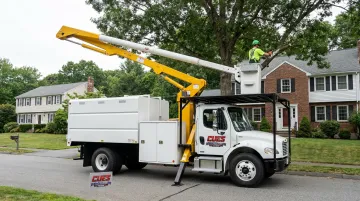
Forestry bucket trucks reduce the need for climbing, allow crews to work near energized lines with dielectrically rated booms, and combine aerial access with debris collection — fewer trucks on site, less crew coordination per job, fewer trips to dump.
Safety is a real driver here. TCI Magazine's analysis of 2022 BLS data reports a tree-trimmer fatality rate of 110 per 100,000 workers, with climbers accounting for roughly half of fall incidents. Aerial lifts carry their own risks — fatal platform falls are documented — but eliminating unnecessary climbing from routine pruning and trimming is a meaningful operational choice.
What to Consider When Choosing the Right Bucket Truck for Tree Service
The right truck depends on your job type, terrain, crew size, and how the business operates. A residential arborist doing ornamental pruning in tight suburban lots has completely different requirements than a line clearance contractor working along transmission corridors.
Each factor below ties a specific spec to what it means on the job.
Working Height and Horizontal Reach
Match working height to the tallest trees you regularly encounter. For reference, common residential species reach significant heights at maturity: red maple hits 40–60 ft, American elm 60–80 ft, and northern red oak 65–100 ft in many regions.
Current forestry models span a wide range — from 45 ft entry-level units up to 75 ft 10 in on heavy-duty configurations. Side reach matters just as much as vertical height when you're working over driveways, rooftops, or utility lines without repositioning.
One spec to watch: "Working height" in manufacturer sheets includes the operator's height. Actual usable boom reach is lower. The Altec TA60, for example, lists a 64 ft working height but 59.8 ft to the bottom of the platform. Always compare platform height when evaluating models side by side.
Boom Type: Overcenter vs. Non-Overcenter
An overcenter boom articulates beyond vertical — giving the operator access to limbs on the far side of a tree, or the ability to work in tight spaces between structures without moving the truck. Versalift identifies overcenter units as popular in forestry for exactly this reason.
Non-overcenter booms are simpler, typically lower cost, and work fine in open environments where you can reposition freely. The tradeoff:
- Overcenter: Greater flexibility in congested residential areas, near power lines, and on jobs where repositioning burns time
- Non-overcenter: Lower entry cost, sufficient for open utility corridors or rural work where truck placement is rarely constrained
Chassis Type and Terrain Capability
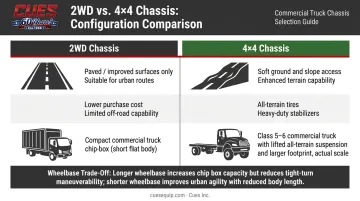
Tree service regularly takes you off pavement — into backyards, along embankments, and onto soft or wet ground. A standard 2WD chassis may sink or lose stability before outriggers ever deploy.
Versalift identifies 4×4 drivetrains, all-terrain tires, and heavy-duty stabilizers for slope compensation as forestry-specific setup options. Key considerations:
- 2WD works for paved or improved surfaces; lower cost
- 4×4 needed for soft ground, slopes, and off-road access
- Wheelbase length affects chip box size and urban maneuverability — longer wheelbases support larger chip boxes but reduce turning radius in tight areas
CDL Requirements and Truck Class
GVWR determines CDL requirements. Under FMCSA definitions, a Class B CDL is required for any single vehicle with a GVWR of 26,001 lbs or more. Class 6 chassis (19,501–26,000 lbs GVWR) fall below that threshold.
This matters for smaller crews. The Versalift MV607, available through CUES, Inc., sits at 25,999 lbs GVWR — just under the CDL threshold. It delivers 65 ft working height, a 250 HP Cummins diesel, and an Allison automatic transmission.
Factor your operators' licenses into the spec decision before you commit to a chassis class.
Safety Features
Evaluate these before purchase:
- Dielectric boom rating — Required for work near energized lines; Terex categories A, B, and C differ in insulation level and testing frequency
- Fall protection anchors — OSHA requires lanyard attachment to the boom or basket; body belts are not acceptable for fall arrest
- ANSI/SAIA A92.2-2021 compliance — The current standard for vehicle-mounted aerial devices, in effect since August 2022
- Hydraulic tool connections — Platform-level hookups for chainsaws and other tools reduce hose management overhead
Budget and Total Cost of Ownership
New forestry bucket trucks cost more upfront but reduce near-term maintenance risk. Pricing shifts substantially based on boom height, chassis class, chip body, and insulation package.
Beyond purchase price, account for:
- Annual boom inspections (required under ANSI A92.2)
- Parts availability and lead times
- Downtime cost when the truck is out of service
- Dealer road service capability
Dealer road service capability is where total cost of ownership diverges most between suppliers. CUES, Inc. runs fully stocked service trucks and carries parts inventory — which means less time waiting and more time working. Call (800) 258-1010 for current pricing on specific configurations.
Forestry Bucket Truck vs. Rear Mount: Which Configuration Do You Need?
The core operational difference comes down to what you need the truck to do on site.
| Factor | Forestry / Chip Body | Rear Mount |
|---|---|---|
| Debris handling | Integrated chip box on board | Requires separate chip truck |
| Wheelbase | Longer footprint | Shorter, better maneuverability |
| Best fit | Self-contained single-truck ops | Multi-truck fleets with existing chip capacity |
| Positioning | Boom behind cab | Boom over rear axle; can back toward work site |
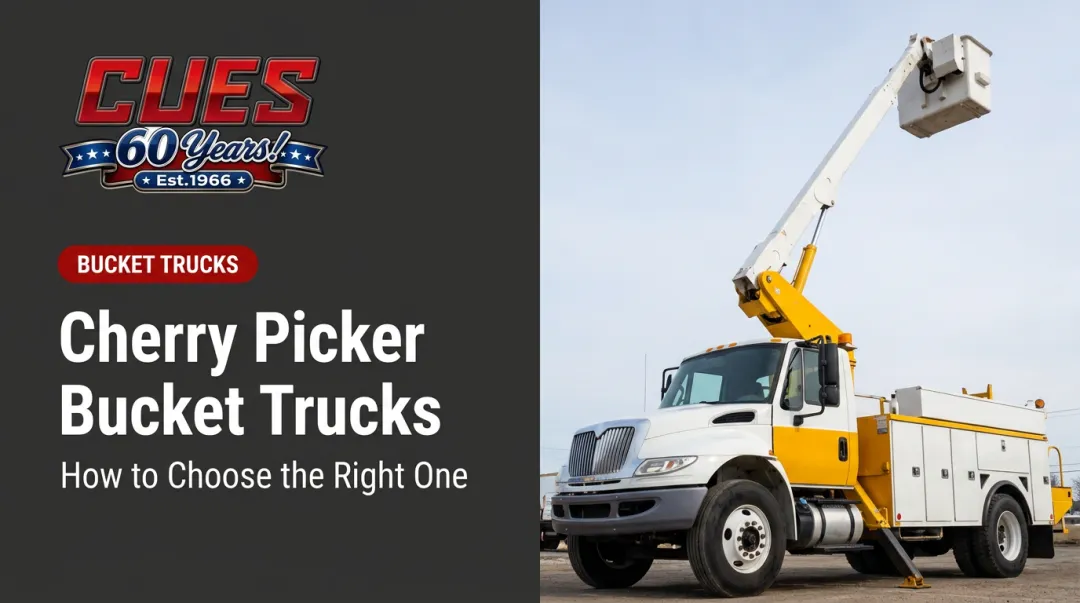
Smaller operations and first-time buyers are typically better served by the forestry configuration. You trim, chip, and haul without coordinating a second vehicle. The Versalift forestry bucket trucks available through CUES offer integrated chip box designs with working heights up to 65 ft, several without a CDL requirement — a practical starting point for owner-operators.
Scaling fleets benefit from rear mounts when chip capacity already exists in the fleet. A two-truck setup — forestry unit hauling chips while the rear mount keeps working — increases throughput on high-volume commercial or storm work.
Rear mounts generally cost slightly more due to additional outrigger and hydraulic complexity, but their shorter wheelbase pays off in dense urban environments where maneuvering room is tight.
How CUES, Inc. Can Help You Find the Right Bucket Truck for Tree Service
CUES, Inc. has been an authorized Versalift® dealer since 1966, serving tree service companies, utilities, and contractors across New England and New York from locations in Amherst, NH and North Franklin, CT.
Their forestry bucket truck inventory includes multiple Versalift configurations built specifically for tree care:
- Versalift MV607 — 65 ft working height, 50 ft side reach, chip box, overcenter aerial, no CDL required (25,999 lbs GVWR)
- Versalift VO270 on Ford F-750 — 75 ft working height, 50 ft side reach, 33,000 lbs GVWR, 300 HP 6.7L diesel, 360-degree continuous rotation
- Versalift International HV 507 4×4 — 75 ft forestry tree truck with chip body, built on an International HV 507 4×4 chassis for enhanced terrain capability
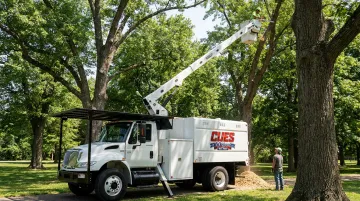
All models come with financing options through CUES — including a payment calculator and lease-to-own structures — and trade-in valuations to help offset the cost of a new unit.
For tree service operations ready to spec out the right configuration, CUES can walk you through available models, chassis options, and financing structures. Contact their team at (800) 258-1010 or browse current inventory at cuesequip.com.
Conclusion
The right bucket truck for tree service comes down to aligning specs — working height, boom type, chassis, and configuration — with the actual demands of your work. No single truck fits every operation, and a mismatched unit costs you in productivity, safety margins, and job site flexibility — every day it's in the field.
Start with your most common job type and the tallest trees you regularly service. Build outward from there. And work with a dealer who knows the equipment well enough to spec the right unit — not just move one off the lot. CUES, Inc. has been matching tree service companies with the right aerial equipment since 1966, with direct manufacturer relationships and the product knowledge to back every recommendation.
Frequently Asked Questions
What is a forestry bucket truck?
A forestry bucket truck is an aerial lift vehicle configured specifically for tree trimming and removal. It typically features an overcenter boom for above-center articulation, a dielectric rating for work near power lines, and an integrated chip box for debris collection. These features set it apart from standard utility bucket trucks.
How much does a bucket truck for tree service cost?
Pricing varies based on working height, boom type, chassis class, chip body, and insulation package. New entry-level forestry units (45–55 ft) cost less than heavy-duty 75 ft configurations on Class 7 chassis. Contact CUES, Inc. at (800) 258-1010 for current pricing on specific models — their inventory spans working heights from 34 ft to 87 ft across multiple configurations.
Can you rent a bucket truck for tree service?
Rental is available through some equipment agencies for seasonal or short-term projects. For long-term operational needs, purchasing is typically more cost-effective — contact CUES, Inc. at (800) 258-1010 to discuss the right fit for your operation.
Do I need a license to operate a bucket truck for tree service?
Trucks over 26,000 lbs GVWR require a Class B CDL; lighter forestry units at or below that threshold do not. Regardless of license class, OSHA requires all aerial lift operators to be trained and authorized before operating the equipment.
What working height do I need for tree service?
Most residential arborist work is covered by 45–65 ft models. Taller species — northern red oak reaches 65–100 ft — or utility line clearance may require 70+ ft. Always compare platform height rather than working height when reviewing specs, as the difference can be 4–6 ft depending on the model.
What is the difference between a forestry bucket truck and a rear mount bucket truck?
A forestry bucket truck mounts the boom behind the cab and includes an integrated chip box for debris handling. A rear mount places the boom over the rear axle without a chip box. It's typically paired with a separate chip truck and offers a shorter wheelbase for tighter site access.