Non-insulated bucket trucks are purpose-built for aerial work where electrical hazard isn't a factor. They're lighter, typically less expensive, and simpler to maintain. But "non-insulated" doesn't mean one-size-fits-all. Boom configuration, working height, platform capacity, chassis type, and fuel source all vary significantly — and the wrong combination creates real operational problems.
This guide covers what non-insulated bucket trucks are, how they differ from insulated models, and the key specifications that determine the right choice for your fleet.
Key Takeaways
- Non-insulated bucket trucks use steel construction (no dielectric coating) and are built for aerial work where no electrical hazards are present
- Boom configuration (overcenter vs. non-overcenter, articulating vs. telescopic) is the most consequential spec decision
- Working height, platform capacity, chassis size, and fuel type must align with your typical job site demands
- Non-CDL options exist: some compact units fall under the 26,001 lb GVWR threshold that triggers a Class B requirement
- Matching specs to the work — not buying the most capable unit available — reduces cost and improves productivity
What Are Non-Insulated Bucket Trucks?
OSHA 1910.67 defines an aerial device as a vehicle-mounted telescoping or articulating device used to position personnel. Within that category, OSHA separately defines an insulated aerial device as one specifically designed for work on energized lines and apparatus. A non-insulated unit simply lacks that energized-line design classification and dielectric rating.
Structurally, non-insulated bucket trucks use steel boom sections and steel buckets. The absence of a fiberglass dielectric coating reduces weight and simplifies construction, with no functional trade-off when the work doesn't involve electrical exposure.
Boom material alone doesn't determine insulation status. ANSI/SAIA A92.2-2021, the governing standard for vehicle-mounted aerial devices, permits metal, wood, fiberglass-reinforced plastic, or other materials. Insulation status depends on the complete device's design, dielectric category marking, and electrical test record — not the presence of a fiberglass component.
Types of Non-Insulated Bucket Trucks
Four main boom configurations cover the majority of non-insulated applications:
| Configuration | How It Works | Best For |
|---|---|---|
| Telescopic | Boom sections extend along the boom axis | Maximum horizontal reach in open areas |
| Articulating | Hinged sections change approach angle | Working around obstructions |
| Overcenter Articulating | Upper boom travels past vertical centerline | Side reach, forestry, working around obstacles |
| Non-Overcenter Articulating | Upper boom stays within truck's footprint | Height-priority work, compact footprint |
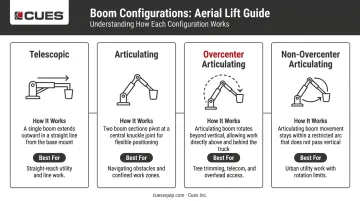
Beyond these four, material handler variants combine personnel access with jib or winch capability, making them useful when the job involves lifting equipment alongside workers. Track-mounted units address soft-ground and uneven terrain scenarios common in forestry and utility pole work.
Common Industries and Applications
Non-insulated bucket trucks show up across several distinct industries:
- Tree service and forestry — overhead canopy work that stays well clear of power lines
- Telecommunications — antenna installation, fiber optic cable runs, splicing work
- Signage and exterior lighting — sign installation, streetlight maintenance, traffic signal work
- Construction — façade access, exterior painting, building envelope work
- Municipal services — parks maintenance, bridge inspection, infrastructure upkeep
In each of these applications, specifying a non-insulated unit is the right call for the job. Deploying an insulated truck for tree trimming or sign work adds unnecessary weight, increases upfront cost, and creates dielectric testing obligations the work never requires.
Non-Insulated vs. Insulated Bucket Trucks: Key Differences
The distinction between these two truck types comes down to three areas: construction, intended use, and ongoing maintenance requirements.
| Category | Insulated | Non-Insulated |
|---|---|---|
| Construction | Fiberglass boom sections and bucket liners with verified dielectric ratings | Steel throughout; simpler to build and maintain, but no electrical protection |
| Intended Use | Required for work on or near energized electrical lines | Appropriate for any aerial task where electrical contact hazard is excluded or controlled |
| Maintenance | Requires periodic dielectric testing — annually at minimum, and after any work that may affect dielectric integrity | Standard hydraulic, structural, and operational inspections only; lower compliance overhead |
OSHA 1910.269(p)(4) does outline conditions under which uninsulated equipment can be used near energized lines (such as covering the line or maintaining minimum approach distance). For most fleets, though, the practical rule is simpler: if the job doesn't involve live lines, a non-insulated truck is the right tool.
One important caution: a truck being "A92.2 compliant" does not confirm it has dielectric capability. The standard governs the vehicle-mounted aerial class broadly. Dielectric status requires a separate design classification, category marking, and current test record.
Key Factors When Choosing a Non-Insulated Bucket Truck
Non-insulated bucket trucks span a wide range of configurations and working heights. The right unit depends on matching specific technical specs to operational demands — a residential tree crew, a telecom contractor, and a municipal maintenance department each need something different.
Working Height
Working height — the maximum safe elevation for the operator with the truck stabilized — is typically the first filter. A few reference points:
- Under 40 ft: Compact telecom and fiber splicing applications, light sign work. The Versalift TEL-31 covers this range with a 35.92 ft working height and 440 lb capacity, suited to telecommunications and streetlight maintenance.
- 40–50 ft: Residential tree trimming, sign installation, and municipal service work where urban access and maneuverability matter more than raw height.
- 60+ ft: Large construction access, bridge inspection, or open-area municipal work. The Altec LS60 reaches 60.6 ft with an impressive 53.1 ft of side reach — demonstrating that height and reach don't always scale together.
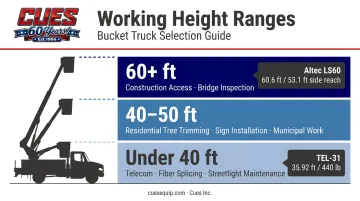
The key principle: spec only as much height as your most demanding regular job requires. Over-specifying height often forces a larger chassis, which creates access problems in tight job sites.
Boom Type: Overcenter vs. Non-Overcenter, Articulating vs. Telescopic
Of all the specs you'll evaluate, boom configuration has the most downstream consequences. It determines how the platform reaches the work and shapes what job sites the truck can handle effectively.
Overcenter vs. non-overcenter:
- Overcenter articulating booms allow the upper boom to travel past the truck's vertical centerline. This expands working positions without repositioning the truck, improves side reach, and handles obstacles well — the preferred choice for forestry and construction.
- Non-overcenter booms constrain upper boom movement to the truck's side. This is a simpler, more compact design suited to applications where height is the priority and side reach is less critical.
Telescopic vs. articulating:
- Telescopic (squirt) booms extend directly along the boom axis, maximizing horizontal reach in open, unobstructed areas.
- Articulating (knuckle) booms use hinged sections to change approach angle, allowing the bucket to reach around buildings, trees, and other obstacles.
Many units combine both : articulating-telescopic designs deliver the maneuverability of a knuckle boom with the extended reach of a telescopic section. Versalift's articulating-telescopic category covers working heights from 30 ft to over 100 ft within this combined design.
Platform Capacity
Platform capacity covers the combined weight the bucket can safely hold: worker, tools, and materials together. Undersizing this spec is both a safety violation and a productivity drain — crews making extra trips for tools lose time on every job.
The Versalift TEL-31 and TEL-35 are rated at 440 lb, while the Altec LS60 carries 600 lb. Capacity is a model-specific rating, not a ballpark figure. OSHA 1910.67 prohibits exceeding manufacturer boom and basket limits.
For jobs that combine personnel access with moderate load lifting, material handler variants include jib or winch capability. This can eliminate a second piece of equipment entirely on certain job types.
Fuel Type and Power Source
Fuel choice affects hydraulic output, operating environment fit, and total chassis weight:
- Diesel: Offers strong hydraulic output for heavier-duty operations and extended run times. Common on mid-range and high-reach non-insulated units.
- Gasoline: Typical on compact medium-duty chassis, lighter applications, and lower working heights.
- Battery-assisted hydraulics: Altec's JEMS system uses stored lithium-ion energy to power truck hydraulics and job site tools without continuous engine idling, cutting emissions and noise. Urban job sites, indoor-adjacent work, and municipalities with idle-reduction ordinances are where this option earns its cost.
Fuel type also affects total chassis weight, which determines whether a CDL is required. Diesel systems generally add weight; if a unit is close to the 26,001 lb threshold, the powertrain choice can move it either side of the line.
Chassis Size and Job Site Conditions
Chassis selection affects three things simultaneously: maneuverability, ground pressure, and licensing.
- Single-axle compact chassis: Better for residential neighborhoods, urban streets, and sites with restricted access or low overhead clearance. The Ford E350 and similar platforms keep GVWRs well under the CDL threshold.
- Tandem-axle and larger: Required for heavy-duty units with higher working heights, larger platform capacities, or outrigger-stabilized configurations that carry more total weight.
- 4WD and off-road options: Versalift's selection guidance specifically recommends off-road tires and 4WD for rugged, uneven terrain. This matters for tree crews working in rough residential yards, utility pole work in wet conditions, or forestry applications.
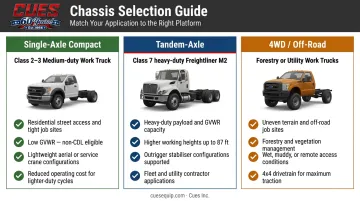
The CDL question is straightforward: FMCSA Class B begins at a GVWR or actual GVW of 26,001 lb or more. The Altec LS60, for example, is available on a minimum 25,999 lb chassis specifically to stay under that threshold. For fleets that can't staff CDL drivers on every unit, that single spec difference determines which drivers can legally operate the truck — worth confirming before you buy.
How CUES, Inc. Can Help You Find the Right Non-Insulated Bucket Truck
CUES, Inc. has been matching aerial equipment to operational requirements across New England and New York since 1966. That tenure means the company has encountered most combinations of job type, terrain, and fleet constraint you'll run into — and their spec consultation reflects that hands-on experience.
As an authorized dealer for Versalift® and Elliott®, CUES provides access to two non-insulated aerial product lines with broad coverage across boom configurations, working heights, and chassis options, backed by manufacturer parts availability.
The Versalift Tel 29 NE, for example, is a purpose-built non-insulated telescopic unit configured for fiber optic splicing work — with a 34 ft working height, 350 lb bucket, 360° rotation, and an onboard Honda generator. That level of application-specific configuration is what spec consultation is for — and it's where CUES adds the most value.
Here's what working with CUES looks like in practice:
- Over 60 years of industry experience across tree service, telecom, construction, and municipal fleets
- Sales, financing options, and spec consultation from locations in Amherst, NH and North Franklin, CT
- Access to Versalift® and Elliott® product lines with manufacturer-backed parts support
- Fully stocked road service trucks to keep your operation moving
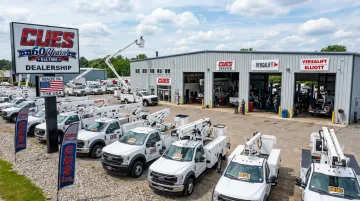
Reach CUES at (800) 258-1010 or browse current inventory at cuesequip.com.
Conclusion
Choosing a non-insulated bucket truck isn't about finding the least expensive option — it's about matching boom configuration, working height, platform capacity, chassis, and fuel type to the specific demands of the jobs the unit will perform most frequently.
The decision framework is straightforward:
- Confirm electrical hazard is not present at the worksite
- Map the work envelope — required height and horizontal reach
- Select boom geometry that handles typical obstacles and setup constraints
- Calculate realistic platform loads for your crew and equipment
- Choose a chassis that satisfies weight, terrain, and licensing requirements
Fleet needs shift as businesses grow or take on new project types. Periodic reassessment with an experienced dealer like CUES, Inc. helps ensure the spec that made sense at purchase still fits the work you're doing today.
Frequently Asked Questions
What is the difference between insulated and non-insulated bucket trucks?
Insulated bucket trucks feature fiberglass-coated boom sections and bucket liners that prevent electrical current from reaching the operator — required for work on or near energized lines. Non-insulated trucks use steel construction throughout and are the appropriate, more cost-effective choice for aerial work where no electrical hazard is present.
What types of non-insulated bucket trucks are available?
The main configurations are telescopic, articulating, and overcenter articulating booms — each suited to different combinations of working height, horizontal reach, and obstacle clearance. Track-mounted and material handler variants cover specialty terrain and load requirements. Matching the boom type to your job conditions is the most important spec decision you'll make.
How can I tell if a bucket truck is insulated?
Insulated trucks have fiberglass boom sections that are visually distinct from steel, and will carry a dielectric category marking on the unit. The manufacturer's spec sheet should reference ANSI A92.2 insulating categories (A through E) — a truck that is merely "A92.2 compliant" without a dielectric category designation is not confirmed as insulated.
Can I drive a bucket truck without a CDL?
Vehicles with a GVWR of 26,001 lb or more require a Class B CDL under FMCSA rules. Some compact non-insulated units are designed specifically to stay under this threshold. Always verify the completed truck's actual GVWR and your state's licensing rules before purchasing.
What industries commonly use non-insulated bucket trucks?
Tree service, telecommunications, construction, signage and exterior lighting, and municipal maintenance are the most common applications. Each relies on aerial access in environments where contact with energized lines is not a concern — making non-insulated units the practical, cost-effective fit.
What regular maintenance does a non-insulated bucket truck require?
Key areas include hydraulic system inspection, boom and structural integrity checks, lubrication of moving components, outrigger testing, and fall protection gear condition. Unlike insulated units, non-insulated trucks do not require periodic dielectric testing — reducing ongoing compliance costs.