
Get the wrong one, and you'll feel it fast. Unplanned equipment downtime rates of 20% to 30% aren't unusual in construction fleets, according to For Construction Pros. A boom that's too short means extra trips. A chassis that's oversized adds fuel cost and complexity you didn't need.
This guide breaks down the L50 and L65 by the numbers, so you can match the right unit to your actual job requirements.
Key Takeaways
- L65 delivers greater reach (65 ft) and higher main winch capacity (5,900 lb) than the L50
- L50 runs on a lighter, non-CDL chassis (19,500-lb GVWR) for compact, moderate-height work
- Pick the L65 for heavy-duty chassis capacity; choose the L50 when you need to stay non-CDL
- CUES supports both models with financing, chassis guidance, and delivery across New England and New York
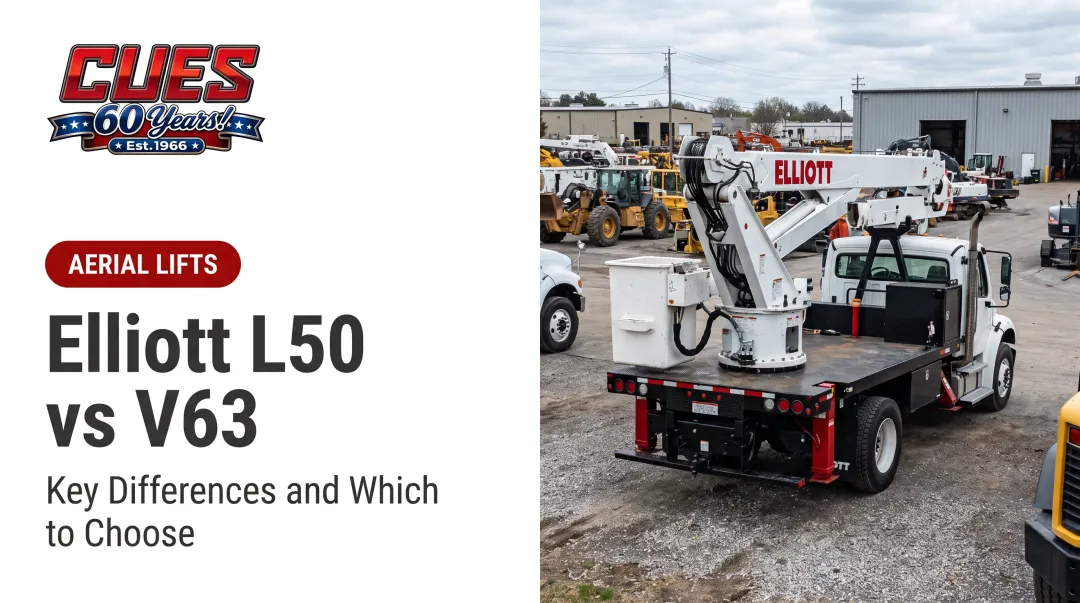
Elliott L50 vs L65: Quick Comparison
Here's how the two units stack up on paper, based on Elliott's current published specifications.
| Specification | Elliott L50 | Elliott L65 |
|---|---|---|
| Working height | 50 ft | 65 ft |
| Working side reach | 40 ft | 59 ft |
| Main winch capacity | 2,000 lb | 5,900 lb |
| Platform capacity | 600 lb | 600 lb (two-person) |
| Platform rotation | 360° boom/turret rotation | 160° platform rotation |
| Minimum GVWR | 19,500 lb (non-CDL) | 25,999 lb (non-CDL) |
| Diagnostics | Standard controls | Bluetooth remote diagnostics |
The L65 brings more than height. Its 5,900-lb main winch nearly triples the L50's 2,000-lb capacity. That extra muscle needs a heavier chassis, jumping from 19,500 lb to 25,999 lb GVWR.
The L50 keeps things lean. Its EZR removable steel platform (40 x 60 inches) and 500-lb Stow & Go jib winch let crews handle material without engaging full boom-tip capacity. Both platforms are rated at 600 lb, so neither model cuts the personnel capacity at height.

What Is the Elliott L50 HiReach?
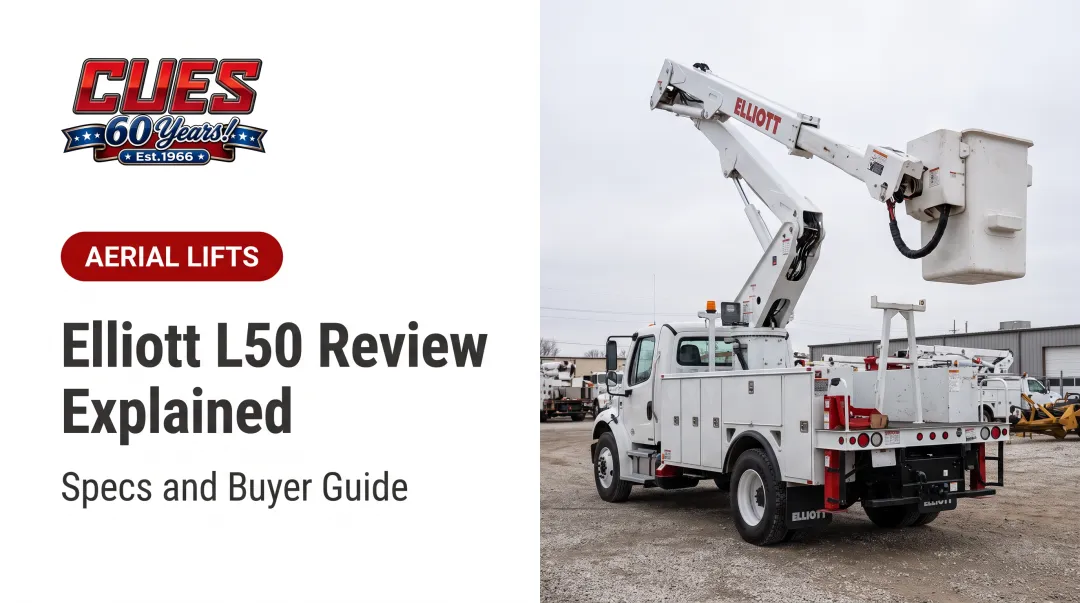
The L50 is Elliott's compact material handling aerial, built for jobs that need real height without the chassis footprint of a heavier truck. It rides on a Class V chassis with a 19,500-lb minimum GVWR, keeping it non-CDL friendly for most fleets.
Elliott positions the L50 toward sign and lighting professionals, government fleets, and industrial users who need dependable access without oversizing the vehicle. The removable EZR platform and 500-lb Stow & Go jib winch let operators lift tools and materials directly from the bucket, cutting down on trips to the ground.
Control layout is flexible as well. The upper station offers three-stick controls or a single-stick setup, giving operators a "point and shoot" feel for precise placement work.
CUES pairs the L50 with two common chassis options:
- 2025 Ford F-600 — 6.7L Power Stroke turbo-diesel, 330 HP, 10-speed automatic
- 2026 Ram 5500 — 6.7L Cummins turbo-diesel, 8-speed automatic
Both land at the same 19,500-lb GVWR Class V rating.
Where the L50 Fits
The L50's sweet spot is moderate-height work where maneuverability and chassis weight matter more than maximum reach:
- Sign and lighting installation or maintenance
- Electrical service and general construction work
- Municipal and public works maintenance
- Window washing and exterior building access
- Telecom and field-service tasks under 50 feet
If your crew spends most of the day in the 30 to 50-foot range and needs a lighter truck for tighter lots or narrower streets, the L50 earns its keep.
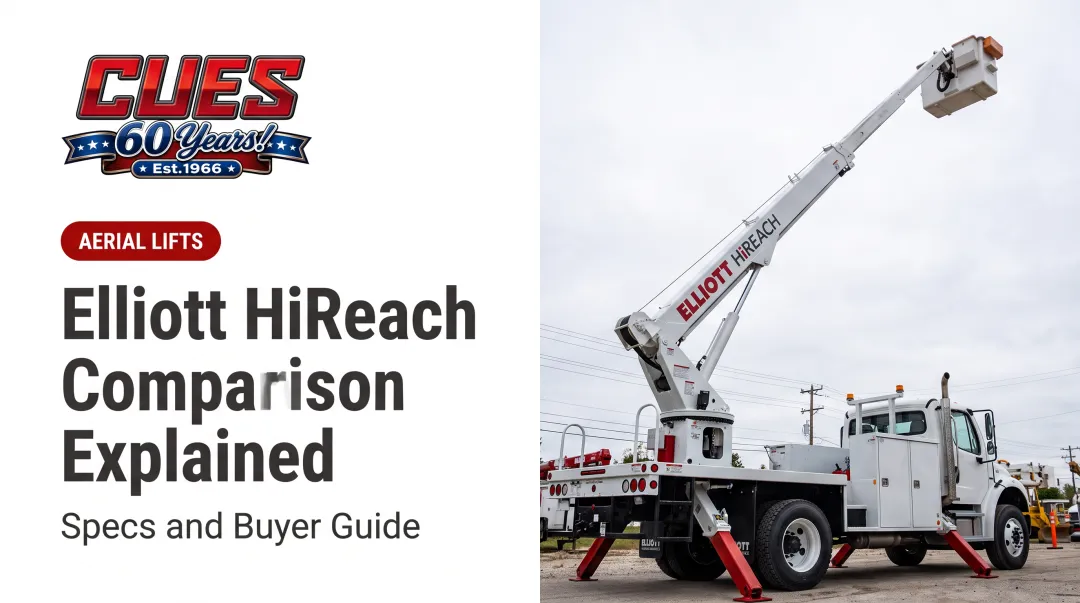
What Is the Elliott L65 HiReach?
The L65 replaced the older L60 with a straightforward goal: more reach, more capacity, less weight than the outgoing model. Elliott says it built the L65 from customer feedback on the L60, targeting better performance, lighter weight, and easier serviceability.
The specs back that up. At 65 feet of working height and 59 feet of side reach, the L65 covers transmission structures, tall signage, and multi-story access jobs beyond the L50's reach. The 5,900-lb main winch capacity means fewer situations where a separate crane needs to show up.
Built-In Serviceability Features
Elliott built the L65 to cut time spent troubleshooting in the field:
- Bluetooth remote diagnostics for real-time operator feedback
- User-assisted deployment and stow technology (guided assist, not fully autonomous)
- One-side vertical outrigger deployment and short-jack capability for tight urban footprints
- Automatic function slowdown near short-jack limits, adding a safety buffer in confined spaces

That short-jack flexibility is worth calling out. It means crews working in restricted alleys or narrow rights-of-way can still set up safely without needing a full outrigger spread.
On weight, Elliott states the L65 weighs over 1,500 lb less than the L60 it replaced.
Elliott's current published spec sheets list a 13,500-lb bare unit weight for both, so treat the "1,500 lb lighter" figure as the manufacturer's stated claim rather than a number you can independently recalculate from those sheets.
Where the L65 Fits
The added reach and capacity point the L65 toward heavier infrastructure work:
- Transmission line maintenance and utility pole work
- Telecom tower access and antenna servicing
- Tall structure inspection (bridges, industrial facilities)
- Sign and lighting jobs beyond the L50's reach ceiling
For buyers who need that profile sooner, CUES lists the L65 as an in-stock unit (stock #41397D) at 25,999-lb GVWR.
Elliott L50 vs L65: Which Is Better?
Neither model wins outright. It depends on what your crew actually does day to day. Run through these four factors before deciding:
- Required height and reach: If your jobs top out around 50 feet, the L65's extra 15 feet of height is unused capacity you're paying to haul around.
- Main boom payload needs: Transmission hardware, transformers, and heavier components favor the L65's 5,900-lb winch over the L50's 2,000-lb rating.
- Chassis and GVWR limits: A 19,500-lb GVWR chassis is easier to license, insure, and maneuver than a 25,999-lb unit. If your fleet standardizes on lighter trucks, that matters.
- Job site space: The L65's short-jack outrigger option helps in tight quarters, but the L50's smaller overall footprint is still the easier fit for narrow streets and packed lots.

Choose the L50 if:
- You need moderate height (up to 50 ft) with a lighter, easier-to-license chassis
- Your material handling loads stay under 2,000 lb
- Sign, lighting, or municipal work dominates your job mix
Choose the L65 if:
- Jobs regularly require 55+ feet of working height
- You're lifting heavier utility hardware or transmission components
- You can accommodate a heavier chassis (25,999-lb GVWR minimum)
Cost of Ownership Considerations
The L50's lighter chassis means lower fuel costs and simpler licensing across a fleet. The L65 costs more to run per mile. On the right project mix, eliminating crane rentals for jobs beyond the L50's reach or capacity can outweigh that fuel difference.
CUES helps fleet managers run the numbers on either side of this decision. Financing options include equipment loans, lease-to-own arrangements, and 90-day deferred payment plans through partners like Wells Fargo Business Credit and Alliance Funding Group. Call 800-258-1010 to run numbers on either model before you commit.
Applying the Decision Framework in the Field
Picture a mid-sized electric utility upgrading part of its aerial fleet. Its crews mostly handle distribution-line maintenance under 50 feet, but a growing number of jobs now involve transmission structures and taller telecom co-location work.
That mixed workload is where the height and payload gap between these two units matters most. A fleet manager in this spot usually runs the same framework covered above:
- Tallest job on the schedule
- Heaviest single lift required
- Whether the yard and routes can handle a heavier chassis
For most utility and telecom fleets, the answer isn't replacing everything with one model. It's running the L50 on day-to-day distribution and sign work, then adding an L65 for taller, heavier jobs that used to need a crane rental.
That split holds fuel costs down on routine work and still covers jobs that would otherwise delay crews or force a subcontracted lift.
Making the Final Decision
Match the unit to your job mix:
- Choose the L50 if crews rarely exceed 50 feet and lifts stay under 2,000 lb — lighter chassis, lower operating cost
- Choose the L65 if taller reach and heavier payloads show up regularly — fewer crane calls and less rescheduling
Either way, the real cost driver isn't sticker price — it's downtime from a mismatched unit. According to Utility Fleet Professional, spec'ing an aerial platform too small can raise injury risk and shorten truck life, while oversizing adds fuel cost and chassis weight you never use.
CUES, an authorized Elliott dealer since 1966, can walk through chassis compatibility, financing, and delivery timing for either model before you sign anything.
Frequently Asked Questions
What is the main difference between the Elliott L50 and L65?
The L50 offers 50 feet of working height with a 2,000-lb main winch on a lighter, non-CDL chassis. The L65 reaches 65 feet with a 5,900-lb winch but requires a heavier 25,999-lb GVWR chassis.
How much lighter is the L65 compared to its predecessor?
Elliott states the L65 weighs over 1,500 lb less than the L60 it replaced, while still improving reach and capacity.
Can the L50 or L65 be mounted on the same truck chassis?
No. The L50 needs a minimum 19,500-lb GVWR chassis, while the L65 requires 25,999 lb. Confirm GVWR compatibility with your existing or planned truck before ordering.
Which Elliott model is better suited for utility line work?
It depends on the job. Distribution work under 50 feet with lighter components favors the L50. Transmission structures or heavier hardware favor the L65's added reach and winch capacity.
Do the L50 and L65 share the same platform technology?
Both use a 600-lb-rated platform, but the L65 adds 160-degree platform rotation and Bluetooth diagnostics not specified on the L50's current spec sheet.
Where can I buy, rent, or get parts for an Elliott L50 or L65 in New England?
CUES, Inc., an authorized Elliott dealer since 1966, offers sales, financing, parts, and select rentals for both models across New England and New York. Call 800-258-1010 for availability.