
Introduction
Picking between an Elliott L50, L65, M87, or V63 isn't as simple as comparing working heights on a spec sheet. Fleet managers juggle traffic safety, crew size, material weight, and driver licensing all at once. A wrong call means overspending on capacity you'll never use or underbuying a unit that can't handle the job.
HiReach units show up everywhere: DOT roadside repairs, electric utility distribution work, telecom installs, sign and lighting maintenance, and general construction. Each application pulls different specs to the top of the priority list.
This guide breaks down the actual specs across the HiReach lineup, explains what separates the models beyond reach, and gives you a practical framework for matching a unit to your fleet's real-world needs.
Key Takeaways
- HiReach's telescopic boom eliminates tail swing, a real safety advantage in traffic lanes and tight urban sites
- Working height, side reach, and material handling capacity vary enough between models that "bigger" isn't always better
- Several HiReach models sit under the 26,001-lb GVWR threshold, opening the operator pool beyond CDL holders
- Authorized dealer parts and service support protects uptime and total ownership cost
Understanding the Elliott HiReach Line: What Sets It Apart
HiReach is Elliott's telescopic boom aerial work platform family. Built for infrastructure, utility, and material-handling crews, it works as a multi-application platform that can reposition, lift, and rotate through a full workday.
Telescopic vs. Articulating: Why Tail Swing Matters
OSHA draws a clear technical line between the two boom types. A telescopic (extensible) boom extends straight out along one axis, while an articulating boom uses two or more hinged sections that swing through an arc as they reach height.
That straight-line extension is why Elliott positions HiReach as reducing tail swing concerns compared to articulating designs. This matters most when you're:
- Working an active traffic lane with limited lane closure width
- Setting up in a narrow median or urban intersection
- Operating near parked vehicles or pedestrian paths
HiReach is also built for strong side reach, with stability tied to a full-length, heavy-duty subframe rather than boom geometry alone.
Built for Multi-Year Infrastructure Work
HiReach platforms run on proportional hydraulic boom controls, which give operators smooth, predictable movement required when working near energized lines or in front of the public. Beyond controls, the line features:
- Reinforced boom construction rated for repeated daily use
- Heavy-duty rotation systems for continuous boom turning
- Service-friendly layouts designed to reduce long-term maintenance downtime
Elliott HiReach Model Comparison: Specs at a Glance
Here's how the current verified HiReach models stack up on paper. Always confirm exact figures on elliottequip.com —or with an authorized Elliott dealer such as Cues Inc.—before finalizing a purchase, since spec sheets update periodically.
| Model | Working Height | Side Reach | Platform Capacity | Main Boom Capacity | Platform Jib | Min. GVWR | CDL Required |
|---|---|---|---|---|---|---|---|
| V63 | 63 ft | 38 ft | 500 lb | 1,000 lb | 500 lb | 19,500 lb | No |
| L50 | 50 ft | 40 ft | 600 lb | 2,000 lb | 500 lb | 19,500 lb | No |
| L65 | 65 ft | 59 ft | 600 lb | 5,900 lb | 500 lb | 25,999 lb | No |
| M87 | 87 ft | 77 ft | 600 lb | 2,000 lb | 500 lb | 25,999 lb | No |
Mid-Range HiReach Models: V63, L50, and L65
The V63 delivers 63 feet of working height on a 19,500-lb GVWR chassis with a 1,000-lb main boom winch. It’s a strong non-CDL pick when height matters more than max side reach or heavy tip-load capacity.
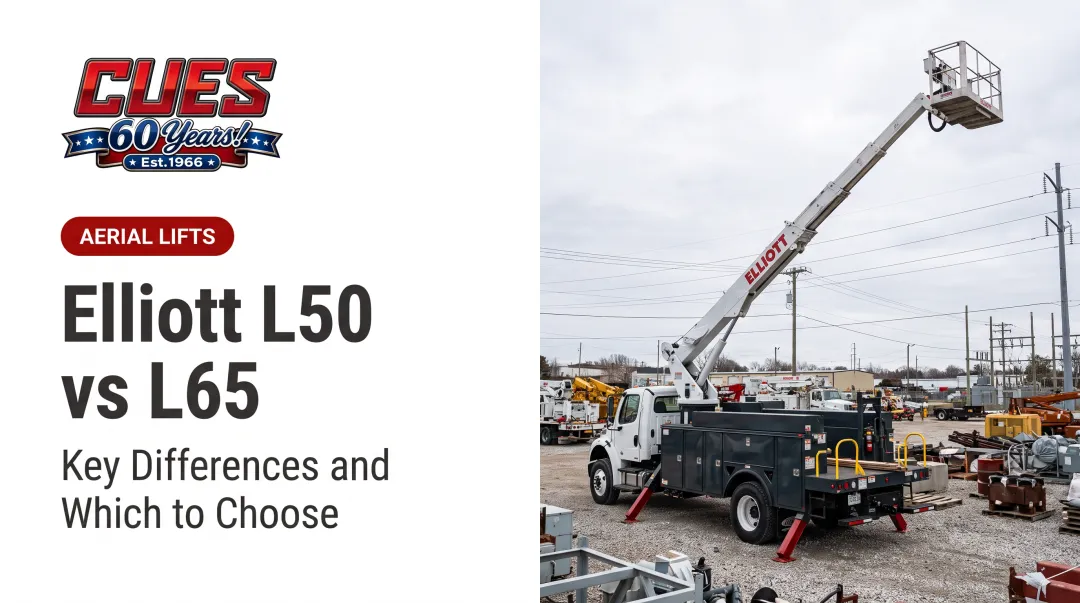
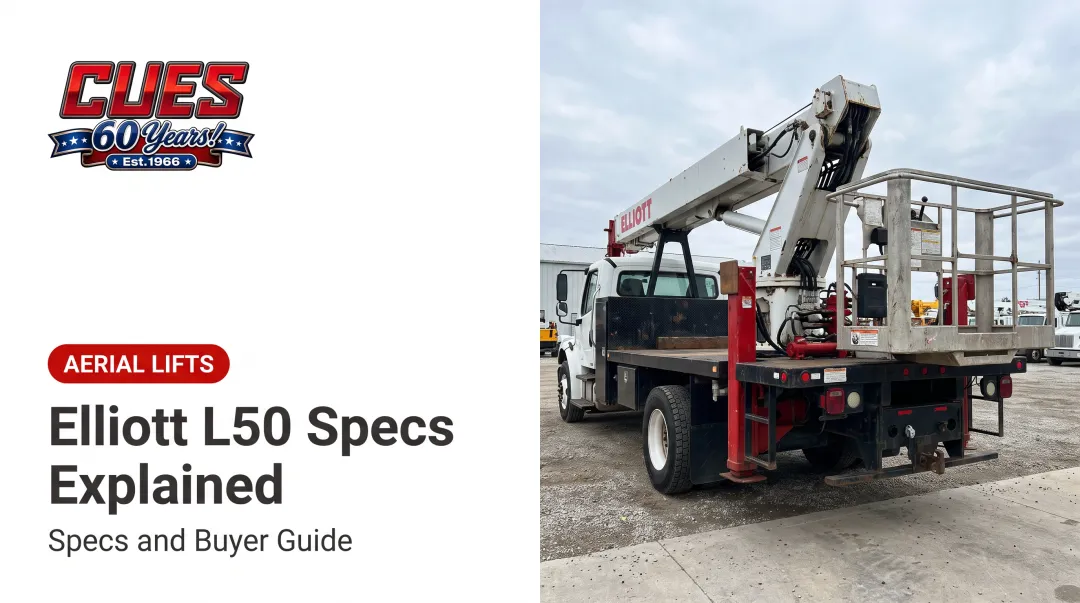
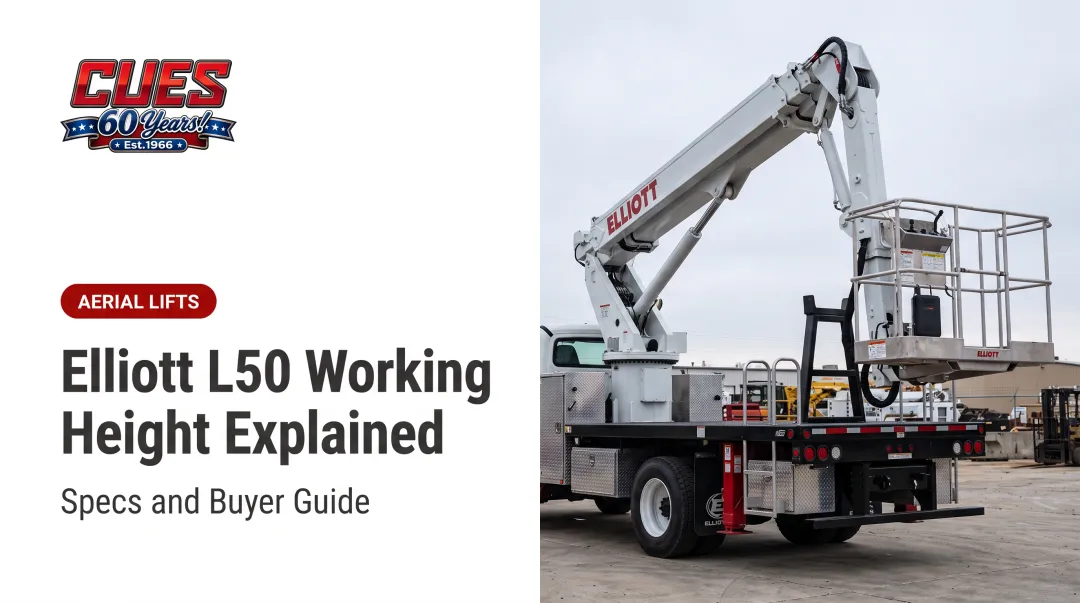
The L50 covers 50 feet of working height with 40 feet of side reach and a 2,000-lb main boom winch—solid for municipal sign work, streetlight maintenance, and moderate-height infrastructure tasks.
Step up to the L65 and side reach jumps to 59 feet, with main boom capacity nearly tripling to 5,900 lbs. That extra lifting power makes the L65 a better fit when crews are hauling heavier fixtures or transformers into position, not just accessing height.
Extended-Reach & Heavy-Duty Model: M87
At 87 feet of working height and 77 feet of side reach, the M87 is Elliott's heavy-duty answer for taller infrastructure and longer-reach utility work. It supports dual material handling: lift at the main boom tip and in the platform via the 500-lb Stow & Go jib winch, so crews can move materials without repositioning the truck.

A quick clarification: "HiReach 87" isn't an official Elliott model designation. If you're shopping the 87-ft class, you'll find it under specific names like the M87 or G85R on Elliott's current product lineup — confirm the exact model before requesting a quote.
Non-CDL HiReach Options
Federal rules set the CDL threshold at a GVWR or actual gross weight of 26,001 lbs or more for a straight commercial vehicle. Every HiReach model in the table above sits below that line:
- V63 – 19,500 lb GVWR
- L50 – 19,500 lb GVWR
- L65 – 25,999 lb GVWR
- M87 – 25,999 lb GVWR
For fleets struggling to find or retain CDL-licensed operators, that's a meaningful expansion of who can legally run the truck. Local regulations can still layer on additional requirements, so it's worth checking your state's rules before assuming full operator flexibility.
E-Line vs. HiReach: Clarifying the Difference
E-Line is Elliott's separate product family, engineered specifically for electric-utility and transmission-line work at higher reach classes. HiReach, by contrast, is built as a multi-use platform covering personnel access and material handling across infrastructure, sign, and general construction work.
If your work is primarily transmission-focused, E-Line deserves a look. For everything else — distribution work, municipal tasks, sign and lighting, general contracting — HiReach is the more versatile fit.
Utility buyers comparing these lines often ask about energized-line protection next. Elliott offers insulated HiReach configurations for that work: the I60F and I85F carry ANSI A92.2 Category C insulation ratings (46kV), providing secondary protection below that voltage threshold. That rating applies to these I-series models only—not the standard L50, L65, V63, or M87.
Key Features to Evaluate Before You Buy
Specs on a sheet only tell part of the story. A few operational features shape how fast crews set up, move material, and stay productive on the job.
Outrigger footprint and setup speed: The V63, for example, uses 9-foot hydraulic outriggers that allow full setup within a single parking space, a real advantage on tight roadside or urban jobs where blocking multiple lanes isn't an option. Short-jacking capability (deploying outriggers on one side only) also matters when you're working a curb line with limited space.
Platform rotation and jib attachments: Continuous boom rotation combined with a platform-mounted jib winch means crews can lift and reposition materials without repositioning the entire truck. Every model in this lineup includes a 500-lb Stow & Go jib option, which:
- Reduces repositioning time between lift points
- Supports two-person crew workflows on material-heavy jobs
- Keeps the platform capable of both access and lifting tasks
Service-friendly design: Long-term uptime depends on how easy the unit is to maintain. Look for internal cable carriers and accessible hydraulic components, details that shorten routine service visits and reduce the odds of a mid-job breakdown.

How to Choose the Right HiReach Model for Your Application
Your application drives which HiReach specs matter most. Match the priorities below to the work you do most often, then confirm fit with the checklist.
For Electric Utilities & Telecom Contractors
Prioritize:
- Insulation rating if working near energized lines (I60F/I85F for Category C protection)
- Platform capacity that comfortably supports a two-person crew plus tools
- Side reach sufficient to clear obstacles and reach distribution equipment without repositioning
For DOT, Public Works & Municipal Fleets
Prioritize:
- The telescopic boom's no-tail-swing advantage for roadside and intersection work
- Non-CDL chassis options (L50, V63, L65, M87) to widen your available operator pool
- Versatility across lighting, signal, and bridge inspection tasks without swapping equipment
For Sign, Lighting & General Contracting
Prioritize:
- Platform rotation range for repositioning without relocating the truck
- Jib material handling capacity for lifting signs, fixtures, or panels into place
- A working height in the 50-87 ft range that covers most installation and maintenance jobs
Matching Specs to Job Requirements
Before you commit to a model, run through this checklist:
- Required working height: measure the actual structure or line height, not a rough guess
- Required side reach: account for obstacles like medians, ditches, or parked equipment
- Material weight to be lifted: confirm both main boom and platform jib capacity match your heaviest regular load
- Non-CDL operation: decide whether staffing flexibility is a deciding factor
Spec sheets don't always reveal what a jobsite actually demands. Request a demo or site assessment from an authorized dealer before finalizing your model. Seeing the unit set up on terrain similar to your real work conditions often surfaces needs a data sheet won't show.
Buying, Financing & Ongoing Support
Why Dealer Authorization Matters
Buying through an authorized Elliott dealer protects coverage, parts access, and service quality. It affects:
- Warranty validation — unauthorized sales channels can complicate coverage claims
- Genuine parts access — OEM components keep hydraulic and boom systems performing to spec
- Manufacturer-trained technicians — factory training means faster, more accurate diagnostics
Financing That Fits Your Budget
Higher-capacity or non-CDL HiReach models are a real investment. Flexible terms help spread the cost. Common options include:
- Lease-to-own arrangements
- 90-day deferred payment plans
- Conventional financing with loan terms ranging from 1 to 20 years
- Trade-in valuation applied toward the purchase
Sales, Rentals, Parts & Road Service Through CUES
CUES, Inc. has been an authorized Elliott dealer across New England and New York since 1966, with locations in Amherst, NH, and North Franklin, CT.
Beyond HiReach sales and select rentals, CUES stocks a full parts department and runs road service trucks. Those trucks handle hydraulic repairs, boom inspections, and electrical diagnostics on the jobsite so you avoid hauling the unit back to a shop.
Sales, parts stock, and mobile service keep a HiReach productive across its service life instead of sitting idle while you wait on a part or technician.

Frequently Asked Questions
What is the difference between Elliott HiReach and E-Line aerial platforms?
HiReach is built for multi-use infrastructure and material-handling work across utility, sign, and construction applications. E-Line is engineered specifically for higher-reaching transmission and electric-utility work.
How high can an Elliott HiReach reach?
Current HiReach models span roughly 50 to 87+ feet of working height, depending on the specific model. Always verify exact figures for your chosen model on Elliott's official spec sheets.
Do you need a CDL to operate an Elliott HiReach truck?
Several HiReach models, including the V63, L50, L65, and M87, are available on chassis under the 26,001-lb GVWR threshold, meaning a CDL isn't federally required. Check local regulations, since state rules can vary.
How much material can an Elliott HiReach platform lift?
Capacity varies by model. Main boom winches range from 1,000 lbs on the V63 up to 5,900 lbs on the L65, and most models add a 500-lb platform jib.
Is the Elliott HiReach boom telescopic or articulating?
It's a straight telescopic design. That geometry eliminates the rear tail swing associated with articulating booms, improving safety in traffic and confined jobsites.
Where can I buy or service an Elliott HiReach in New England or New York?
CUES, Inc. is an authorized Elliott dealer offering HiReach sales, parts, and road service from locations in Amherst, NH, and North Franklin, CT, serving customers throughout NH, CT, MA, and NY.