Choosing the wrong cherry picker bucket truck doesn't just create inconvenience. It creates safety exposure, missed schedules, and wasted money.
The terms "cherry picker" and "bucket truck" get used interchangeably, but the selection process involves real technical decisions — boom type, working height, insulation rating, weight capacity, terrain suitability, and fuel configuration. Each variable matters, and the wrong answer on any one of them can make an otherwise capable truck the wrong truck for your operation.
Key Takeaways
- Cherry picker bucket trucks are truck-mounted aerial devices used by utility, telecom, tree service, and construction crews to safely access elevated work areas
- Boom type (articulated vs. telescopic), working height, and insulation rating are the three most consequential selection variables
- Insulated models are mandatory near energized electrical lines — an OSHA requirement with no exceptions
- Rated weight capacity drops when the boom extends outward — always verify specs at your actual working position, not just at center
- Purchasing makes financial sense for consistent, high-frequency use — financing options can reduce the upfront barrier for fleets ready to commit
What Is a Cherry Picker Bucket Truck?
A cherry picker bucket truck is a vehicle-mounted hydraulic boom with an enclosed work platform (or bucket) at the end, designed to lift personnel safely to elevated positions. The name traces back to 1944, when Jay Eitel conceived the device after picking cherries — he later founded Telsta in 1953, producing one of the first utility-industry aerial lifts. Southern California Edison and PG&E were among its earliest customers.
That context matters for procurement: OSHA 29 CFR 1910.67 defines an "aerial device" as a vehicle-mounted telescoping or articulating device used to position personnel. This is the term to use on spec sheets and procurement documents, not "cherry picker."
Core Components
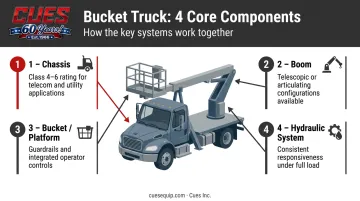
Every bucket truck shares four functional elements:
- Chassis — The truck base determines mobility, stability, and load-bearing capacity. Medium-duty platforms (Class 4–6) suit telecom and utility distribution work; heavier chassis handle forestry and construction demands
- Boom — The extendable arm is the defining component. Telescopic booms extend linearly for height; articulating booms bend at joints for obstacle clearance; many units combine both
- Bucket/Platform — The enclosed work basket at the boom's end, equipped with guardrails, harness attachment points, and operator controls; capacity varies by model and must be matched to actual crew and tool loads
- Hydraulic System — Powers boom and platform movement; system quality directly affects responsiveness and control feel under load
Industries That Rely on Bucket Trucks
- Electric utilities (power line maintenance and repair)
- Telecommunications (fiber, cell tower, and antenna work)
- Tree service and forestry (pruning, trimming, hazard removal)
- Construction and building maintenance (signage, exterior work)
- Municipalities (streetlights, holiday lighting, public works)
Types of Cherry Picker Bucket Trucks
Boom configuration, insulation rating, and mobility system each determine where a bucket truck can be deployed safely. Choosing the wrong type doesn't just limit performance — it creates safety exposure.
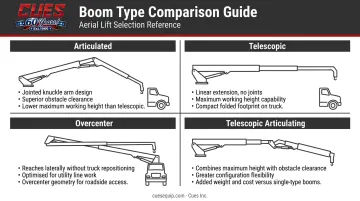
Articulated Overcenter
The boom has a jointed "knuckle" that allows it to travel beyond vertical — past 180 degrees from its stowed position. This gives operators the ability to reach positions to the side and behind the truck without repositioning the vehicle.
Best for: utility line work, forestry, and applications where poles, branches, or structures create lateral obstacles.
Articulated Non-Overcenter
The upper boom stays below its overcenter travel limit, restricting lateral reach but maintaining a more compact operational footprint. Better suited for fixed, accessible locations where the truck can be staged directly below the work area.
Typical uses: building maintenance, municipal tasks with predictable setups.
Telescopic and Telescopic Articulating
Telescopic booms extend sections linearly for maximum height. Telescopic articulating models add jointed sections to that reach, combining height with obstacle clearance capability — at the cost of added weight and mechanical complexity.
Best for:
- Construction sites requiring extended vertical reach
- Telecom infrastructure installs
- Tower and antenna work where height and obstacle clearance both matter
Insulated vs. Non-Insulated
For electrical work, this distinction is non-negotiable. OSHA requires insulated aerial devices when the lift could contact energized lines, unless those lines are protectively covered or the equipment is properly grounded.
Insulated models feature non-conductive bucket liners and insulated boom sections rated under ANSI/SAIA A92.2-2021 — Category B covers 69kV and below; Category C covers 46kV and below. Non-insulated trucks suit construction, tree trimming, and sign maintenance where electrical exposure isn't a factor.
Track-Mounted
Track-mounted units use crawler assemblies instead of wheels, providing lower ground pressure and better stability on slopes, soft soil, mud, or swamp terrain. Wheeled trucks would sink or lose stability in these conditions — making tracked units the default choice for forestry and remote utility work.
Important caveat: drive slope ratings on tracked units are not the same as permissible aerial operating slopes. Always verify the unit's manual for allowable inclination during aerial operations.
Key Factors to Consider When Choosing the Right Bucket Truck
The right truck connects your specific job requirements to the right technical specs. A unit that exceeds specs in every area except the one that matters — insulation, terrain, reach — is the wrong truck.
Working Height and Side Reach
Working height is the maximum safe elevation for productive task completion. Common catalog groupings fall into under 50 ft, 50–59 ft, and 60+ ft — but these are commercial bands, not regulatory minimums. Identify the highest work point your most demanding jobs require, then add only the manufacturer's permitted operating margin.
Don't overlook side reach (horizontal distance the boom can extend laterally). The Altec LS49, for example, lists a 49 ft working height alongside a 41 ft side reach — in some applications, that lateral capability is the deciding factor, not vertical height.
Boom Type and Maneuverability
Match boom type to the physical constraints of your most common job sites:
- Articulated booms handle obstacles better but may limit maximum height
- Telescopic booms reach higher but offer less angular flexibility
- Overcenter capability adds lateral access without moving the truck
- Telescopic articulating combines both at added weight and cost
Consider overhead obstructions, utility pole spacing, tail swing (the rearward arc when the boom extends sideways), and available staging space — especially on busy roadsides or tight urban blocks.
Insulation Rating
For any work near energized lines or electrical equipment, the truck must be rated and labeled as insulated — both the bucket liner and boom sections. Under ANSI/SAIA A92.2-2021, insulation categories are assigned by system voltage:
| Category | Voltage Scope |
|---|---|
| A | Up to 765 kV; includes additional provisions for energized-line work |
| B | 69 kV and below |
| C | 46 kV and below (tested and maintained to Category C requirements) |
One important limitation: insulation protects only the insulated portions. Uninsulated boom sections and uninsulated body parts must still maintain OSHA's minimum approach distances. Workers must treat non-insulated components as live exposure points regardless of the truck's rating category.
Weight Capacity
The bucket's rated capacity must account for the total weight of all personnel, tools, equipment, and materials simultaneously in the platform. OSHA expressly prohibits exceeding manufacturer boom and basket limits.
One frequently missed detail: capacity ratings decrease with off-center positioning. Side reach and elevated angle reduce the effective rated load. Calculate your actual maximum payload — crew plus gear — and verify it against the manufacturer's capacity chart at your expected operating position, not just the headline number.
Terrain and Site Conditions
Wheeled trucks require stable, level ground. Terex technical guidance states that most aerial devices are approved for operation within 5 degrees of level — some models require 0 degrees. Evaluate your most demanding deployment environment, not just typical conditions.
For slopes, soft soil, or muddy sites, tracked units offer lower ground pressure — Altec's tracked models spec around 6–7.5 psi ground contact — but the aerial operating slope is still a separate, model-specific limit.
Fuel Type
Three configurations cover most fleets:
- Diesel: Standard across heavy-duty configurations; higher torque suits extended operations and remote sites
- Hybrid: A battery pack powers the hydraulic lift instead of idling the diesel engine, cutting fuel consumption during stationary lift operations — FirstEnergy deployed hybrid bucket trucks specifically for this reason
- Gas: Available on lighter-duty configurations; lower upfront cost but less suited to high-cycle hydraulic demand
California fleets: CARB's Truck and Bus Regulation requires diesel vehicles over 14,000 lbs to run 2010-or-newer engines and emissions systems. Confirm compliance before procuring diesel units for California operations.
How CUES, Inc. Can Help
CUES, Inc. has served contractors, utilities, and municipalities across New England and New York since 1966. As an authorized dealer for Versalift® and Elliott Equipment Company®, CUES provides direct access to manufacturer-quality equipment and guidance on matching specs to your job requirements.
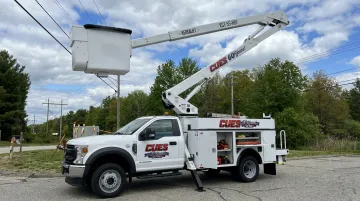
Current inventory includes insulated models built specifically for electrical utility and telecom work. The Versalift VST-55-HDI, for example, carries a confirmed Category C, 46kV insulation rating and features the TruGuard™ Insulated Control System — one of the few explicitly rated configurations available in the Northeast. Working heights in CUES's active lineup span from 34 ft (the Versalift Tel 29 NE splicer truck on a Ford E350 cutaway) up through 65 ft configurations on heavier chassis platforms.
Available configurations cover a range of operational needs:
- Chassis options: Ford F-550, F-600, Ram 5500, and heavier platforms
- Licensing: Both non-CDL and CDL-required configurations, depending on GVWR
- Financing: Lease-to-own and deferred payment structures through Alliance Funding Group
To discuss inventory, specs, or the right configuration for your application, contact CUES directly at (800) 258-1010 or visit cuesequip.com to browse available units.
Conclusion
The right cherry picker bucket truck is the one matched to your actual operation — working height, boom type, insulation rating, weight capacity, terrain, and fuel type all need to align with your toughest job sites, not just your typical ones.
Equipment needs evolve over time. Fleets age, job scopes shift, and safety regulations get updated — so revisiting your aerial equipment lineup periodically keeps crews safe, productive, and compliant. Working with a dealer like CUES, Inc., which has served electric utility, telecom, tree service, and municipal customers since 1966, means having experienced guidance when those decisions come up.
Frequently Asked Questions
Is a cherry picker the same as a bucket truck?
The terms are used interchangeably in common usage. Technically, "cherry picker" is the colloquial name for what is more formally called a bucket truck or aerial work platform — both refer to truck-mounted boom devices with a work platform for lifting personnel to elevated areas.
What is the typical working height range for bucket trucks?
Manufacturer catalogs commonly group units into under 50 ft, 50–59 ft, and 60+ ft ranges. These are commercial categories, not regulatory classifications — select based on the maximum elevation your most demanding tasks require, plus any manufacturer-specified operating margin.
Do I need an insulated bucket truck for electrical line work?
Yes. OSHA requires insulated aerial devices when the lift could contact energized lines. Insulated models feature non-conductive bucket liners and insulated boom sections rated under ANSI/SAIA A92.2-2021 categories.
What is the difference between an articulated and telescopic bucket truck boom?
Articulated booms have jointed sections that allow operators to maneuver around obstacles with greater angular flexibility. Telescopic booms extend linearly for greater maximum reach with a more compact footprint. Many current models combine both features for height and obstacle clearance.
Should I buy or rent a cherry picker bucket truck?
Buying makes financial sense for organizations with consistent, frequent aerial work needs. For project-specific or seasonal deployments, a lease-to-own or financed purchase may better align with cash flow requirements — evaluate total cost of ownership against projected utilization before committing.
How often should a bucket truck be inspected or serviced?
OSHA requires lift controls to be tested before each shift. ANSI/SAIA A92.2-2021 adds a frequent inspection at the earlier of three months or 150 operating hours, plus a comprehensive periodic inspection at least every 12 months by qualified personnel. Inspections are also required after any overload, overturn, or electrical contact event.