
Introduction
Elliott rolled out two new material handling aerial devices in 2023: the L50 HiReach and the V63 HiReach. Neither requires a commercial driver's license to operate, which opens the driver pool considerably for utility, telecom, and sign crews.
But these two units solve different problems. Pick the wrong one, and you'll either pay for reach you never use or show up without the lifting capacity a job demands. Either mistake hits your budget and your schedule.
CUES, Inc., an authorized Elliott dealer serving New England and New York, sells, rents, and services both models. This guide breaks down the specs and use cases so you can match the right HiReach to your fleet.
Key Takeaways
- L50: 50-ft height, 40-ft side reach, 2,000-lb capacity for heavier lifts in tight footprints
- V63: 63-ft height, 38-ft side reach, 1,000-lb capacity for maximum vertical access
- Shared traits: non-CDL chassis, Office in the Sky tool circuits, lifetime structural warranty, ANSI A92.2
- The right pick depends on your typical job height and load, not the highest number on the sheet
L50 vs V63: Quick Comparison
Here's how the two units stack up on paper, based on Elliott's published specification sheets:
| Spec | L50 HiReach | V63 HiReach |
|---|---|---|
| Working height | 50 ft | 63 ft |
| Working side reach | 40 ft | 38 ft |
| Main boom capacity | 2,000 lb | 1,000 lb |
| Work platform | 40" x 60", 600 lb, 160° rotation | 40" x 60", 500 lb, 180° rotation |
| Chassis/GVWR | Approx. 19,000–19,500 lb | 19,500 lb GVWR |
| Outrigger spread | 10 ft | 9 ft |
| CDL required | No | No |
Both units mount on chassis under the federal CDL weight threshold of 26,001 lb, so a broader range of drivers can operate either truck.
That said, towing setups, hazmat configurations, or passenger arrangements can still trigger CDL requirements regardless of base chassis weight. Check with your safety team before you assume every driver on staff is cleared.
What is the Elliott L50 HiReach?
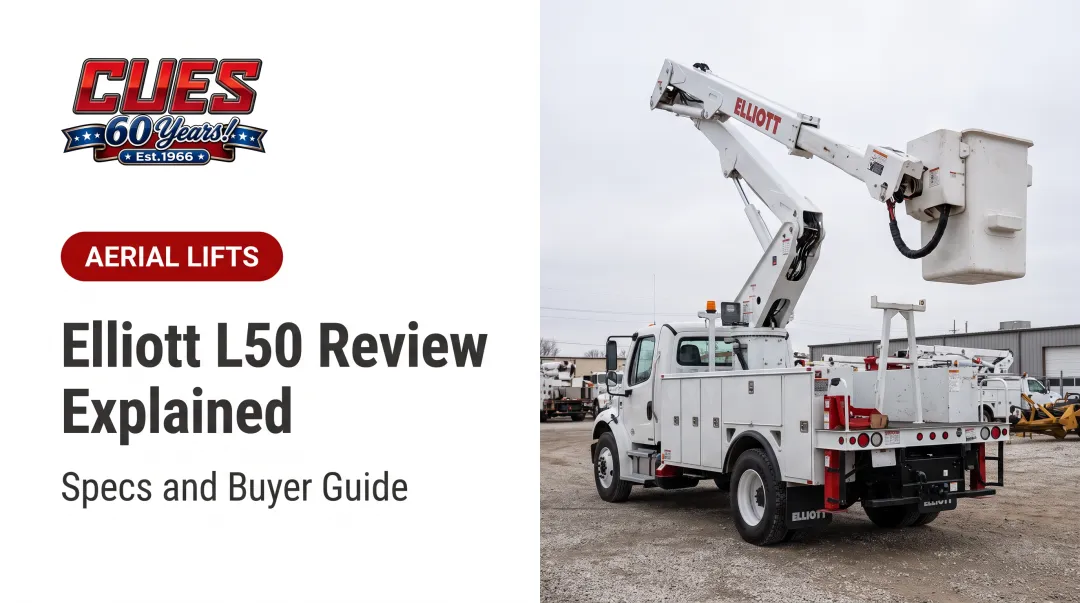
The L50 is a telescopic material handling aerial device built for jobs where the load matters more than the height. If your crew is lifting transformers, pole-top hardware, or heavy sign panels at a moderate elevation, this is the unit engineered around that exact tradeoff.
Core benefits:
- 2,000-lb main winch capacity: double what the V63 offers for heavier hoists to the work zone
- Open-rail platform with roughly double the work area of a standard two-worker bucket
- Zero tail-swing, so the boom rotates without the rear sweeping into traffic or nearby structures

Compact Footprint, Fewer Site Restrictions
Elliott designed the L50's outriggers to deploy within the chassis mirror footprint. On a residential street or a cramped commercial lot, that means you're not blocking a second lane just to set up. The 10-ft outrigger spread still delivers full stability, but the working footprint stays tight.
That same duty-focused build includes a lifetime structural warranty on the turret, boom sections, subframe, and outriggers, plus ANSI A92.2 certification across all operating modes.
Where Payload Drives the Choice
The L50 fits naturally into workflows where payload drives the decision:
- Pole-top equipment installs and transformer changeouts for electric utilities
- Heavier sign and lighting fixture placement
- Telecom equipment mounts that exceed typical bucket-truck ratings
- General construction lifts where a crane isn't justified but a bucket alone won't cut it
CUES currently stocks L50 units on both Ford F-600 and Ram 5500 chassis. The Ram version is set up for sign and lighting work, which matches how many contractors use this platform day to day.
What is the Elliott V63 HiReach?
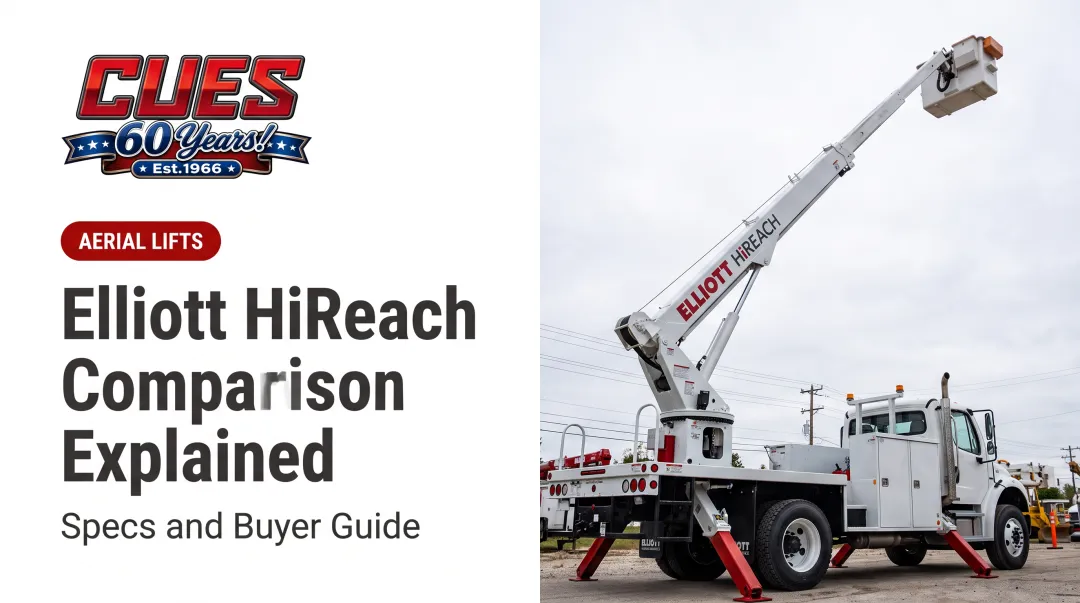
The V63 is Elliott's tallest HiReach model, built for jobs where reach outweighs payload. At 63 feet of working height, it accesses structures the L50 simply can't reach, though it trades away half the lifting capacity to get there.
Core benefits:
- 63-ft working height for tall structures, transmission work, and elevated signage
- ~1,500 lbs lighter than its predecessor, with 20% fewer hydraulic fittings and fewer leak points (Elliott V63 introduction)
- 9-ft outrigger footprint, small enough to set up in a single parking space with full 360-degree stability
Office in the Sky Platform Tools
The V63 includes Elliott's Office in the Sky circuits—welding, cutting, hydraulic, air, and pressure-washing tools built into the platform. The L50 shares the same setup. Crews skip hauling separate generators or compressors up 60 feet; the tools are already at the work point.
Use Cases of the V63
The V63 is built for jobs where working height comes first:
- Transmission line work above the reach of standard bucket trucks
- Tall signage installation and maintenance on highway or stadium structures
- Building and tower maintenance where repositioning the truck isn't practical
- Bridge inspection work requiring extended vertical or lateral access
CUES lists the V63 as a non-CDL sign and lighting bucket truck, and it's also documented for utilities, electrical contracting, and government infrastructure work — anywhere the job site has more vertical distance than horizontal load.
L50 vs V63: Which One Should You Choose?
The specs matter less than how they map to your actual jobs. Before deciding, weigh these factors:
- Typical job height — Do most of your calls require 50 feet or less, or do you regularly need to clear 55-63 feet?
- Average material weight — Are crews lifting heavy transformers and hardware, or mostly positioning workers with light tools?
- Jobsite footprint — Does your typical site allow a 10-ft outrigger spread, or do tighter urban lots favor the V63's slightly smaller 9-ft footprint?
- Total fleet budget — Factor in maintenance, fuel efficiency, and warranty coverage, not just the sticker price.

Choose the L50 if heavier material handling is a regular part of the job. Choose the V63 if reaching taller structures with lighter loads, or fitting tighter urban sites, is the priority.
Real-World Application
CUES currently stocks both models new:
- 2025 Ford F-600 L50 with a 2,000-lb winch and 600-lb platform
- 2025 V63 built as a non-CDL sign and lighting truck with a 500-lb platform and 1,000-lb winch
Contractors shopping between the two typically map their last dozen jobs against the height and load factors above. The pattern usually points clearly to one unit or the other.
Fleet managers who split work between heavy component installs and tall-structure access sometimes run both models rather than forcing one truck to cover every scenario. If you're not sure which category fits your work, a consultation with CUES can save you from buying the wrong tool twice.
Ready to compare the L50 and V63 against your actual job list? Contact CUES, Inc. at 800-258-1010 for a fleet consultation, financing options, or current rental availability.
Conclusion
The L50 and V63 are built for different jobs, so the right pick depends on what your crews do most days:
- L50: Heavier material handling in a tight footprint
- V63: Maximum height and vertical access over raw payload
That choice shapes job-site productivity, operator safety, and long-term fleet cost. Match the specs to your most frequent job requirements, not to whichever sheet shows the bigger number.
As an authorized Elliott dealer, Cues Inc. can help you pair either model with the right chassis, body, and job mix. Call 800-258-1010 to walk through the fit for your fleet.
Frequently Asked Questions
What is the main difference between the Elliott L50 and V63?
The L50 prioritizes higher material handling capacity (2,000 lb) at 50 feet, while the V63 prioritizes greater height (63 feet) with a lower 1,000-lb capacity. Pick based on which factor matters more for your typical job.
Do the L50 and V63 require a CDL to operate?
No. Both units mount on chassis under the CDL weight threshold, allowing a broader range of operators to drive them. Towing or hazmat configurations can change that, so confirm your specific setup.
Which Elliott HiReach model offers a larger work platform?
Both share a 40" x 60" platform footprint, but the L50's platform supports a higher 600-lb capacity versus 500 lb on the V63.
Can the L50 or V63 be used for utility pole and line work?
Yes, both are used in utility applications. The L50 is favored for heavier component installs like transformer changeouts, while the V63 is favored for taller transmission structure access.
What is Elliott's "Office in the Sky" feature?
It's a suite of platform-mounted tools—welding, cutting, hydraulic, air, and pressure-washing circuits. The package is available on both the L50 and V63 for on-platform task versatility.
How do I decide which model fits my company's fleet?
Start by evaluating your typical job height and load requirements against the specs above. Then consult an authorized Elliott dealer such as CUES, Inc. for a tailored fleet assessment.