Introduction: Why the 50-Foot Aerial Lift Is a Fleet Staple
Fleet managers in utilities, telecom, and tree care face a persistent challenge: matching equipment reach to real-world job requirements without over-specifying. Go too small and crews can't complete the work safely. Go too large and you're paying for reach you never use, plus a heavier truck that's harder to maneuver on tight residential streets.
The 50-foot aerial lift truck sits squarely in the middle of that spectrum. It reaches standard distribution poles, handles medium-sized trees in urban settings, and accesses 3–4 story commercial buildings — all on a chassis that stays practical to operate and park.
NIOSH data covering 2011–2014 recorded 87 deaths and 1,380 injuries involving aerial lifts across all types, which underscores why equipment selection and compliance aren't afterthoughts. Getting the right truck for the right job is the first safety decision a fleet manager makes.
This guide covers specifications, applications, safety requirements, and buying decisions to help you integrate a 50-foot aerial lift into your fleet with confidence.
Key Takeaways
- "50-foot" describes the lift's working height, not the truck's length
- Platform capacities typically range from 450–600 lbs across this class
- Insulated booms are required for work near energized lines; non-insulated units suit tree care and construction
- GVWR determines CDL requirements; many configurations sit just below the 26,001 lb federal threshold
- Total cost of ownership rises with age, so factor in maintenance trajectory alongside purchase price
Understanding the "50-Foot" Designation in Aerial Lifts
A common source of confusion in this category: "50-foot" refers to the aerial lift's working height, not the length of the truck underneath it.
Key Height Terms Defined
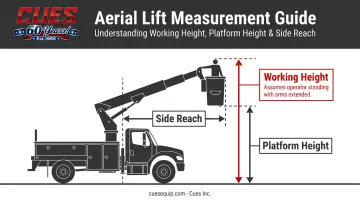
Three measurements matter when comparing models:
- Working Height — The vertical distance an operator can reach from the ground, assuming they're standing in the bucket with arms extended above the platform floor. Manufacturers calculate this differently, so always verify the method in the spec sheet before comparing models.
- Platform Height — The maximum height of the bucket floor itself. This is consistently lower than the published working height. The Elliott L50, for example, publishes a 50-foot working height with a 40-foot side reach and a 600 lb platform capacity.
- Side Reach — How far the platform can extend horizontally from the truck's centerline. On comparable models, this spans roughly 26–40 feet — a wide variance that matters enormously for working around obstacles.
What the Truck Itself Looks Like
The truck chassis class depends on the lift configuration, not the other way around. Based on published manufacturer data:
- The Elliott L50 recommends a 19,500 lb GVWR chassis
- The Elliott I50F recommends a 25,999 lb GVWR chassis
- Stowed transport heights run approximately 10 ft 4 in to 11 ft 6 in
Neither of those examples crosses the federal 26,001 lb CDL threshold, though other factors — such as load configuration and state-level rules — can still trigger CDL requirements.
Key Applications for 50-Foot Aerial Lifts
The 50-foot working height is genuinely versatile, but it earns its place in specific contexts. Here's where it performs best.
Electrical Utility and Telecommunications
Distribution poles are the bread-and-butter application. Standard wood poles used in rural distribution systems can reach Class 6 heights and beyond, and most residential utility work — transformer installation, line maintenance, service drops — falls squarely within a 50-foot working height.
For telecom, the picture is similar. Fiber-to-the-premises deployment continues to expand, with NTCA survey data showing 85.8% of rural serviceable locations now reached by fiber — up from 83.5% the prior year. That ongoing buildout means consistent aerial work demand at pole heights where a 50-foot lift handles the task without the permitting and equipment overhead that comes with larger units.
Trucks used near energized lines must carry dielectric-rated booms. OSHA 1910.269 permits only qualified employees to work on or near exposed energized parts and requires training in recognizing live parts, voltage determination, and minimum approach distances.
CUES, Inc. stocks insulated Versalift models with Category C 46kV ratings for utility applications — the VST-55-HDI at 59 feet is the closest current unit to the 50-foot class. Call (800) 258-1010 to confirm current inventory.
Arboriculture and Tree Care
Urban trees present a specific challenge: mature red maples, for example, average 60–90 feet at full height — taller than a 50-foot lift can reach at the crown. But that's rarely what arborists need. Limb removal, lower canopy pruning, and maneuvering in confined residential lots are exactly where the 50-foot class delivers.
Side reach often matters more than raw height. An articulating boom that can work around a house, a fence, or an adjacent tree is frequently more valuable than a few extra feet of vertical reach.
Versalift's forestry-specific configurations — with 360-degree continuous rotation, hydraulic tool circuits, and chip bodies — are purpose-built for this work. CUES, Inc. carries forestry-configured units with up to 50 feet of side reach.
Construction and Exterior Maintenance
Building height is the key variable. Common roofline ranges by story count:
- 3-story: 35–45 feet
- 4-story: approximately 55 feet
- Typical scope: window washing, siding repair, caulking, HVAC access, exterior lighting
A 50-foot working height covers most exterior maintenance on three- to four-story structures without the overhead of larger equipment.
Non-insulated booms work fine when there's no risk of contact with energized lines. Insulated booms don't restrict the work — they simply add a safety margin.
Signage and Lighting Installation
Common applications in this category include:
- Parking lot light poles: typically 20–30 feet, with commercial installations running higher
- Highway overhead signs: structure sits well above the 17-foot minimum clearance required by MUTCD standards
- Billboard service: requires both vertical height and horizontal reach to access the face safely
The 50-foot class handles most of this work without the permitting and logistical overhead that comes with larger equipment.
Critical Specifications to Evaluate
Use this as a comparison checklist when reviewing models side by side.
Boom and Lift Design
This class covers three boom configurations:
- Telescopic booms extend in a straight line, maximizing horizontal reach and providing direct-line access. Best for open environments where obstacles aren't a factor.
- Articulating booms bend at one or more joints, enabling "up-and-over" movement around buildings, trees, and other obstructions. Essential for urban and residential work.
- Articulating-telescopic hybrids (like the Versalift VST series) combine both capabilities — flexibility to work around obstacles plus extended reach when needed.
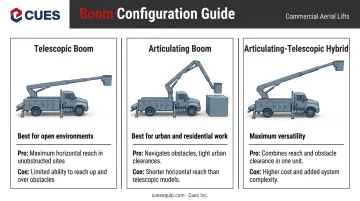
For most fleet applications across utility, telecom, and tree care, an articulating or hybrid design is worth the added cost.
Platform and Capacity
Published platform capacities for this class run 450–600 lbs based on current manufacturer specifications. That range covers:
- One operator plus tools and materials comfortably
- Some configurations support two-person platforms at the higher end of that capacity range
Check whether the stated capacity includes personnel only or accounts for tools and equipment — it affects how work is actually planned on the job site.
Insulated vs. Non-Insulated Booms
This is the most consequential spec decision:
| Use Case | Boom Type Required |
|---|---|
| Energized line work (utility) | Insulated (dielectric) — Category C or higher |
| Near-line telecom work | Insulated, verify voltage rating |
| Tree care (no overhead lines) | Non-insulated acceptable |
| General construction/maintenance | Non-insulated acceptable |
The Elliott I50F carries a Category C, 46 kV insulation rating as a factory configuration. Insulation ratings are model and configuration-specific — verify each unit individually.
Chassis and Drivetrain
GVWR sizing should account for the lift weight plus expected payload:
- Most 50-foot class configurations fall in the 19,500–25,999 lb recommended GVWR range
- 4x2 drivetrains suit most road-based utility and telecom work
- 4x4 configurations are worth the cost for fleets that regularly work in adverse conditions — muddy substations, rural rights-of-way, storm restoration work
Outriggers and Stability
Outriggers stabilize the truck during lift operations. The two common types:
- A-frame outriggers deploy from a single pivot point, require less road width to set up, and are common on Versalift and Elliott models in this class
- H-frame outriggers extend straight out from both sides, offering a wider stability footprint but requiring more space
For urban job sites with tight street access, confirm the deployed outrigger spread before committing to a configuration.
Power Source
Two power setups appear in this class:
- Power take-off (PTO): The truck engine drives hydraulic fluid to operate the lift — the standard setup for most fleet applications
- Auxiliary power units (APUs) or battery systems: Reduce engine idle time, cut fuel consumption, and lower noise output during extended boom operations
If your fleet works in residential areas, hospital campuses, or has idle-reduction requirements, ask manufacturers specifically about APU and battery-based options.
Safety and Compliance: A Fleet Manager's Checklist
A 2023 fleet manager survey found a 39% increase in managers prioritizing safe and correct vehicle operation — and 42% identified staying current on regulatory changes as a key compliance priority. For aerial lifts specifically, here's what those regulations require in practice.
Operator Training
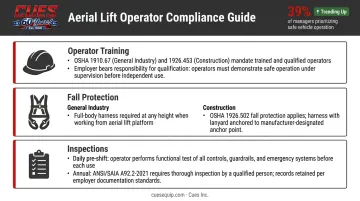
OSHA 1910.67 (general industry) and 1926.453 (construction) both require that only trained or authorized persons operate aerial lifts. Controls must be tested each day before use. OSHA does not issue an operator "certificate." The employer is responsible for training and qualifying workers on the specific equipment used.
Fall Protection
- General industry (1910.67): Personal fall-arrest or travel-restraint system attached to the boom or basket
- Construction (1926.453): Body belt and lanyard attached to boom or basket
Full-body harnesses, hard hats, and appropriate footwear round out the minimum PPE requirements.
Regular Inspections
Daily pre-shift control testing is an OSHA rule. Annual inspections are addressed by ANSI/SAIA A92.2-2021, the governing standard for vehicle-mounted aerial devices. A92.2-2021 covers design, manufacture, testing, inspection, maintenance, training, and operation.
Keep documented inspection records on file. In an incident investigation, those records are what establish compliance — and protect your fleet from liability.
Choosing the Right 50-Foot Aerial Lift for Your Fleet
New vs. Used
For fleet buyers, new equipment offers a clear operational advantage: known maintenance history, current safety systems, full manufacturer warranty, and financing eligibility through dealer programs. The acquisition cost is higher — but the cost-over-time math often tells a different story.
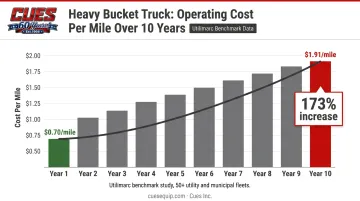
A Utilimarc benchmark study covering 50+ utility and municipal fleets found heavy bucket-truck operating costs at $0.70/mile in year 1, climbing to $1.91/mile by year 10 — a 173% increase. Equipment that looks like a bargain at purchase can carry a compounding maintenance burden that erodes that savings quickly.
Renting vs. Buying
For fleets where a 50-foot aerial lift runs as part of core operations, ownership typically makes more financial sense than renting. When the equipment is in daily or near-daily use, rental costs accumulate quickly — and driver familiarity with a standardized unit adds real operational value over time.
CUES, Inc. offers flexible financing options, including lease-to-own structures through third-party lenders, to make acquisition more accessible than a straight upfront purchase.
Selecting a Brand and Dealer
Manufacturer reputation comes down to two things: parts availability and dealer support network. When a unit goes down mid-project, the question isn't which brand looks best in a brochure. It's how fast you can get a technician and the right part on-site.
CUES, Inc. is an authorized dealer for Versalift® and Elliott®, both with deep roots in the truck-mounted aerial lift market. Operating since 1966 across New England and New York, CUES provides manufacturer-backed support, direct parts sourcing, and sales expertise in matching configurations to specific fleet applications. Their inventory runs from 34-foot van-mounted units to 75-foot forestry trucks, covering the full range of commercial aerial lift needs.
Total Cost of Ownership
TCO includes more than the purchase price:
- Fuel costs — chassis fuel type and engine efficiency matter over a fleet lifecycle
- Maintenance trajectory — factor in the age-cost benchmark above when evaluating any option
- Insurance — insulated configurations may affect coverage terms for utility fleets
- Downtime cost — an out-of-service unit affects crew productivity, not just maintenance budget
CUES, Inc.'s road service capability and stocked parts inventory directly address the downtime factor. A dealer with mobile service support and parts on hand gets trucks back to work faster than waiting on a parts order from a distant warehouse.
Frequently Asked Questions
What are the dimensions of a 50-foot truck?
"50-foot" refers to the aerial lift's working height, not the truck's length. The truck chassis itself typically runs 25–30 feet in length and approximately 8 feet wide. Stowed height ranges from roughly 10 feet 4 inches to 11 feet 6 inches depending on chassis and lift configuration.
What is the difference between working height and platform height on an aerial lift?
Platform height is the elevation of the bucket floor at maximum reach. Working height is higher — it accounts for the operator's own reach above that floor. Always check both figures when comparing models, since manufacturers calculate the difference differently.
Do you need a CDL to drive a 50-foot aerial lift truck?
It depends on the truck's GVWR. Under 49 CFR Part 383, a Class B CDL is required for any single vehicle with a GVWR of 26,001 lbs or more. Many 50-foot class configurations — including some Versalift and Elliott models — are engineered at 25,999 lbs specifically to remain non-CDL.
What are the OSHA requirements for operating an aerial lift?
OSHA requires employer-provided training, daily control testing before use, and use of fall protection (a personal fall-arrest or travel-restraint system in general industry; body belt and lanyard in construction). The employer — not OSHA — is responsible for operator qualification on specific equipment.
Is it better to rent or buy a 50-foot bucket truck for a commercial fleet?
For commercial fleets running aerial lifts as part of core operations, buying is more cost-effective than renting. Flexible financing options make acquisition manageable without a large upfront outlay, and ownership means the asset is always available when your crews need it.
What are the leading brands for 50-foot aerial lifts?
Versalift and Elliott are the leading manufacturers in this class. Elliott's L50 and I50F and Versalift's VST and SST series (ranging from 45 to 59 feet) are proven options at this height. CUES, Inc. is an authorized dealer for both brands and can match the right model to your application.