The challenge most fleet managers face isn't a lack of options. It's the opposite. Construction sites demand multiple truck types serving distinct roles, and a procurement strategy built on brand loyalty or "biggest available" thinking tends to produce fleets full of mismatched equipment. According to NTEA, the North American commercial truck and truck-equipment industry totaled $168.8 billion in 2024 — a market scale that reflects just how central commercial work trucks are to construction and infrastructure operations.
This guide breaks down the five most essential construction work truck types for commercial fleets, with selection criteria that go beyond badge preference.
Key Takeaways
- Match every truck to a defined operational role — supervision, hauling, towing, trades support, or lifting
- GVWR classification governs payload limits, towing ratings, and CDL requirements — selecting the wrong class creates compliance and safety exposure
- Chassis cab trucks are the most upfit-flexible platform for vocational applications
- Aerial and crane trucks are purpose-built equipment engineered for specific lifting and access demands
- Total cost of ownership over 3–5 years matters more than sticker price
Overview of Construction Work Trucks in Commercial Fleets
A "construction work truck" in a commercial fleet context spans a wide range — from Class 1 light-duty pickups used for project management to Class 5+ vocational chassis cabs running dump bodies or aerial devices. Fleet composition matters more than any individual model choice.
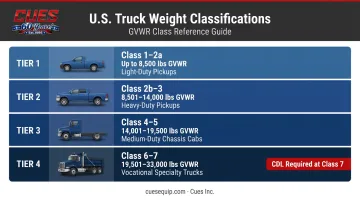
Truck weight classifications (per U.S. DOE) run from:
- Class 1–2a: Up to 8,500 lbs GVWR (light-duty pickups)
- Class 2b–3: 8,501–14,000 lbs (heavy-duty pickups)
- Class 4–5: 14,001–19,500 lbs (medium-duty chassis cabs)
- Class 6–7: 19,501–33,000 lbs (vocational and specialty trucks)
S&P Global Mobility reported 21% growth in Class 2 truck registrations in 2023, driven largely by construction demand, reflecting how central these vehicles are to active project fleets.
That demand reflects a deliberate approach: the best-performing construction fleets match each truck type to a specific function rather than relying on one-size-fits-all vehicles. The five types below cover the core of that mix.
Best Types of Construction Work Trucks for Commercial Fleets
Each truck type below was evaluated on payload and towing capacity, upfit compatibility, fleet versatility, total cost of ownership, and suitability for construction-specific job site demands.
Light-Duty Pickup Trucks (Class 1–2a)
Light-duty pickups (GVWR under 8,500 lbs) handle daily mobility, light hauling, and crew transport for project managers, estimators, and tradespeople who don't need a heavy platform. Common models include the Ford F-150, Chevy Silverado 1500, and Ram 1500.
Why this class works at fleet scale:
- Lower acquisition and operating costs than heavy-duty alternatives
- No CDL required
- Better fuel economy for frequent highway and multi-site use
- Flexible between job site and office use
The tradeoff is real — payload and towing headroom is limited. These trucks are not the right tool for equipment trailers or bulk material runs.
| Factor | Detail |
|---|---|
| Best Use Cases | Supervisor transport, supply runs, light tool hauling, small utility trailer towing |
| Max Available Payload | Up to 2,260–2,440 lbs (varies by model and configuration) |
| Key Selection Criteria | Crew cab for passenger use, tow package, fuel type, 4WD for off-road sites |
2026 OEM payload maxima: Ford F-150 at 2,440 lbs, Ram 1500 at 2,360 lbs, Chevy Silverado 1500 at 2,260 lbs. Actual available payload varies with cab, options, and installed equipment.
Heavy-Duty Pickup Trucks (Class 2b–3)
For most serious construction fleets, Class 2b–3 pickups (GVWR 8,501–14,000 lbs) form the backbone. The Ford F-250/F-350 Super Duty, Chevy Silverado 2500HD/3500HD, and Ram 2500/3500 are built for repeated heavy towing and frequent multi-site operation.
The key advantage for fleets: these trucks handle daily towing and hauling loads that would accelerate wear on a light-duty platform. Diesel engine options add torque output and long-term durability — particularly relevant in high-cycle fleet environments.
| Factor | Detail |
|---|---|
| Best Use Cases | Towing equipment trailers, skid steers, compact machinery; transporting palletized materials |
| Max Gooseneck Towing | Up to 40,000 lbs (F-350 with HO diesel, DRW, proper configuration); Ram 3500 reaches 36,610 lbs |
| Key Selection Criteria | SRW vs. DRW, gooseneck or 5th wheel hitch compatibility, diesel vs. gas, GCWR compliance |
Towing maximums require specific axle, engine, and hitch configurations — always verify against the OEM towing guide before spec'ing a trailer.
Chassis Cab & Flatbed/Dump Trucks (Class 3–5)
Strip the factory bed and you get the most upfit-flexible platform in any construction fleet. Chassis cabs accept flatbeds, dump bodies, contractor bodies, and stake beds — common platforms include the Ford F-450/F-550, Chevy Silverado 4500HD/5500HD, and Ram 4500/5500.
Payload capacity climbs significantly above pickup variants. A 2026 Ram 5500 4x4 with the 6.4L gas engine is rated for up to 12,260 lbs payload and a 19,500 lb GVWR — more than five times what a light-duty pickup carries.
| Factor | Detail |
|---|---|
| Best Use Cases | Dump body trucks for material hauling, flatbeds for equipment delivery, contractor body supply transport |
| Typical Max Payload (Class 5) | Up to ~12,000–15,000 lbs depending on platform and body configuration |
| Key Selection Criteria | Cab-to-axle length for body fitment, frame rail strength, upfit vendor compatibility, diesel availability |
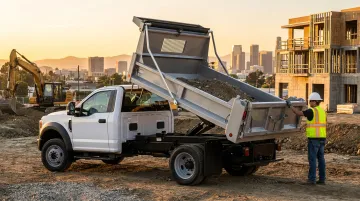
Completed vehicle payload is always less than chassis rating — the body, upfit equipment, tools, fuel, and occupants all consume available capacity.
Service Body & Utility Body Trucks
Service body trucks mount enclosed aluminum or steel compartments onto a chassis cab platform — the standard choice for electrical, plumbing, HVAC, and general construction crews who need organized, weather-protected storage over open-bed flexibility.
Key fleet advantages over open-bed configurations:
- Reduces tool loss through locked, compartmentalized storage
- Eliminates secondary storage trailers on many job types
- Improves crew efficiency at shift start and end
Body material matters for fleets operating in New England:
- Aluminum: Lighter, corrosion-resistant, preferred where road salt exposure is heavy
- Steel: Higher raw payload cost (adds weight), but durable for high-impact use cases
| Factor | Detail |
|---|---|
| Best Use Cases | Electrical, plumbing, HVAC, finish trades; field service crews; multi-tool construction support |
| Common Body Materials | Aluminum (salt-belt preferred) or steel (impact-resistant) |
| Key Selection Criteria | Compartment count and layout, body length vs. cab-to-axle measurement, crane or lift integration |
Crane & Aerial Work Trucks
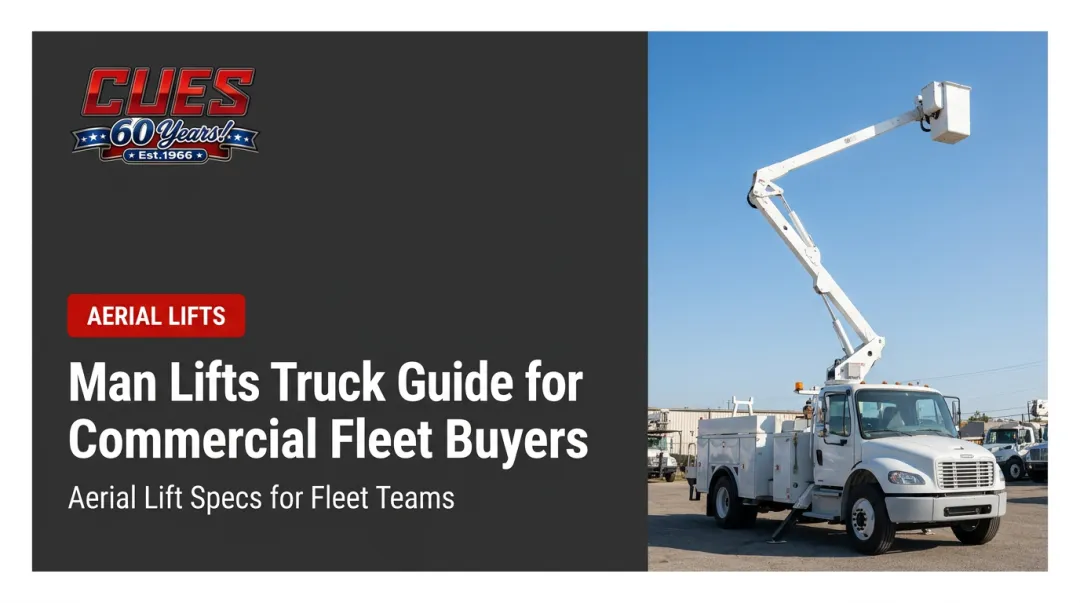
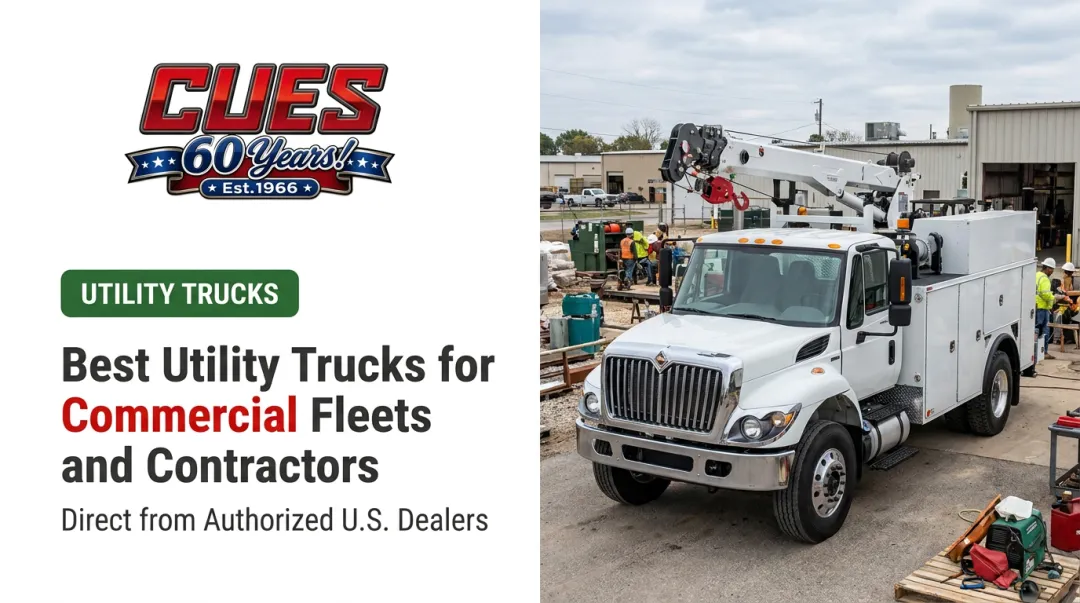
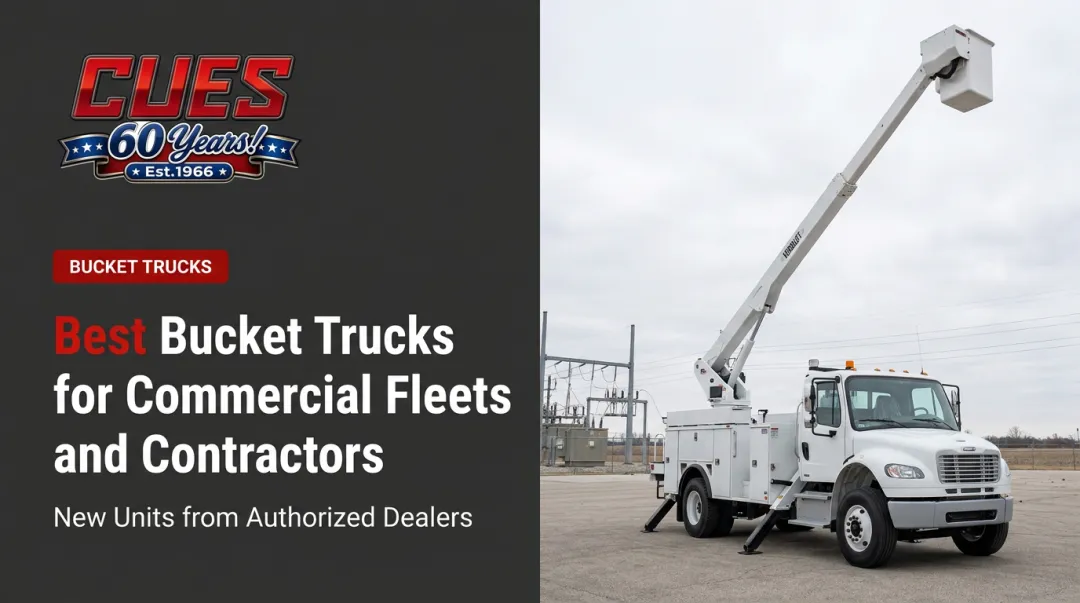
Crane trucks and aerial work trucks (bucket trucks) are purpose-built for construction and utility work at height — crane trucks for material picks and equipment placement, aerial trucks for elevated platforms serving electrical, telecom, and construction crews. Most platforms run on Class 4–7 chassis, with some Class 3 configurations available.
Selecting the right unit means matching platform reach, load capacity, and rotation spec to the specific job — not simply choosing the tallest boom available.
| Factor | Detail |
|---|---|
| Best Use Cases | Overhead utility and telecom work, elevated construction tasks, material picks, sign and light installation |
| Key Specs to Evaluate | Working height, side reach, platform capacity, rotation arc, base vehicle GVWR |
| Key Selection Criteria | ANSI/SAIA A92.2-2021 compliance for aerial devices, crane load chart ratings, chassis compatibility, dealer service support |
Current CUES, Inc. inventory includes aerial work trucks built on Class 4–6 chassis platforms from authorized manufacturers including Versalift®, Elliott®, and Auto Crane®. Available units include the Versalift VST-55-HDI (59 ft 7 in working height, 600 lb platform capacity, non-CDL) and the Elliott V63 HiReach (63 ft working height, 500 lb two-person platform, 1,000 lb main winch) — both suited for construction fleet applications requiring elevated access and material handling.
How to Choose the Right Construction Work Truck for Your Fleet
Start With Job Role, Not Brand
The most common procurement mistake is choosing trucks by brand preference or defaulting to the largest available option. Every truck in the fleet should map to a specific function: supervision, hauling, towing, trades support, or lifting. If you can't articulate what a truck does daily, it's probably the wrong spec.
Understand GVWR and CDL Thresholds
GVWR governs payload limits, warranty coverage, and driver licensing requirements. Overloading a truck beyond its GVWR creates safety risks and voids warranties — both costly problems for fleet operators.
Key thresholds to know:
- Class 2b–3 (up to 14,000 lbs GVWR): No CDL required for most configurations
- Class 4–6 (14,001–26,000 lbs GVWR): Generally no CDL required for single-vehicle use
- Class 7+ (26,001 lbs GVWR or above): Triggers federal Class B CDL requirement per 49 CFR 383.91
Always verify combined GCWR when towing. A non-CDL truck can cross CDL thresholds once a heavy trailer is factored in.
Build a Deliberate Fleet Mix
A well-composed construction fleet typically looks like this:
- Light-duty pickups for management, supervision, and daily mobility
- Heavy-duty pickups or chassis cabs for towing equipment trailers and hauling bulk materials
- Service body trucks for trades crews requiring organized tool and parts storage
- Aerial or crane trucks for elevated work and precision lifts
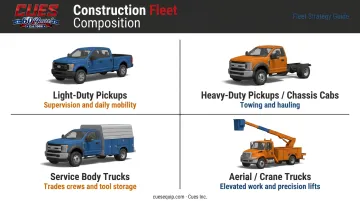
Rarely does one truck type serve all these needs efficiently. Fleets that try to consolidate around a single platform end up compromising somewhere.
Model Total Cost of Ownership Over 3–5 Years
Purchase price is just one line item. The factors that actually drive fleet cost over time include:
- Diesel vs. gas engine choice (diesel typically offers better torque and longer service intervals for high-use applications)
- Payload utilization rates — a truck running at 40% capacity is wasted spend
- Upfit costs and lead times
- Resale value at disposition
- Maintenance and downtime costs
Run a TCO model before finalizing any spec. A truck that costs $10,000 more upfront but runs 30% more efficiently over five years isn't the expensive option.
Prioritize Local Serviceability
For fleets operating in New England, parts availability and dealer proximity directly affect project timelines. A specialized aerial or crane truck waiting two weeks for out-of-region warranty work creates real scheduling and budget exposure. When evaluating upfitted trucks, prioritize manufacturers and dealers with local service support.
Conclusion
The best construction fleet isn't built around one truck type. Strong fleets combine light-duty daily drivers for management, heavy-duty haulers for high-capacity towing and bulk loads, chassis cabs upfitted for trade-specific roles, and purpose-built aerial and crane trucks for elevated work.
Fleet managers should audit their current composition against actual job demands. Key areas to evaluate:
- Where vehicles are underutilized relative to their class and capacity
- Where payload or towing demands are pushing trucks past safe operating limits
- Where specialized upfits could eliminate the need for secondary equipment
- Whether current procurement decisions account for long-term scalability and serviceability
Every vehicle in the fleet should earn its place — and leave room to grow.
For construction and utility fleet operators in New England and New York, CUES, Inc. has been supplying commercial fleets since 1966 with sales and financing for heavy-duty trucks, aerial devices, cranes, and service body solutions. Contact them at 800-258-1010 or visit their locations in NH and CT to discuss your fleet requirements.
Frequently Asked Questions
What trucks do construction workers use?
Construction workers use a range from light-duty pickups (F-150, Silverado 1500) for supervisors and tradespeople to heavy-duty trucks (F-250/350, Silverado 2500/3500HD) for hauling and towing. Trades crews and elevated-work operations typically use chassis cab trucks upfitted with service bodies, flatbeds, or aerial devices.
What is the difference between a pickup truck and a chassis cab for construction work?
A pickup comes with a factory-built bed; a chassis cab has no rear body, allowing fleet operators to mount a custom vocational body suited to a specific trade or function. Chassis cabs also carry significantly higher payload ratings and greater upfit flexibility than comparable pickup variants.
What GVWR class should a commercial construction fleet prioritize?
Most fleets rely on Class 2a–2b (light-to-heavy-duty pickups) for general use and Class 3–5 chassis cabs for vocational applications. The right class depends on payload and towing requirements, and whether drivers need a CDL — which kicks in at 26,001 lbs GVWR for a single vehicle under federal regulations.
What are the most common upfits added to construction work trucks?
The most common upfits are service and utility bodies for tool storage, flatbed or dump bodies for material hauling, aerial/bucket bodies for elevated access, and crane mounts for lifting operations. All upfits must be matched to the chassis cab's cab-to-axle length and available GVWR capacity.
Should construction fleets buy or rent specialized work trucks?
Buying makes sense for trucks in continuous daily use. For fleets uncertain about upfront costs or expansion scope, flexible financing programs can make specialized equipment — including aerial lifts and crane trucks — more accessible. Contact CUES, Inc. at 800-258-1010 to discuss purchase and financing options.
How often should construction work trucks be serviced?
OEM intervals vary significantly by engine type and duty cycle — Ford gasoline engines in harsh conditions may require changes every 3,000–5,000 miles, while Ram diesel trucks can reach 15,000 miles under favorable monitoring. Follow your specific OEM schedule rather than a one-size-fits-all benchmark.