Introduction
Every construction project depends on logistics as much as labor. A truck that's undersized for its payload, or incompatible with the crane or aerial device it needs to carry, doesn't just slow things down — it stops work entirely while you sort out a fix. Equipment downtime on commercial job sites costs an average of $760 per hour in lost productivity, according to industry fleet estimates.
Heavy-duty construction trucks span a wide range, from three-quarter-ton pickups to Class 8 commercial rigs, and each tier serves a fundamentally different role on the job site. A crew transport truck and a boom truck share a category in name only.
This guide covers the full spectrum: key selection criteria, the top heavy-duty truck models from Class 3 through Class 8, and how to match truck capability to your actual construction application — whether that's hauling materials, towing equipment, or hosting a crane or aerial device.
Key Takeaways
- Heavy-duty construction trucks run from Class 3 HD pickups to Class 8 commercial chassis — the right class depends on payload, towing demands, and upfit needs
- Top picks: Ford F-Series Super Duty, Ram HD lineup, Chevrolet Silverado HD, International HV Series, and Freightliner M2 — each suited to different site roles, from on-road service to heavy-haul
- GVW rating, engine torque, and chassis configuration should drive your selection — not brand loyalty
- New England operators must account for spring frost restrictions, which can reduce allowable gross weights by 25–35%
- CUES, Inc. has supplied upfitted heavy-duty trucks to construction fleets across New England and New York since 1966
Overview of Heavy-Duty Trucks in the Construction Industry
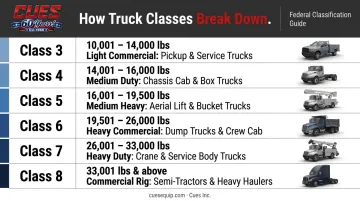
Truck classification in the U.S. is federally defined by GVWR (Gross Vehicle Weight Rating), and knowing where a truck falls on that scale directly determines what it can legally haul, tow, and carry on a job site:
| Class | GVWR Range | Typical Construction Role |
|---|---|---|
| 3 | 10,001–14,000 lbs | HD pickups, crew transport, light material haul |
| 4 | 14,001–16,000 lbs | Chassis cab for service bodies, light crane mounts |
| 5 | 16,001–19,500 lbs | Medium chassis cab, aerial device platforms |
| 6 | 19,501–26,000 lbs | Utility trucks, dump bodies, aerial lifts |
| 7 | 26,001–33,000 lbs | Severe-duty vocational, heavy crane, large dump |
| 8 | 33,001+ lbs | Full commercial, heavy haul, large boom trucks |
According to S&P Global Mobility, U.S. commercial vehicle registrations totaled over 1.6 million units in 2023 — a 14% increase over 2022 — with Class 3 up 16% and Class 6 up 18%, both partly driven by construction demand.
That growth spans a wide range of job site roles. The profiles below break down the five platforms construction operations rely on most — from Class 3 HD pickups to crane-ready Class 7–8 commercial chassis.
Best Heavy-Duty Trucks for Construction
Trucks were evaluated on payload capacity, GVWR, engine torque, chassis flexibility for upfitting, and proven performance in active construction applications.
Ford F-Series Super Duty (F-250 / F-350 / F-450 / F-550)
The Super Duty is the most widely deployed HD pickup platform in commercial construction. It scales from Class 2 (F-250) to Class 5 (F-550 chassis cab), covering crew transport, material hauling, towing, and crane truck applications within a single platform family.
2025 Model Specs:
| Model | Max GVWR | Max Payload | Max Gooseneck Tow |
|---|---|---|---|
| F-250 | 11,400 lbs | 4,268 lbs | 23,000 lbs |
| F-350 DRW | 14,000 lbs | 8,000 lbs | 38,000 lbs |
| F-450 | 14,000 lbs | 8,000 lbs | 40,000 lbs |
| F-550 Chassis Cab | 19,500 lbs | Configuration-dependent | Configuration-dependent |
| Engine | HP | Torque |
|---|---|---|
| 7.3L Gas V8 | 430 HP | 485 lb-ft |
| 6.7L Power Stroke Diesel | 475 HP | 1,050 lb-ft |
| 6.7L High-Output Power Stroke Diesel | 500 HP | 1,200 lb-ft |
The High-Output diesel is required for the F-450's 40,000-lb gooseneck rating — the highest in the pickup segment.
Key construction features:
- F-450/F-550 cab chassis compatible with service bodies, aerial devices, and crane mounts
- Factory trailer brake controller and tow packages standard on commercial trims
- Pro Power Onboard delivers onboard generator power (up to 7.2kW) for job site tools
- Ford Pro Intelligence telematics: GPS tracking, predictive diagnostics, idle-time monitoring, driver behavior data
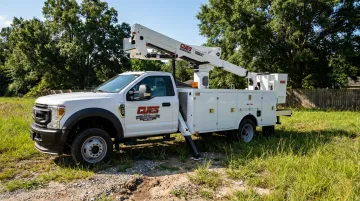
The F-550 chassis cab is a common base for aerial bucket trucks. CUES, Inc. stocks upfitted F-550 and F-600 units with Versalift aerial devices — ready to deploy for utility and construction work across New England.
Ram HD Lineup (Ram 2500 / 3500 / 4500 / 5500)
Ram's HD lineup matches Ford step-for-step in the chassis cab segment, with one clear differentiator: the Cummins 6.7L inline-six diesel produces the highest torque in any pickup-class truck on the market.
2025 Model Specs:
| Model | Max GVWR | Max Payload | Max Diesel Towing |
|---|---|---|---|
| Ram 2500 | 10,000 lbs | 3,600 lbs | Per configuration |
| Ram 3500 Pickup | 14,000 lbs | 7,590 lbs | 36,610 lbs |
| Ram 4500 Chassis Cab | 16,500 lbs | 9,700 lbs (gas) | 29,440 lbs |
| Ram 5500 Chassis Cab | 19,500 lbs | 12,550 lbs (gas) | 34,540 lbs |
| Engine | HP | Torque |
|---|---|---|
| 6.4L HEMI V8 (Gas) | 370 HP | 429 lb-ft |
| 6.7L Cummins Diesel (4500/5500) | 360 HP | 800 lb-ft |
| 6.7L Cummins High Output (2500/3500) | 430 HP | 1,075 lb-ft |
Ram claims best-in-class available base diesel torque at 1,075 lb-ft for the 2500/3500 with the High Output Cummins — the strongest low-end pulling force in the pickup segment.
Key construction features:
- Class-exclusive Auto-Level Rear Air Suspension on 2500/3500 — adapts to payload automatically, with a Bed Lowering Mode that drops the rear ~2 inches for easier loading
- Ram 4500/5500 chassis cab rated for dump beds, service bodies, and crane mounts
- ZF 8-speed automatic on 4500/5500 chassis cab models
- Trailer Backup Assist standard on applicable configurations
CUES, Inc. carries Elliott bucket trucks built on the Ram 5500 chassis cab — one of the most requested configurations for contractors needing Class 5 payload with aerial reach.
Chevrolet Silverado HD / GMC Sierra HD (2500HD / 3500HD)
The Silverado HD's reputation in commercial fleets is built on the Duramax-Allison powertrain pairing. The Allison 10-speed automatic features Continuous Power Technology, which maintains full drive force through gear changes. In stop-and-go construction site driving, that consistency adds up across a full shift.
2025 Model Specs:
| Model | Max Payload | Max Towing |
|---|---|---|
| Silverado 2500HD | Up to 8,408 lbs | 22,500 lbs (conventional) |
| Silverado 3500HD DRW | Up to 7,442 lbs | 36,000 lbs |
| Engine | HP | Torque | Transmission |
|---|---|---|---|
| 6.6L Gas V8 | 401 HP | 464 lb-ft | Allison 10-speed |
| 6.6L Duramax Diesel | 470 HP | 975 lb-ft | Allison 10-speed |
Key construction features:
- Duramax-Allison combination is the standard benchmark for fleet longevity in vocational applications
- Allison's Continuous Power Technology eliminates power interruption during shifts — built for construction duty cycles
- Integrated trailer brake controller standard
- Available CarbonPro composite bed resists dents and corrosion from heavy material contact
- GMC Sierra ProGrade Trailering System for trailer load monitoring and management
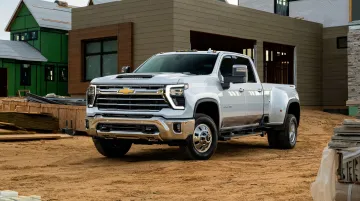
The Silverado/Sierra HD tops out at the 3500HD. There is no GM chassis cab equivalent to the F-550 or Ram 5500, so upfit-intensive applications requiring Class 5 capability will need to move to one of those platforms — or cross into purpose-built vocational territory entirely.
International HV Series (Class 6–7 Severe Duty)
When pickup-based platforms reach their limits — heavy dump work, large crane mounts, full-size utility bodies — the International HV Series is where many construction fleets go next. Unlike pickup-derived chassis cabs, it's engineered from the ground up for vocational loading cycles.
Specs Overview:
| Configuration | Class | Engine Options | HP Range |
|---|---|---|---|
| HV 509/609 | Class 6–7 | S13 Integrated Powertrain, Cummins | Up to 515 HP |
| HV 515/615 | Class 6–7 | S13 Integrated Powertrain, Cummins | Up to 515 HP |
| Cummins Option | Class 6–7 | Cummins diesel | Up to 360 HP / 800 lb-ft |
Key construction features:
- Set-back front axle design delivers the best turning radius in its class — significant on congested urban and suburban job sites across New England
- Configured from the factory for dump, mixer, crane, and utility upfit applications
- PTO (power take-off) compatible for hydraulic crane and aerial device operation
- Severe-duty frame and suspension rated for demanding off-road terrain
- Vocational upfit provisions for dump bodies, service crane mounts, and utility bodies
CUES, Inc. has upfitted International HV chassis units with Versalift forestry equipment — a practical option for New England buyers who need aerial reach with the durability to handle demanding terrain.
Freightliner M2 106 / 114SD (Class 6–8 Commercial)
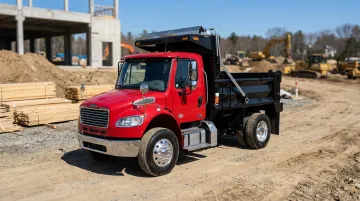
The Freightliner M2 106 is the best-selling medium-duty truck in North America. On large-scale construction sites — heavy dump hauling, boom truck configurations, material transport — it represents the transition from pickup-adjacent platforms to commercial equipment built specifically for the job.
Specs Overview:
| Model | Class | Max GVWR | HP Range | Torque Range |
|---|---|---|---|---|
| M2 106 Plus | 6–8 | 66,000 lbs | 200–360 HP | 520–1,150 lb-ft |
| 114SD Plus | 7–8 | 92,000 lbs | Up to 525 HP | Per configuration |
M2 106 Engine Options:
| Engine | HP | Torque |
|---|---|---|
| Detroit DD5 | 200–240 HP | 520–660 lb-ft |
| Cummins B6.7 | 240–325 HP | 660–750 lb-ft |
| Cummins L9 | 260–350 HP | 720–1,150 lb-ft |
| Detroit DD8 | 260–360 HP | 660–1,050 lb-ft |
Key construction features:
- Modular cab and chassis design accommodates a wide range of body installations without custom engineering
- PTO provisions standard for hydraulic crane and aerial device operation
- Detroit Assurance safety suite includes Active Brake Assist 6, Adaptive Cruise Control, Lane Departure Warning, and Side Guard Assist
- Strong aftermarket parts network keeps fleet downtime low
- 114SD Plus handles heavy dump and concrete mixer applications that exceed M2 106 capacity
How We Chose the Best Heavy-Duty Construction Trucks
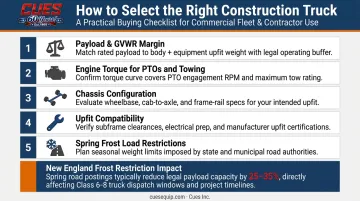
Trucks were assessed against real construction use cases — material hauling, equipment towing, crew transport, and upfit hosting — not just spec sheet comparisons. The single most common mistake buyers make is choosing a truck based on brand loyalty or cab style without verifying GVWR, payload rating, and upfit compatibility for their specific trade.
Core selection factors:
- Meets or exceeds typical load requirements for the application, with margin built in for GVWR and payload
- Delivers sufficient engine torque for towing heavy trailers and operating PTOs on crane and aerial device upfits
- Chassis configuration (pickup vs. cab chassis vs. full commercial chassis) determines what upfits are viable
- Confirms upfit compatibility before purchase — service bodies, aerial devices, crane mounts, and dump beds each have specific chassis requirements
- Demonstrates long-service reliability, which matters more than peak-spec numbers for fleet buyers
Total cost of ownership is one factor that often gets underweighted. Fuel costs, maintenance intervals, parts availability, and resale value should carry equal weight to the purchase price.
For New England operations, spring frost laws reduce allowable gross vehicle weights by 25–35% on affected roadways — meaning a truck rated at 19,500 lbs GVWR could be restricted to roughly 13,650 lbs gross during the March–May thaw period. Building in that derating margin may push buyers toward a higher GVWR class than their nominal payload would suggest.
Conclusion
The best heavy-duty construction truck is the one matched to the job — payload requirements, upfit needs, and operating terrain should drive the decision, not the nameplate on the hood.
The truck itself is only half the equation. A capable chassis paired with the right upfit — a service body, crane system, or aerial device — becomes a purpose-built work unit. Choosing a supplier who handles both the chassis and the equipment simplifies procurement, reduces compatibility issues, and gets the unit to the job site faster.
That's where a regional specialist makes a difference. For construction companies and contractors in New England and New York, CUES, Inc. has been supplying heavy-duty trucks, aerial devices, service cranes, and truck bodies since 1966. Their inventory spans Class 2-3 through Class 7-8 platforms with upfit options from Versalift, Elliott, Auto Crane, and BrandFX — sold as complete, work-ready units or as standalone equipment for contractors who source their own chassis.
Reach their team at 800-258-1010 or visit their locations in Amherst, NH and North Franklin, CT.
Frequently Asked Questions
What is the best heavy-duty truck for construction?
It depends on the application. Most contractors are well-served by pickup-based HD platforms — the F-350, Ram 3500, or Silverado 3500HD — for towing, crew transport, and material runs. Class 6–8 commercial trucks like the International HV or Freightliner M2 are necessary when the job requires dump bodies, large crane mounts, or payloads that exceed what a pickup chassis can handle.
What is a massive construction truck called?
Large on-highway construction trucks are typically referred to by their federal weight class (Class 7 or Class 8) or vocation — dump truck, boom truck, haul truck. Class 8 vehicles have GVWRs above 33,000 lbs. Off-highway, the largest machines are articulated haul trucks or rigid-frame mining trucks, which operate outside federal road classifications entirely.
What is the difference between a Class 3 and a Class 8 heavy-duty truck?
Federal truck classes are defined by GVWR. Class 3 starts at 10,001 lbs (think an F-350 or Ram 3500), while Class 8 covers anything above 33,001 lbs — including semi-trucks and heavy vocational rigs. Construction fleets span the full range; drivers operating Class 7+ vehicles (26,001 lbs GVWR and above) generally require a CDL.
What payload capacity do I need for construction work?
General contractors doing material runs typically need 2,000–4,000 lbs of payload, which falls within the range of most HD pickup platforms. Dump and crane applications require significantly higher ratings — sometimes exceeding 10,000 lbs on Class 5–7 chassis. Always verify the actual weight of your materials and upfit equipment against the truck's rated payload before spec'ing.
Should I buy or rent a heavy-duty construction truck?
Buying makes sense for high-utilization fleets, permanent upfits, and long-term ROI. For heavily upfitted units — crane trucks, aerial devices, service bodies — ownership is usually the better call, since permanent body installations don't transfer between chassis easily. Flexible financing can help manage upfront costs if cash flow is a concern.
What upfits are most commonly used on heavy-duty construction trucks?
The most common construction upfit types include:
- Service bodies — organized tool and parts storage
- Flatbed/platform bodies — oversized load transport
- Dump bodies — loose material hauling
- Crane and aerial systems — utility and overhead access work
Chassis compatibility (cab-to-axle length, frame strength, PTO provisions) must be confirmed for each upfit before ordering.