
The problem is that spec sheets rarely make comparison easy. Every manufacturer highlights different numbers, and it's tough to tell whether a model like the Elliott L50 actually matches your jobsite conditions or just looks good on paper.
This guide breaks down the L50's real specifications, its standout features, the industries it fits best, and what to check before you commit to a purchase.
Key Takeaways
- 50-ft working height and 2,000-lb main winch capacity for sign, lighting, and utility material work.
- 500-lb jib winch, compact 10-ft outriggers, and Bluetooth diagnostics speed setup and cut downtime.
- Confirm outrigger footprint, tool circuit needs, and local service support before you buy.
- An authorized Elliott dealer like CUES, Inc. can cover financing, parts, and road service after the sale.
Elliott L50 Overview: What Makes This Aerial Device Different
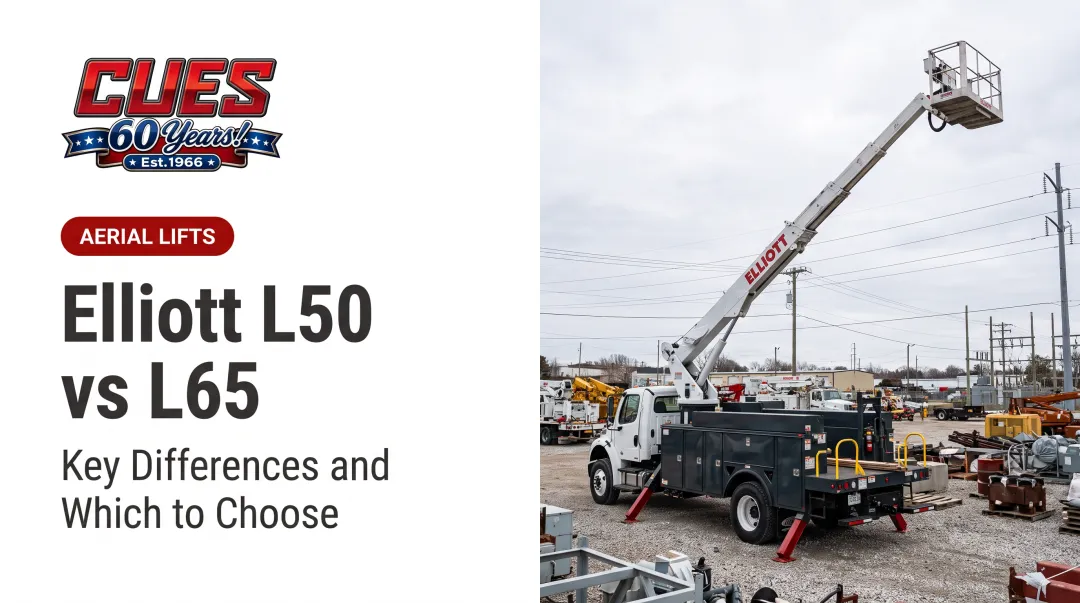
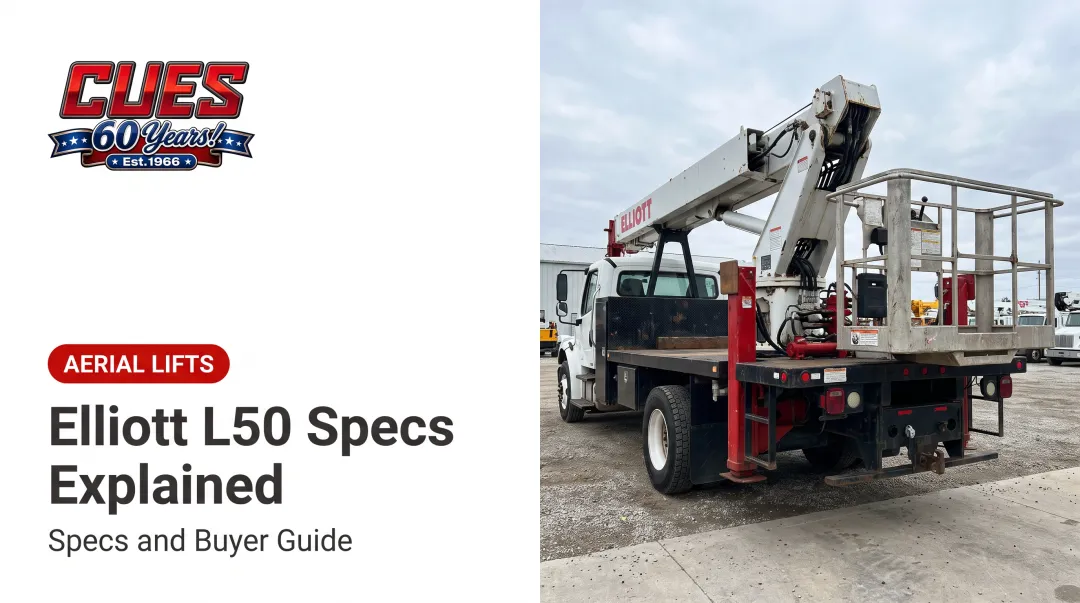
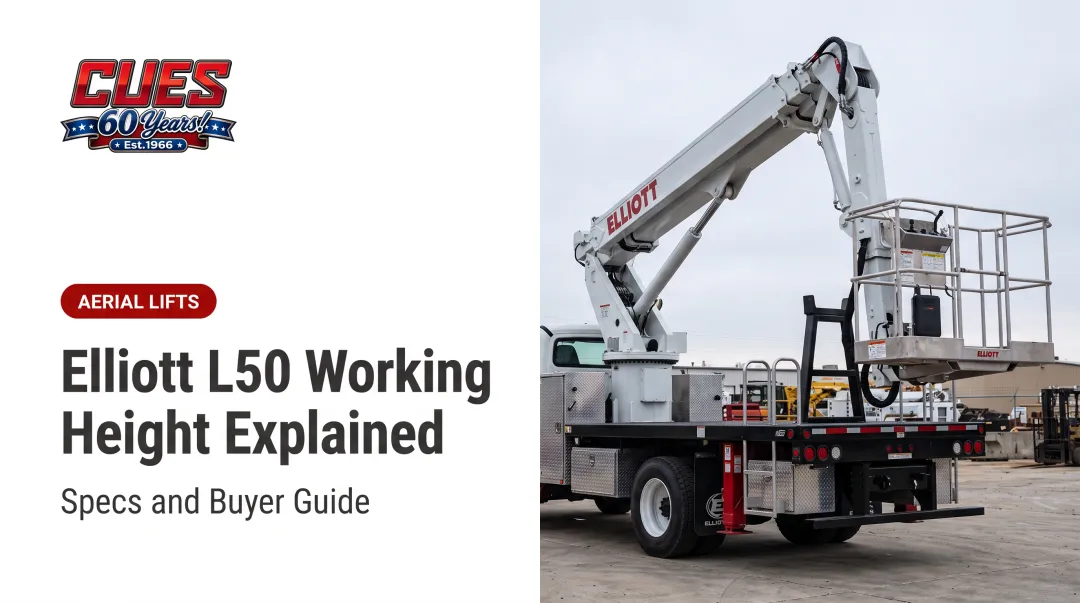
Elliott Equipment Company introduced the L50 in late 2023 as a long-reach, lightweight platform for sign, lighting, and material-handling crews who need more than a basic bucket truck.
CUES, Inc. stocks recent model-year builds, including a 2025 L50 on a Ford F-600 and a 2026 unit on a Ram 5500, so buyers are looking at current-production machines—not the original launch unit.
The core idea behind the L50 is simple: combine a truck-mounted aerial platform with genuine material handling capability in one chassis. Instead of sending a bucket truck and a separate crane or flatbed to the same job, crews get both functions from a single vehicle.

Where the L50 Fits in Elliott's Lineup
Elliott builds machines well beyond the L50's 50-ft class, including the L65 HiReach, which offers 65 feet of working height and a heavier 25,999-lb GVWR chassis for larger utility and construction fleets. The L50 sits below that tier intentionally.
- Positioned for tighter jobsites and lighter-duty chassis (Class V, roughly 19,500-lb GVWR)
- Aimed at sign, lighting, and government fleets rather than heavy transmission utility work
- Trades some reach for a smaller footprint and lower operating weight
That smaller footprint shows up on real jobsites. Crews can work urban corridors and residential streets without the heavier chassis the L65 requires.
Market timing helps too. The 2026 IPAF rental market report found the US MEWP rental market grew 4% to roughly $15.8 billion in 2025, with fleet size up 2% to about 875,000 units. That figure is industry-wide, not L50-specific, but it matches what CUES sees among electric utility, telecom, and sign customers across New England and New York.
Elliott L50 Specifications & Technical Features
The L50's numbers tell a specific story: a machine built for confined spaces that still moves real weight. Here's the at-a-glance breakdown.
| Spec | Rating | Why It Matters |
|---|---|---|
| Working height | 50 ft | Reaches most billboard, pylon sign, and pole-mounted infrastructure jobs |
| Side reach | 40 ft | Extra horizontal access without repositioning the truck |
| Main winch | 2,000 lb | Hydraulic lifting for signs, transformers, and bulk materials |
| Jib winch | 500 lb | Stows directly in the platform for precise positioning |
| Outrigger spread | 10 ft (front and rear) | Fits tight urban lots and highway shoulders |
| Platform capacity | 600 lb (40 x 60 in steel) | Two-person capacity with tools |
Reach and Footprint Built for Tight Sites
The L50's 10-ft front and rear outrigger spread is the detail that matters on tight jobsites. A narrow footprint means a crew can set up:
- On a downtown sidewalk without blocking a full lane
- On a highway shoulder without a full closure
- In a residential driveway without pulling into the yard
Paired with the 40-ft side reach, that narrow stance still delivers meaningful net reach once the boom extends.
Material Handling That Actually Moves Weight
Most bucket trucks lift people and maybe a toolbox. The L50 is different. Its 2,000-lb main winch and 500-lb jib winch let crews hoist channel letters, LED fixtures, or utility hardware directly to the work zone, cutting out a second trip with a separate crane truck.
CUES's current L50 build sheets also list options that speed setup and cut downtime:
- Electric or hydraulic upper controls in three-stick or single-stick layouts
- Bluetooth remote diagnostics with real-time performance feedback
Technicians can spot issues before they turn into a service call.

Productivity, Safety, and Operator Comfort Features
Specs get equipment on the shortlist. Day-to-day usability is what keeps operators productive and fleets running with fewer incidents.
Faster Setup, Shorter Learning Curve
The L50 offers an optional Convenience Package that streamlines machine setup and boom stow, shaving minutes off every job cycle. Across multi-crew fleets, those minutes compound quickly over a full week.
Controls and onboard safeguards matter just as much for seasonal or rotating operators:
- Straightforward three-stick or single-stick platform controls
- Automatic function slowdown near boom limits during short-jack setups
- ANSI A92.2 certified safety systems
Visibility and Confined-Space Maneuverability
Elliott lists an optional rear backup camera on the L50. Cab controls also include a glove-friendly touchscreen. Both help on winter utility calls, where gloves and low light are standard working conditions.
The compact footprint speeds day-to-day positioning on tight jobsites:
- Tighter turning in dense downtown blocks
- Easier setup in residential cul-de-sacs
- Less time spent repositioning around parked cars or obstacles
Who Should Buy the Elliott L50? Industry Applications
Not every fleet needs this exact combination of reach and lifting power. The L50 fits best in a few specific use cases:
- Sign and lighting companies get the clearest match. Launch coverage specifically cites channel letters, pylon signs, LED fixtures, and poster billboards as jobs where the height-and-winch combo pays off.
- Electric utility and telecom crews can reach elevated infrastructure and hoist equipment in one trip, instead of staging a separate materials lift.
- Tree service, construction, and field service teams get one machine for aerial access and material transport, which means fewer vehicles on smaller jobs.
If your work rarely involves lifting anything heavier than a toolbox, a standard aerial lift without the winch package is usually the more cost-effective choice.
Buyer's Guide: What to Consider Before Purchasing an Elliott L50
Before signing a purchase order, walk through these four checkpoints.
1. Confirm Your Jobsite Fits the Footprint
The L50's 10-ft outrigger spread handles most tight sites, but ground conditions still matter. Utility Fleet Professional notes that outrigger pads should be used under every outrigger regardless of surface, since manufacturer feet alone can't account for every ground condition.
Check overhead clearances and confirm the rotation range covers your typical setup angles.
2. Match Tool Circuits to Your Actual Work
If your crews run hydraulic drills, crimpers, or welding equipment from the platform, confirm exactly which tool circuits are included versus optional on your specific build. Elliott offers 110V, hydraulic-tool, welder, and pressure-washer accessories, but availability varies by configuration.
3. Compare Buying, Leasing, and Financing
The L50 is a significant purchase. CUES structures financing options that include:
- Lease-to-own arrangements
- 90-day deferred payment plans
- Customizable payment terms across 1 to 20-year loan structures
- Trade-in valuation on existing equipment
4. Factor In Parts, Service, and Long-Term Support
Ownership costs extend well past the purchase price. Consider:
- Lifetime structural warranty and one-year parts-and-labor coverage from Elliott
- Local parts availability for winch, hydraulic, and control components
- Road service for on-site repairs

This is where an authorized dealer matters. CUES, Inc. has served New England and New York since 1966 from locations in Amherst, NH, and North Franklin, CT.
Beyond the 2025 Ford F-600 and 2026 Ram 5500 L50 builds, CUES backs every unit with a stocked parts department, factory-trained technicians, and road service trucks that keep downtime low.
Frequently Asked Questions
What is the working height of the Elliott L50?
The Elliott L50 delivers a 50-ft working height and 40-ft side reach—enough for most pylon signs, billboards, and elevated utility work without repositioning the truck.
How much weight can the Elliott L50 lift?
The Elliott L50 is rated for a 2,000-lb main winch plus a 500-lb jib winch that stows in the platform, so crews can hoist signs, fixtures, and utility hardware straight to the work zone.
What makes the Elliott L50 different from other aerial work platforms?
The Elliott L50 combines material handling with aerial access on one compact chassis, so sign and lighting crews don’t need a separate crane truck for heavy lifts.
Which industries commonly use the Elliott L50?
Sign and lighting companies, electric utility and telecom crews, and construction or field service operations all use the L50 for combined access-and-lift work.
What safety features does the Elliott L50 include?
Standard features include three-stick or single-stick controls, automatic function slowdown near boom limits, and ANSI A92.2 certification. A backup camera is available as an option.
Where can I buy or get service support for an Elliott L50 in New England or New York?
CUES, Inc. is an authorized Elliott dealer in Amherst, NH, and North Franklin, CT, offering sales, financing, parts, rentals, and support across New England and New York.