This guide gives you a practical framework for understanding hydraulic boom trucks, evaluating the two primary configurations, and matching the right machine to your actual project demands — not just the specs on a brochure.
Key Takeaways
- A hydraulic boom truck combines a commercial truck chassis with a hydraulic lifting boom for lifting, transport, and load positioning
- Rated capacity drops sharply as boom radius increases; always evaluate the load chart at your actual pick radius, not the headline tonnage
- Telescopic booms excel at straight vertical lifts; knuckle/articulating booms handle tight spaces and obstacles
- New England contractors must account for spring frost law weight restrictions that vary by state and route
- Renting suits project-specific needs; ownership pays off with consistent, year-round demand
What Is a Hydraulic Boom Truck?
A hydraulic boom truck is a commercial truck chassis fitted with a hydraulic crane boom. It lifts, loads, and positions heavy materials — all from a single road-legal vehicle that drives freely between job sites without a separate transport truck.
That combination of mobility and lifting power is what separates boom trucks from dedicated crane carriers. NCCCO defines a boom truck as a rotating crane with a fixed or telescopic boom mounted on a commercial truck chassis that retains payload-hauling capability. If it can't haul payload, it's a truck crane — a different category entirely.
Core Components Contractors Should Know
The telescopic boom is the primary lifting arm. Extension length and luffing angle together determine how high and how far a load can be safely placed — raising the angle trades horizontal radius for height, while extending the boom expands the working envelope but reduces rated capacity.
Boom movement is driven by a hydraulic cylinder system pressurized through one of two pump types:
- Gear pumps — fixed displacement, continuous flow at full engine pressure; simpler and less expensive to service
- Variable-displacement piston pumps — adjust output to match demand; more controllable and efficient, but add mechanical complexity and service cost
Outriggers extend laterally from the truck frame before any lift, distributing load to prevent tipping. Pad size matters: soft soil, compacted gravel, and pavement each behave differently under load, and an undersized pad is a stability risk regardless of the crane's rating.
The operator cab and winch/hook system complete the package. A swing cab rotates with the boom, giving continuous sightlines across the full working arc. A fixed cab costs less but limits visibility on complex lifts.
Why Contractors Rely on Hydraulic Boom Trucks
- Road-legal mobility between job sites without a dedicated transport vehicle
- Faster setup than purpose-built crane equipment
- One machine handles lifting, material delivery, and aerial access
- Payload-carrying truck bed available for simultaneous material transport (depending on configuration)
Types of Hydraulic Boom Trucks Contractors Should Know
Configuration determines which jobs a boom truck can actually perform. The two primary designs serve different work conditions, and picking the right one depends on your typical job site, not just your lift capacity needs.
Telescopic (Straight) Boom Trucks
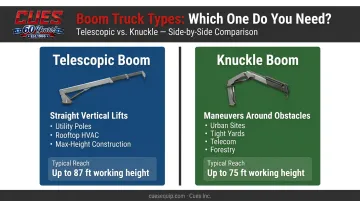
Telescopic booms extend via sliding inner sections on a single axis. They're built for lifting heavy loads straight up to significant heights with a clear vertical path.
Best applications:
- Utility pole setting
- HVAC equipment placement on rooftops
- Construction lifts requiring maximum height and rated capacity
For scale, National Crane's stand-up line publishes models reaching up to 167 feet of vertical reach. A 10-ton model like the National 400B tops out at 66 feet of tip height; a 50–55-ton NBT50L series reaches 202 feet. Capacity class and reach do not scale predictably, so always verify the specific model's load chart before spec'ing a job.
Knuckle Boom (Articulating) Trucks
Knuckle booms feature a hinged outer section that folds and unfolds, allowing the boom to maneuver around obstacles, work at horizontal angles, and operate in areas where vertical clearance is limited.
Best applications:
- Urban construction with overhead obstructions
- Building materials delivery in tight yards
- Telecom and fiber installation
- Forestry and tree care
Published reach examples vary widely by model: the IMT 2.5/18 reaches 23 feet 10 inches horizontally, while the Hiab EFFER iQ.1400 HP extends to 110 feet horizontal and 123 feet vertical.
Crane-Over-Cab vs. Rear-Mount
Beyond boom type, crane mounting position affects how the truck integrates into your workflow:
- Crane-over-cab: Preserves truck bed space for cargo; best when you need to transport materials and lift on the same run
- Rear-mount: Positions the crane behind the vehicle; better when your lift zone is consistently at the back or tied to a towed trailer
Key Factors to Consider When Choosing a Hydraulic Boom Truck
No single boom truck works for every contracting operation. Getting the selection wrong affects safety, productivity, and operating costs on every job. These six factors move you from general interest to a defensible equipment decision.
Lifting Capacity
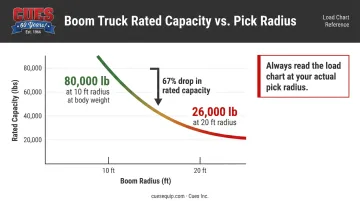
Rated capacity (measured in tons) must exceed the heaviest load you'll regularly handle — but the headline number tells only part of the story. Capacity drops sharply as boom radius and angle increase.
A real example: the Elliott 40105 with a 30-foot boom is rated at 80,000 lb at 10 feet of radius — but only 26,000 lb at 20 feet. That's a 67% capacity reduction across just 10 feet of additional reach.
Before evaluating any model, calculate your typical load weights and your most common pick radius. The load chart at that radius is your real capacity number.
- Undersizing creates safety violations and equipment stress
- Oversizing adds unnecessary cost, weight, and fuel consumption
- Never compare crane models by headline tonnage alone
Boom Reach and Height
Maximum working height and horizontal reach determine whether the truck can access the lift zone without repositioning. On urban job sites with set-back structures or overhead obstacles, this is often the binding constraint.
Use your most demanding lift scenario — greatest height plus greatest radius simultaneously — as your minimum spec baseline. Average jobs don't define your equipment requirements; the hardest job does. Sketch that worst-case lift before you start evaluating models.
Job Site Terrain and Ground Conditions
Terrain affects both mobility and outrigger stability. OSHA 1926.1402 requires sufficiently firm, drained, and graded ground conditions for every lift. The controlling entity on the job site bears that responsibility.
A practical pad check: required pad area = maximum outrigger reaction ÷ allowable ground-bearing pressure. Obtain the outrigger reaction from the manufacturer for the exact crane, extension, load, and radius. Don't estimate.
Contractors on rough terrain or remote sites should evaluate whether a standard boom truck chassis is sufficient or whether rough-terrain crane equipment better fits the work.
Mobility and Road Requirements
Terrain fitness gets a truck to the site — road compliance gets it there legally. Total vehicle weight (truck plus crane plus load) must comply with federal and state axle weight limits before the unit ever leaves the yard.
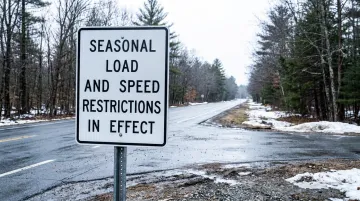
New England contractors face an additional layer: spring frost law restrictions. These vary significantly by state and route:
| State | Spring Posting Notes |
|---|---|
| New Hampshire | Route-specific; 2026 postings began March 9; limit is the lesser of 30,000 lb or tire width × 300 lb/in |
| Maine | MaineDOT evaluates state and state-aid highways annually; dates and routes vary by thaw conditions |
| Vermont | Municipalities file limits annually by February 10; some town highways capped at 24,000 lb |
| Massachusetts, CT, RI | No statewide standard percentage; check MassDOT and municipal postings individually |
Check live route postings rather than relying on a regional estimate — the rules vary by road, municipality, and year.
Truck chassis class also matters beyond just road compliance:
| Class | GVWR |
|---|---|
| 5 | 16,001–19,500 lb |
| 6 | 19,501–26,000 lb |
| 7 | 26,001–33,000 lb |
| 8 | 33,001 lb and above |
Class determines not just road compliance but also available payload capacity beyond the crane itself.
Safety Systems and Compliance
Modern hydraulic boom trucks include several required safety systems. For covered equipment manufactured after March 2003 over 6,000 lb, OSHA 1926.1416 requires at least one operating aid: a load-weighing device, load moment indicator (LMI), rated-capacity indicator, or limiter.
Anti-two-block systems are required for telescopic boom cranes manufactured after February 28, 1992. Confirm these systems are present and functioning on any unit under consideration.
Operator certification requirements are layered:
- Federal: OSHA requires training, certification or licensing, and employer evaluation (NCCCO is one accredited route)
- State: Massachusetts requires a hoisting license; Connecticut licenses crane/hoisting operators; New York issues a Certificate of Competence with Class C and D Boom Truck categories; Rhode Island requires hoisting engineer licensing
Factor certification and training costs into your total acquisition cost before committing to a purchase.
Total Cost of Ownership
Purchase price is only the first line item. True ownership cost includes:
- Insurance and annual inspections
- Hydraulic system maintenance (Altec benchmarks a hydraulic flush and oil change every 2,000 PTO hours)
- Operator wages and certification
- Parts availability and dealer proximity
- Storage and transportation
Dealer proximity and parts availability directly affect uptime. When a hydraulic component fails mid-project, a regional dealer with stocked inventory gets you back on site faster than a distant supplier with a lead time.
To calibrate expected spend, National NBT30 30-ton units list from $199,500 to $610,000 depending on age, configuration, and condition. Request written local quotes and compare annualized ownership cost at your realistic utilization rate.
Buying vs. Renting a Hydraulic Boom Truck
The right answer depends on how often the equipment actually works.
Ownership makes sense when:
- You have consistent, recurring lifting needs across multiple projects each year
- The equipment will be used enough to justify fixed costs over a 5–7 year horizon
- You want the unit available on demand without delivery minimums or availability gaps
Renting makes sense when:
- Your lifting needs are project-specific or seasonal
- You want to eliminate insurance, storage, and maintenance overhead
- You need newer equipment without a capital commitment
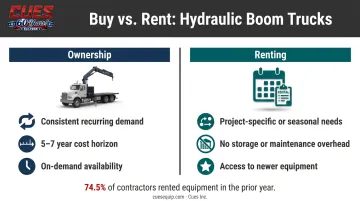
A 2024 EquipmentWatch survey found that 74.5% of construction equipment users had rented in the prior year — the rent-vs-buy calculation is something most contractors revisit regularly, not once.
For contractors who lean toward ownership but face capital constraints, financing closes the gap. Equipment loans and lease-to-own structures — with terms typically running 24–84 months — have made ownership accessible for smaller operations without requiring large upfront outlays. CUES, Inc. offers financing options tailored to contractor situations; their financing page at cuesequip.com is a practical starting point for understanding what's available.
How CUES, Inc. Can Help You Choose the Right Hydraulic Boom Truck
CUES, Inc. has been a trusted equipment partner for contractors across New England and New York since 1966. They work with utility, construction, telecom, and field service companies to identify and acquire the right aerial devices, cranes, and truck-mounted equipment.
As an authorized dealer for Versalift®, Elliott®, Auto Crane®, and BrandFX®, CUES gives contractors access to a proven lineup of equipment backed by manufacturer warranty coverage. Inventory spans compact articulating units on Class 5 chassis — like the Versalift SST-40-EIH on a Ford F-550 at 45-foot working height — up to high-reach models like the Elliott G85R at 87 feet on a Freightliner M2.
That range matters when you're matching a machine to a specific job type, crew size, and chassis preference.
What makes CUES a practical starting point for this purchase:
- Access to multiple proven brands through a single authorized dealer relationship
- Equipment specialists who can match working height, chassis class, and insulation requirements to your actual jobs
- Flexible financing options that align acquisition cost with your cash flow
- Inventory covering Class 5 through Class 7-8 configurations, non-CDL options included
Contractors in New England and New York can reach CUES at their Amherst, NH or North Franklin, CT locations to speak directly with an equipment specialist who can match the right machine to your specific lifting requirements. Call (800) 258-1010 or visit cuesequip.com to get matched with the right unit.
Frequently Asked Questions
What is a hydraulic boom truck?
A hydraulic boom truck is a commercial truck chassis fitted with a hydraulic crane boom that uses pressurized fluid to extend, lift, and position heavy loads. It functions as both a road vehicle and a lifting machine in one unit, so most job sites don't require separate transport and crane equipment.
How much does a boom truck cost?
New hydraulic boom trucks vary widely based on capacity, boom length, chassis class, and brand. Used National NBT30 30-ton units currently list from roughly $199,500 to $610,000 depending on configuration and condition; new 50-ton units run $300,000–$339,000 and up. Financing can make ownership accessible for contractors who need the equipment but want to manage upfront costs.
What is the difference between a boom truck and a hydraulic truck crane?
A boom truck is a commercial truck with a crane mounted on it — road-legal, multi-purpose, and capable of hauling payload. A hydraulic truck crane is a dedicated crane carrier designed primarily for heavy lifting with significantly higher load capacities. Boom trucks trade some raw lifting power for mobility and versatility — truck cranes are built when maximum capacity is the only priority.
Do I need a special license to operate a hydraulic boom truck?
Most operators need a CDL (based on GVWR) for the vehicle and crane operator certification for lifting. State requirements vary — Massachusetts, Connecticut, New York, and Rhode Island all layer additional rules on top of federal OSHA standards, so verify both before putting any equipment into service.
What lifting capacity do I need for my contracting work?
Start with the heaviest load you'll regularly lift, then check the load chart at your actual pick radius — not just the headline rating. Rated capacity drops sharply with extension: an Elliott 40105 goes from 80,000 lb at 10 feet of radius to 26,000 lb at 20 feet.
Should I buy or rent a hydraulic boom truck?
Frequent users with consistent year-round demand typically benefit from owning; contractors with seasonal or project-specific needs often find renting more cost-effective. For operations that use equipment regularly, financing with terms ranging from 24 to 84 months can make ownership viable without a large upfront outlay.