
Introduction
Comparing aerial devices on paper is harder than it should be. Two lifts can both claim "50 feet," yet perform completely differently once you factor in side reach, outrigger footprint, or platform capacity.
Many fleet managers and contractors struggle to translate spec sheets into real job-site decisions.
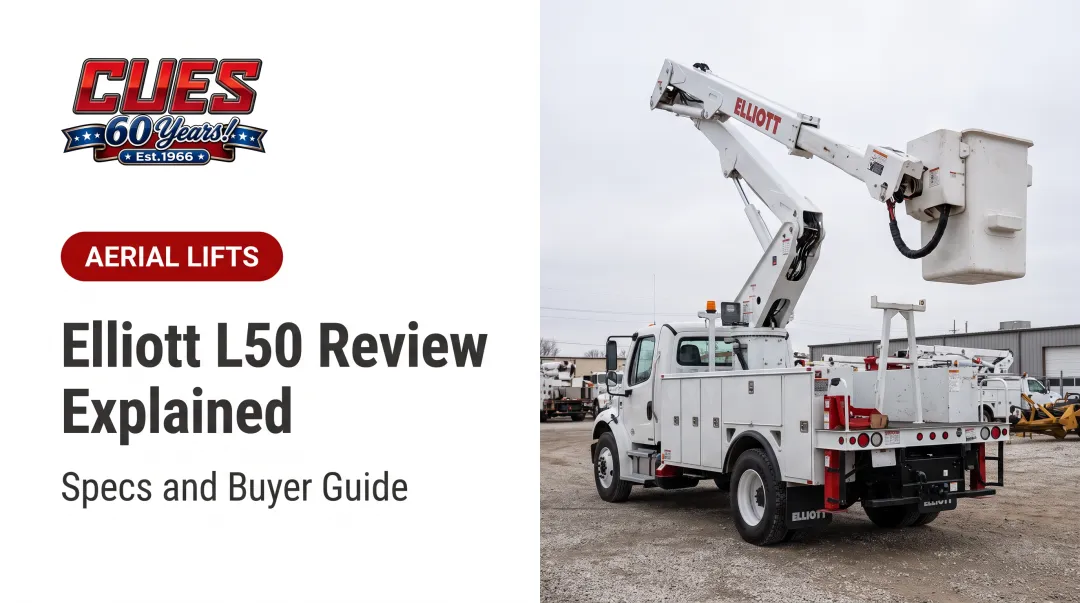
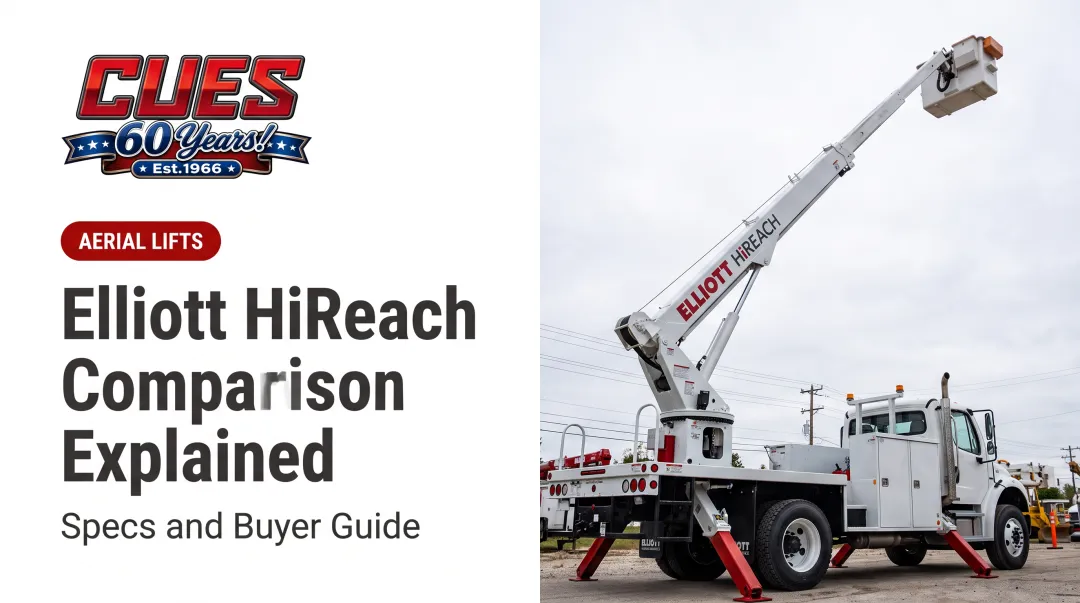
The Elliott L50 HiReach has become a go-to unit for utility, telecom, tree care, and construction crews that need personnel lifting and material handling in a single truck-mounted package.
This guide breaks down every core L50 spec, the features that set it apart from competing lifts, and what to check before you buy—plus where to purchase, finance, and service one in New England and New York.
Key Takeaways
- 50-ft working height and 40-ft working side reach on a Class V, 19,000–19,500 lb. GVWR chassis
- 2,000-lb main winch capacity for heavy material handling, paired with a 600-lb platform
- Boom auto stow, outrigger auto leveling, and Bluetooth diagnostics shorten setup and cut unplanned downtime
- A Lifetime Structural Warranty protects your investment and supports resale value
- Matching specs to the job and choosing the right dealer matters as much as sticker price
Elliott L50 Specifications Explained
Reach and Working Height Specs
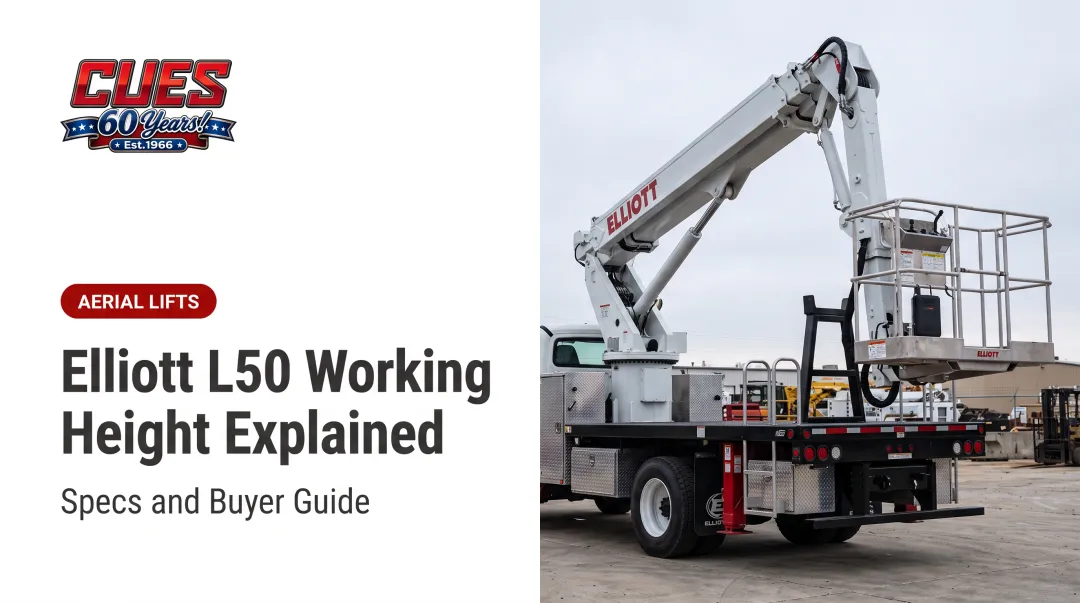
Working height is the maximum vertical distance the platform can reach from ground level. On the L50, that is 50 ft.
Working side reach is the horizontal distance the platform can extend from the machine's center of rotation, per IPAF best-practice guidance. The L50 delivers 40 ft. of side reach.
Why the distinction matters: pole work and line maintenance often need height more than horizontal distance. Tree trimming or setback jobs frequently need the opposite. Knowing both numbers tells you whether the L50 fits your typical work.
The L50's 10-ft. outrigger spread and narrow footprint let crews set up safely in tight utility rights-of-way, residential streets, or job sites where a wider outrigger pattern simply won't fit.

Platform & Material Handling Capacity
The L50 uses an EZR 40 x 60-in. steel platform with a skid-resistant aluminum floor and a 600-lb. capacity. It's rated for up to 160 degrees of rotation, giving operators positioning flexibility without repositioning the truck. The platform is also removable, so crews can switch to winch or boom-tip sheave lifting for jobs that don't need a personnel basket.
Beyond the platform, the L50's main boom carries a 2,000-lb. main winch capacity, enough to lift transformers, utility poles, or equipment sections without bringing a separate crane to the site.
For smaller moves, the 500-lb. jib winch adds flexibility:
- Positioning smaller hardware without repositioning the main boom
- Handling secondary lifts while the platform stays occupied
- Reducing wear on the main winch for lighter, repetitive tasks
Chassis & Control Requirements
The L50 mounts on a Class V chassis in the 19,000–19,500 lb. GVWR range. CUES currently lists it on both a Ford F-600 and a Ram 5500 in that weight class. That's well below the federal 26,001-lb. threshold that triggers Group B commercial driver's license requirements under 49 CFR 383.5.
That said, don't treat every L50 order as automatically CDL-free. State and local licensing rules vary, and the final chassis configuration matters. Confirm requirements with your jurisdiction before assuming any operator can run the unit.
Upper controls come as either an operator-configured three-stick or single-stick electric/hydraulic setup. The choice affects training time and operator preference more than raw capability. Crews already familiar with one layout will ramp up faster on it.
Key Features and Technology That Set the L50 Apart
Beyond raw reach and capacity, several design choices affect how fast crews set up, where they can work, and what ownership costs look like over the life of the truck.
Auto set-up and stow. One-touch outrigger deployment and boom auto stow cut time spent manually leveling the truck and stowing the boom at the end of a shift. Fewer manual steps also mean fewer chances for operator error during setup, a common source of job-site incidents.
Remote Bluetooth diagnostics. The L50's Bluetooth diagnostics let technicians pull data without climbing into the cab.
A 2024 analysis from AEM and DozerHub, cited by Volvo Construction Equipment, found that predictive maintenance on heavy equipment can cut maintenance costs by 18–31%, reduce downtime by 30–50%, and extend equipment life by up to 20%. Those are sector-wide figures, not L50-specific guarantees, but they explain why remote diagnostics are now standard on modern aerial equipment.
Platform accessories. Across Elliott's HiReach lineup, platform options can include:
- 110V power
- Welding and cutting circuits
- Hydraulic and air outlets
- Pressure-washing capability
- Material handling forks
CUES can also spec L50 units with sign forks, platform lighting, and composite pads for sign, lighting, and electrical maintenance crews.
Confined-space outriggers. Outriggers that deploy within the chassis mirrors let operators work in narrow alleys, tight residential streets, or crowded sites where a wide stance isn't an option.
Boom construction. The L50 uses a high-strength, lightweight 4-plate steel boom built to reduce weight and deflection. Hydraulics are designed with fewer leak points, which means less fluid loss and fewer unplanned service calls over the machine's life.
Lifetime structural warranty. Elliott backs the L50's subframe, turrets, and structural boom components with a lifetime, parts-only warranty, separate from the standard one-year parts-and-labor coverage. Annual documented inspections through an authorized distributor keep that coverage active. That protection is also a real factor in resale value later on.

Buyer's Guide: Choosing the Right L50 Configuration
Don't shop by spec sheet alone. Match the L50's capabilities to what your crews actually do:
- Utility line work benefits most from the combined height and side reach
- Tree care crews lean on the jib winch and platform rotation for positioning around canopy
- Construction and material handling teams get the most value from the 2,000-lb. main winch capacity
Chassis Compatibility and Licensing
CUES typically pairs the L50 with either a Ford F-600 (6.7L Powerstroke, 330 HP, 10-speed automatic) or a Ram 5500 (6.7L Cummins, 8-speed automatic), both on a Class V, 19,500-lb. GVWR chassis.
If your fleet has mixed operator certifications, confirm licensing requirements with your state before finalizing an order. Chassis weight alone doesn't guarantee CDL exemption everywhere.
New, Used, or Rental?
CUES currently stocks the L50 as new inventory only: a 2025 Ford F-600 build and a 2026 Ram 5500 build. There's no used L50 in current inventory.
CUES does offer rental equipment, though that program currently centers on Versalift bucket trucks in the 45- to 75-foot range rather than the L50 specifically. If renting an L50 is a priority, ask your dealer about current availability before assuming it's an option.
A strong resale market, driven partly by the Lifetime Structural Warranty, makes new purchase a reasonable long-term play for fleets planning to keep equipment five-plus years.
Ask about financing terms before you commit. CUES offers purchase, lease, lease-to-own, and 90-day deferred payment plans, with financing available through AFG LeasePath. Their payment calculator supports terms from one to 20 years, which helps you budget monthly or bi-weekly payments before you talk numbers with a salesperson.
L50 vs. V63 HiReach: Which Model Fits Your Needs
| Spec | L50 HiReach | V63 HiReach |
|---|---|---|
| Working height | 50 ft. | 63 ft. |
| Working side reach | 40 ft. | 38 ft. |
| Main winch capacity | 2,000 lb. | 1,000 lb. |
| Platform capacity | 600 lb. | 500 lb. |
| Outrigger spread | 10 ft. | 9 ft. |
The L50 wins on material handling and footprint; the V63 wins on raw height. If your jobs involve heavier lifts (transformers, equipment sections, poles), the L50's 2,000-lb. winch is the bigger asset.
If your crews regularly need to clear taller structures or overhead obstructions, the V63's extra 13 feet may matter more than the lifting capacity difference. Both models are available new through CUES.
Why Buy and Service Your Elliott L50 Through CUES
CUES, Inc. has operated as an authorized Elliott dealer since 1966, serving utility, telecom, tree care, and construction fleets across New England and New York from locations in Amherst, New Hampshire, and North Franklin, Connecticut.
That authorization covers the full ownership lifecycle:
- Sales of new L50 configurations, including Ford F-600 and Ram 5500 builds
- Service and maintenance, including routine inspections, engine repairs, and hydraulic-line work
- Parts sourcing across Elliott makes and models, including harder-to-find components
CUES runs fully stocked road-service trucks that come to your location, so you don't have to haul a downed lift mid-job. CUES technicians work with OEM parts and diagnostic tools to help keep warranty coverage intact.

CUES offers purchase, lease, lease-to-own, and deferred payment structures through partners like AFG LeasePath, so fleets can add an L50 without disrupting cash flow.
For current L50 availability or a financing quote, call 800-258-1010, or reach Amherst, NH at (603) 889-4071 and North Franklin, CT at (860) 886-7081.
Frequently Asked Questions
What is the working height and reach of the Elliott L50?
The L50 offers a 50-ft. working height and a 40-ft. working side reach. That combination suits utility and infrastructure work requiring both vertical clearance and horizontal positioning around poles or structures.
What size chassis does the Elliott L50 require?
The L50 mounts on a Class V chassis in the 19,000–19,500 lb. GVWR range. This falls below the federal 26,001-lb. CDL threshold, but licensing still depends on your state and specific configuration.
How much weight can the Elliott L50 lift on its main boom?
The main winch carries up to 2,000 lb., while the jib winch adds an additional 500-lb. capacity for smaller material moves. Together, they let crews handle most lifts without a secondary crane.
What warranty does Elliott offer on the L50?
Elliott backs the L50 with a Lifetime Structural Warranty on the subframe, turrets, and structural boom components, plus a separate one-year parts-and-labor warranty. Annual documented inspections are required to keep structural coverage active.
How does the L50 compare to the Elliott V63 HiReach?
The L50 offers greater main winch capacity (2,000 lb. vs. 1,000 lb.) and a tighter outrigger footprint, while the V63 reaches 13 feet higher. The right choice depends on whether your jobs prioritize lifting capacity or vertical reach.
Where can I buy or rent an Elliott L50 aerial device?
CUES, Inc., an authorized Elliott dealer, offers new L50 sales, financing, parts, and service across New England and New York. Contact CUES at 800-258-1010 to check current inventory and rental options.