The Auto Crane 4004EH, sold today under the model name EHC-4, is one of the more common cranes fleets consider for utility, field service, and mechanic trucks. But the headline spec sheet rarely tells the whole story.
This guide breaks down the verified specifications, safety features, and buying questions fleets should ask before signing a purchase order. We'll also cover where CUES, Inc. fits in as a New England and New York Auto Crane dealer.
Key Takeaways
- The 4004EH (rebranded EHC-4) is a telescoping electric-hydraulic crane, not a knuckle boom
- Rated 4,000 lb at a 4-ft radius, dropping to just 780 lb near full reach
- The 16-ft and 20-ft booms require different weight ratings, alternators, and GVWR minimums
- Chassis requirements vary between documentation versions: confirm specs before ordering a truck
- CUES, Inc. helps fleets match crane configuration to the right chassis and financing plan
What Is the Auto Crane 4004EH?
The Auto Crane 4004EH is a service crane built for mounting behind the cab or at the rear of a truck body. Auto Crane now markets this same crane under the name EHC-4, with "EH" standing for electric-hydraulic.
That naming detail matters. Some cranes in this weight class use articulating booms that fold at multiple pivot points. The 4004EH doesn't work that way. It extends and retracts telescopically, then rotates on a fixed base, more like a traditional boom truck crane than a knuckle-boom design.
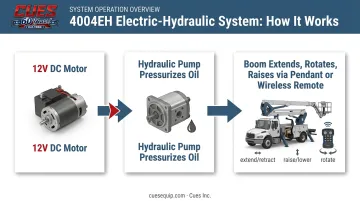
Here's how the power system operates:
- A 12-volt DC motor mounted on the crane drives a hydraulic pump
- The pump pressurizes oil that extends, retracts, raises, lowers, and rotates the boom
- Operators run the crane through a wired pendant or wireless remote, not a manual valve bank
Because the motor pulls directly from the truck's electrical system, alternator output and battery reserve capacity belong on your spec checklist. Fleets running this crane are typically field service, gas-distribution, and utility service trucks, loading and unloading compressors, pumps, or replacement parts throughout the workday.
Auto Crane 4004EH Specifications Fleets Should Know
Auto Crane sells the 4004EH in two boom lengths, and the difference between them affects more than reach.
| Specification | 16-ft Boom | 20-ft Boom |
|---|---|---|
| Crane rating | 16,000 ft-lb | 16,000 ft-lb |
| Max capacity | 4,000 lb at 4-ft radius | 4,000 lb at 4-ft radius |
| Capacity at max radius | 1,000 lb at 16 ft | 780 lb at ~20.5 ft |
| Boom elevation | -5° to +75° | -5° to +75° |
| Installed weight | ~890 lb | ~1,077 lb |
| Minimum GVWR (current listing) | 8,800 lb, Class 3 | 8,800 lb, Class 3 |
According to Auto Crane's current EHC-4 product page, the 4,000-lb headline number only applies at a 4-ft radius. That capacity falls sharply as the boom extends, and older manuals list even lower outer-radius values. Run the load chart for your exact working distance before quoting a job.
Power and Electrical Requirements
- 12V DC hoist motor rated around 4.8 hp
- Maintenance-type battery: 575 CCA minimum, 130-minute reserve capacity
- Alternator: 70A minimum per current documentation, though some legacy manuals call for up to 165A
That electrical spread is real, not a typo. The 2021 EHC-4 operator's manual lists different alternator and GVWR minimums than current product pages. Get the build-specific documentation for your serial number before ordering a chassis.
Control Options
- Hard-wired pendant control
- Wireless remote (tethered backup available)
- NexStar wireless proportional remote with load monitoring, diagnostics, and multiple speed settings
Normal operation doesn't include a manual valve package. Manuals describe an emergency override valve for use during a power loss, not a standard control method.
Key Features and Benefits for Fleet Operations
Telescoping Boom for Predictable Positioning
Because the 4004EH extends along a single axis instead of folding at multiple joints, operators face a shorter learning curve. Reach stays predictable at every extension length, and fewer joints mean fewer wear points to inspect.
Multiple Layers of Overload Protection
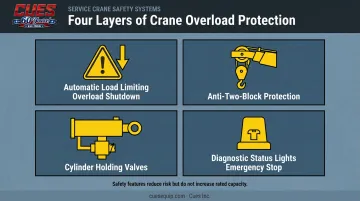
The crane includes:
- Automatic load limiting and overload shutdown
- Anti-two-block protection
- Cylinder holding valves
- Diagnostic status lights and emergency stop
These features reduce the chance of an overload incident, but they don't expand rated capacity. Crews still need to check the load chart before every lift, not rely on the crane to catch mistakes.
Compact Footprint and Chassis Fit
The 20-ft version's base plate measures 16.75 x 13.5 inches, and the boom stows at just under 12 feet. That leaves room on the bed for tool boxes and material racks. Hydraulic fittings and service points sit in accessible locations, which cuts shop time during routine checks.
The 4004EH mounts on Titan 16 and Titan 38 mechanic bodies and fits a range of Class 3-and-up chassis. But GVWR minimums differ across documentation versions (8,800 lb current versus 10,500 lb in the 2021 manual). Don't treat this as a universal fit across a mixed fleet without checking each build.
Applications and Industries Best Suited for the 4004EH
Auto Crane's own literature points to field service, installation work, gas-distribution trucks, and mechanic bodies as the primary use cases for this crane. That doesn't rule out other industries, though. Capacity and reach at your working radius determine fit, not the industry label on the truck.
Reasonable applications based on the published load chart include:
- Utility and gas-distribution crews loading valves, compressors, and pole hardware within the crane's rated capacity at working radius
- Field service and mechanic trucks lifting engines, pumps, and replacement components during service calls
- Construction crews moving job-site materials without a dedicated crane truck, provided the lift stays under the load chart limit
Other industries can work too, just with less documentation to lean on. For telecom cable-spool handling or tree service material moves, weigh the actual component before committing. Manufacturer literature doesn't publish dedicated case studies for those tasks, so match your load against the radius-specific chart rather than assuming fit.
Buying Guide: What Fleets Should Evaluate Before Purchasing
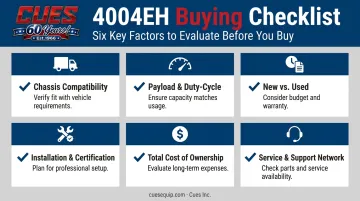
Chassis Compatibility
- Confirm GVWR against your exact build's requirement (8,800 lb per current pages, 10,500 lb per the 2021 manual)
- Verify frame resisting bending moment, listed at 210,600 in-lb minimum in the 2021 manual
- Check mounting location and outrigger clearance, at least 3 ft 9 in from truck centerline on the 20-ft version
Payload and Duty-Cycle Needs
- Size the crane against your heaviest routine lift, not the 4,000-lb headline rating
- Remember that capacity drops to roughly 780-1,000 lb near full reach
- Factor in duty cycle: published guidance calls for about 15 minutes of loaded operation followed by a 30-minute cooldown
New vs. Used Considerations
New units come with current specs, active warranty coverage, and up-to-date documentation. Used or refurbished units may still carry older manual specs, so match the paperwork to the actual serial number before assuming compatibility. Fleets prioritizing predictable specs and warranty protection typically lean new.
Installation and Certification
Professional installation should cover mounting, electrical hookup, and post-installation stability testing.
OSHA's certification exception under 1926.1427 only applies to equipment rated 2,000 lb or less. Since the 4004EH exceeds that threshold at most radii, covered construction work may require a certified operator. Mechanic-truck repair work and tree trimming carry separate exclusions, so confirm which rule applies to your task.
Total Cost of Ownership
- Weigh financing terms, maintenance intervals, and parts lead time, not just the purchase price
- Build daily, weekly, and quarterly inspection tasks into technician schedules
- Confirm parts lead times with your dealer before a breakdown forces the question
Service and Support Network
Work with a dealer who can walk you through the current build sheet, not just hand over a spec PDF. Ask how quickly they source parts and schedule support when something goes down.
A dealer with decades of experience selling the brand is more likely to catch version-specific spec conflicts before they become a truck that fails GVWR requirements. Cues Inc., for example, has been an authorized Auto Crane dealer since 1966.
Why Fleets Choose CUES, Inc. as Their Auto Crane Dealer
CUES, Inc. has sold aerial devices, cranes, and truck equipment across New England and New York since 1966. As an authorized Auto Crane dealer, CUES works through the exact documentation conflicts outlined above, confirming which manual, GVWR threshold, and electrical requirement apply to the configuration you're ordering.
What that means for fleets:
- Decades of experience pairing Auto Crane models with the right chassis, from Class 3 mechanic trucks up
- Flexible financing options built to help fleets add equipment without draining capital budgets
- A team that checks current build sheets against older manuals, so your truck meets GVWR and RBM requirements the first time
If you're weighing a new 4004EH/EHC-4 against other options, request a quote through CUES to confirm the build details that match your fleet's application.
Frequently Asked Questions
What is the maximum lifting capacity of the Auto Crane 4004EH?
The 4004EH is rated 4,000 lb at a 4-ft radius, but that number drops fast as the boom extends, down to roughly 1,000 lb at 16 ft or 780 lb near 20 ft. Always check the load chart for your specific radius.
What trucks can the Auto Crane 4004EH be mounted on?
Current manufacturer specs call for a Class 3 chassis with an 8,800-lb minimum GVWR, though older documentation lists 10,500 lb. Confirm GVWR and frame RBM with your dealer before ordering a chassis.
How much does an Auto Crane 4004EH cost for a fleet purchase?
Pricing depends on boom length, control package, financing terms, and dealer. Request a quote from an authorized dealer like CUES, Inc. for configuration-specific figures.
What is the difference between the 4004EH and other Auto Crane models?
The 4004EH (EHC-4) sits between the smaller EHC-3.2 (3,200 lb) and the larger EHC-5 (5,000 lb, Class 4 chassis) in Auto Crane's electric-hydraulic lineup. Capacity, reach, and minimum chassis requirements set them apart.
How often does the Auto Crane 4004EH require maintenance?
The manufacturer's manual calls for daily checks of hooks, cables, and fluid levels, weekly hardware checks, quarterly lubrication, and annual hydraulic fluid changes. Follow the schedule in your specific owner's manual.
Can the Auto Crane 4004EH be used for utility line work?
Yes, as long as the load, such as pole hardware or a small transformer, falls within the crane's rated capacity at your working radius. Double-check the component's actual weight against the load chart before lifting.