Commercial fleet buyers across utilities, telecom, tree service, and construction face these decisions regularly — and the consequences of getting them wrong compound across every unit in the fleet.
This guide covers what man lift trucks are, the major configurations available, the specification factors that matter most, and how to align equipment choices with real operational requirements.
Key Takeaways
- OSHA 29 CFR 1910.67 and ANSI/SAIA A92.2 govern man lift trucks — build specs around compliance from the start.
- Horizontal outreach, not working height alone, determines where crews can safely position the truck.
- Insulation category must match the voltage environment; wrong-rated equipment near energized lines is an OSHA violation.
- Chassis GVWR must be validated after factoring in the aerial device, body, tools, fluids, and crew weight.
- TCO over a 10-year service life varies dramatically based on parts availability, inspection costs, and downtime — sticker price is a poor proxy.
What Is a Man Lift Truck?
A man lift truck — more precisely defined by OSHA 1910.67 as a "vehicle-mounted elevating and rotating work platform" — is an aerial device mounted on a truck chassis that elevates workers and tools to heights unreachable from the ground. The formal equipment standard is ANSI/SAIA A92.2-2021, which covers vehicle-mounted extensible booms, articulating booms, aerial ladders, and combination designs.
Road-legal mobility is what sets man lift trucks apart from standalone scissor lifts or self-propelled boom lifts. These units drive directly to the job site, set up on outriggers, and deploy — no trailer, no separate transport required.
The core components that directly affect fleet performance:
- Lower truck chassis — determines GVWR, axle ratings, maneuverability, and CDL requirements
- Boom assembly — telescopic, articulating, or combination; governs the work envelope
- Work platform or bucket — rated for a specific combined load of operator, tools, and materials
- Hydraulic or electro-hydraulic actuation system — drives the lift mechanism and affects fuel consumption, idle time, and emissions compliance
Industries That Rely on Man Lift Trucks
Application type dictates specification requirements. The primary commercial sectors:
- Electric and gas utilities — energized line work requiring insulated aerial devices (IADs)
- Telecommunications — cable and fiber installation at mid-range heights in urban and suburban environments
- Municipal public works — streetlight maintenance, traffic signal work, and signage
- Tree service — arborist work and canopy clearing where articulating reach around obstacles matters
- Commercial construction — elevated installation and maintenance across varied jobsite conditions
Each of these applications carries distinct height, reach, insulation, and chassis requirements — which is why spec'ing the right unit starts with the work, not the truck.
Types of Man Lift Trucks for Commercial Fleets
Boom Configurations
Three configurations cover most commercial fleet applications:
- Telescopic (straight-arm) — extends in a straight line; best for open-span work like transmission line maintenance or utility pole work where obstacle clearance isn't a constraint
- Articulating (knuckle-boom) — joints allow positioning around obstructions; preferred for tree service and telecom work in tight or cluttered environments
- Combination (articulating-telescopic) — provides both obstacle clearance and extended reach; adds mechanical complexity but serves fleets that encounter varied conditions regularly
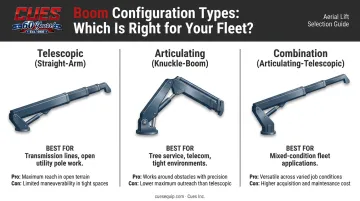
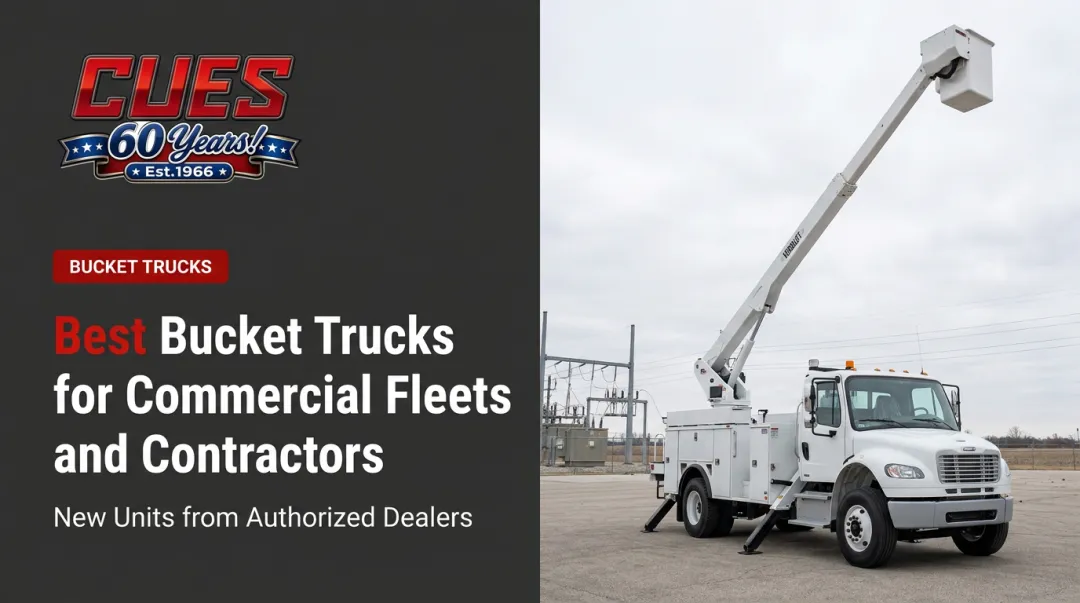
The Versalift SST-40-EIH — available through CUES, Inc. on Ram 5500 and Ford F-550 chassis — uses an articulating-telescopic combination at 45 feet. The VST-55-HDI reaches 59 feet on a Ford F-600 4x4 with the same combination approach. Neither is a default choice. The right configuration comes down to the actual work envelope your crews operate in daily.
Insulated vs. Non-Insulated Aerial Devices
For electric utility fleets, this distinction is non-negotiable. Insulated aerial devices (IADs) feature dielectrically rated booms that provide secondary protection when working near energized lines.
ANSI/SAIA A92.2 uses insulation "categories," not classes (Category C covers 46kV, for example), and the device nameplate, test certificate, and OEM declaration must all match the voltage environment crews will encounter.
Per OSHA's aerial lift guidance, unqualified workers generally maintain a 10-foot clearance from energized lines. Qualified utility employees follow voltage-based minimum approach distances under 1910.269. Insulation provides secondary protection; it doesn't replace work-practice rules or PPE.
Non-insulated units are appropriate for telecom, tree service, and construction applications where energized conductors aren't part of the work environment. Once insulation requirements are settled, working height becomes the next critical specification to lock in.
Working Height Categories
| Height Band | Typical Application | Chassis Impact |
|---|---|---|
| Under 40 ft | Light-duty utility, fiber splicing, signage | Medium-duty, often non-CDL |
| 40–75 ft | Telecom, municipal, most utility line work | Class 5–6, frequently non-CDL |
| 75+ ft | Transmission lines, high-voltage utility | Class 7–8, CDL typically required |
CUES, Inc.'s current inventory spans 34 feet (Versalift Ford E350 Splicer) up to 65 feet (Versalift VO260 and Elliott L65), covering the most common telecom, utility, and forestry applications across the region.
Single vs. Dual-Bucket Configurations
Dual-bucket (two-man platform) configurations allow two workers aloft simultaneously, which improves productivity on line work that requires a helper. The trade-off is weight: dual platforms carry higher rated loads, which affects chassis selection and completed-vehicle GVWR calculations. The Elliott L65, available through CUES, Inc. on a Freightliner M2 106, features a 160-degree hydraulically rotating two-man platform with a 600 lb combined capacity and a 5,900 lb main winch, designed specifically for crews that need both workers aloft at the same time.
Key Factors When Buying Man Lift Trucks for Your Fleet
Fleet procurement decisions should connect technical specifications directly to operational requirements and long-term cost management. Here's what to evaluate.
Working Height and Horizontal Outreach
These two dimensions must be evaluated together. A unit with adequate working height but insufficient horizontal outreach forces crews to reposition the truck repeatedly — adding setup time, creating traffic control complications, and increasing exposure to jobsite hazards.
ANSI/SAIA A92.2 doesn't prescribe a minimum outreach-to-height ratio. Actual geometries vary significantly by model: the Versalift SST-40-EIH at 45 feet offers under 28 feet of outreach, while the Elliott H60F at 65 feet reaches 49 feet laterally. The right approach is to map your actual work scenarios — pole setbacks, tree canopy clearance, building offsets — and request the full working-envelope chart from the OEM at the intended platform load before selecting a model.
Weight Capacity and Chassis Compatibility
Platform rated load capacity (operator + tools + materials) must be matched against the chassis's Gross Vehicle Weight Rating after the entire completed vehicle is configured. Per NTEA's vehicle certification guidance, the final-stage manufacturer certifies the completed vehicle — and the procurement file should include as-built axle weights, payload reserve, and stability calculations.
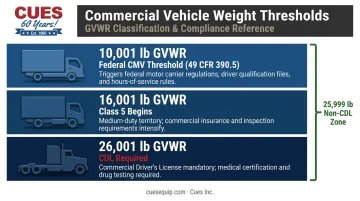
Federal commercial motor vehicle thresholds begin at 10,001 lb GVWR under 49 CFR 390.5. Class 5 starts at 16,001 lb. CDL requirements kick in at 26,001 lb. The CUES, Inc. inventory includes several non-CDL configurations at or below 25,999 lb GVWR — including the Versalift VST-55-HDI at 600 lb platform capacity — which matters significantly for fleets that need operational flexibility without CDL-licensed operators on every truck.
Chassis type also affects where the truck can work. 4x4 configurations are preferable for tree service and rural utility applications with soft or uneven terrain. Single-axle medium-duty trucks suit tight urban environments common across New England.
Insulation Rating for Electrical Work
Any fleet performing energized electrical work must specify an ANSI/SAIA A92.2-rated insulated boom with the correct insulation category for the voltage environments crews will encounter. The device nameplate, dielectric test certificate, and OEM documentation must all confirm the rating.
One key point from Terex's published ANSI summary: Category E provides secondary, not primary, protection. Primary protection remains PPE, hot sticks, cover-up, and maintaining minimum approach distances. Daily visual inspection and annual dielectric testing are required maintenance items, not optional.
Power Source Considerations
Engine-driven PTO hydraulics are the dominant configuration in commercial aerial device fleets: proven, reliable, and straightforward to maintain. The trade-off is engine hours — every hour the boom operates adds hours to the engine, accelerating wear and maintenance intervals.
Electric PTO (ePTO) and auxiliary power unit (APU) systems allow engine-off hydraulic operation, reducing fuel consumption, engine hours, emissions, and noise. This is particularly relevant in Connecticut, Massachusetts, New York, and New Hampshire, all of which have anti-idling regulations with limits ranging from 3 to 5 consecutive minutes, though most include exceptions for auxiliary equipment like aerial lifts in active use.
No direct cost comparison between PTO and ePTO for aerial fleets exists in published research. Model your own fleet's annual boom hours, fuel cost, and engine maintenance intervals to determine whether the added complexity and payload penalty of an ePTO system delivers net savings.
OSHA and ANSI Compliance Requirements
All vehicle-mounted aerial devices used to lift personnel must comply with:
- OSHA 29 CFR 1910.67 — general industry vehicle-mounted elevating and rotating work platforms
- OSHA 29 CFR 1926.453 — construction aerial lift requirements
- OSHA 29 CFR 1910.269 — electric power generation, transmission, and distribution (utility fleets)
- ANSI/SAIA A92.2-2021 — current design, testing, and inspection standard
ANSI A92.2 requires annual periodic inspection by a qualified person, a major structural inspection after 15 years and every 10 years thereafter, and documented operator training with retraining after accidents or near-misses. Current OSHA maximum penalties reach $165,514 per willful or repeated violation — penalties at that level represent a serious financial and operational risk that no fleet budget can absorb casually.
Fleet buyers should factor inspection costs, training record management, and boom certification scheduling into procurement planning from day one.
Total Cost of Ownership
TCO extends well beyond the purchase price. A TCO framework for man lift trucks should include:
- Acquisition — purchase price, upfit costs, registration and permitting
- Planned maintenance — Versalift's published schedule calls for general inspection every 3 months or 250 service hours, hydraulic fluid and filter service every 6 months or 500 hours
- Inspection and certification — annual ANSI A92.2 periodic inspection, dielectric testing for IADs, 15-year structural inspection
- Downtime costs — crew cost during out-of-service periods, substitute rental rates, towing, project delays
- Parts availability — proximity to a dealer with stocked OEM parts directly affects how long a unit sits when something fails
- Resale value — insulated units with clean inspection histories and strong brand support retain value better than orphaned equipment
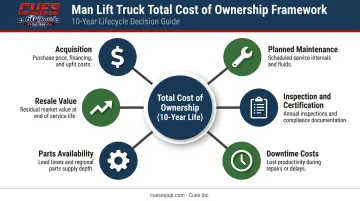
NTEA's lifecycle cost framework consistently shows that operating and maintenance costs dominate total ownership cost over a typical 10-year service life. A unit with a lower sticker price but limited regional parts support can be significantly more expensive to own than a higher-priced unit backed by a well-stocked authorized dealer network.
How CUES, Inc. Can Help Commercial Fleet Buyers
CUES, Inc. has operated as a specialized provider of aerial devices and truck equipment across New England and New York since 1966. As an authorized dealer for both Versalift® and Elliott® aerial devices, they offer fleet buyers access to two established product lines with strong North American dealer networks — which matters when you're weighing parts availability, warranty support, and long-term serviceability.
For fleet buyers, the authorized dealer relationship matters beyond the initial transaction. New Versalift equipment purchased through CUES, Inc. carries a lifetime structural warranty on the aerial device, plus 1-year parts and labor coverage. The underlying Ford chassis warranty adds further bumper-to-bumper and powertrain protection.
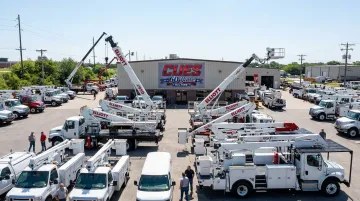
That coverage applies to a practical range of ready-to-spec equipment. Current inventory includes:
- Working heights from 34 to 65 feet across multiple chassis configurations
- Non-CDL options with up to 600 lb platform capacity — useful for fleets avoiding CDL operator requirements on mid-range utility trucks
- Insulated and non-insulated models across both the Versalift and Elliott lineups
- 4x2 and 4x4 configurations with gas and diesel fuel options
Fleet buyers in NH, CT, MA, and NY can contact CUES, Inc. directly to discuss specifications, arrange equipment evaluations, or explore flexible financing options. Call 800-258-1010 or visit cuesequip.com to get a conversation started with their team.
Conclusion
Selecting the right man lift truck for a commercial fleet isn't a single-variable decision. Working height, horizontal outreach, platform capacity, insulation category, chassis GVWR, power source, and compliance requirements all interact. A utility fleet running energized line work at 60 feet needs a fundamentally different spec than a telecom contractor navigating suburban setbacks at 45 feet.
The lowest-cost unit rarely delivers the best operational value. Treat equipment selection as an ongoing process: review utilization data annually, track maintenance and inspection costs by unit, and reassess specifications as operational requirements shift. The right equipment partner — one with regional experience, authorized dealer access, and a stocked parts department — lowers total lifecycle cost and keeps your fleet out of the shop. CUES, Inc. has supported utility and commercial fleet buyers across New England since 1966, with authorized access to Versalift and Elliott equipment and a fully stocked parts inventory to back it up.
Frequently Asked Questions
What is the difference between a bucket truck and a man lift truck?
The terms are used interchangeably in most commercial contexts. "Bucket truck" typically refers to utility-grade aerial devices with an insulated or non-insulated bucket, while "man lift truck" is a broader term for any truck-mounted platform designed to elevate workers. Both fall under the vehicle-mounted aerial device category governed by ANSI/SAIA A92.2 and OSHA 1910.67.
What working height should I specify for my commercial fleet?
It depends on the tallest structures your crews service. Most telecom and municipal applications fall in the 40–75 foot range, while transmission line and high-voltage utility work typically requires 75 feet or more. Always specify beyond the maximum anticipated task height to maintain a safe operational buffer.
Do man lift trucks need to meet ANSI and OSHA standards?
Yes. All vehicle-mounted aerial devices must comply with OSHA 29 CFR 1910.67 and ANSI/SAIA A92.2-2021, which require operator training, documented annual inspections, and regular dielectric testing for insulated units.
Should my fleet buy or rent man lift trucks?
Buying makes sense for fleets with consistent daily utilization and specialized insulation requirements. Renting suits seasonal demand or project-based work where capital investment isn't justified. Run a TCO comparison using your actual annual boom hours before committing.
What routine maintenance do man lift trucks require?
Core requirements include daily pre-use control tests (OSHA-mandated), inspections every 3 months or 250 hours, hydraulic service every 6 months or 500 hours, annual periodic inspection per ANSI A92.2, and dielectric testing for insulated units. Access to a qualified service provider with OEM parts stocked on-site keeps downtime low.