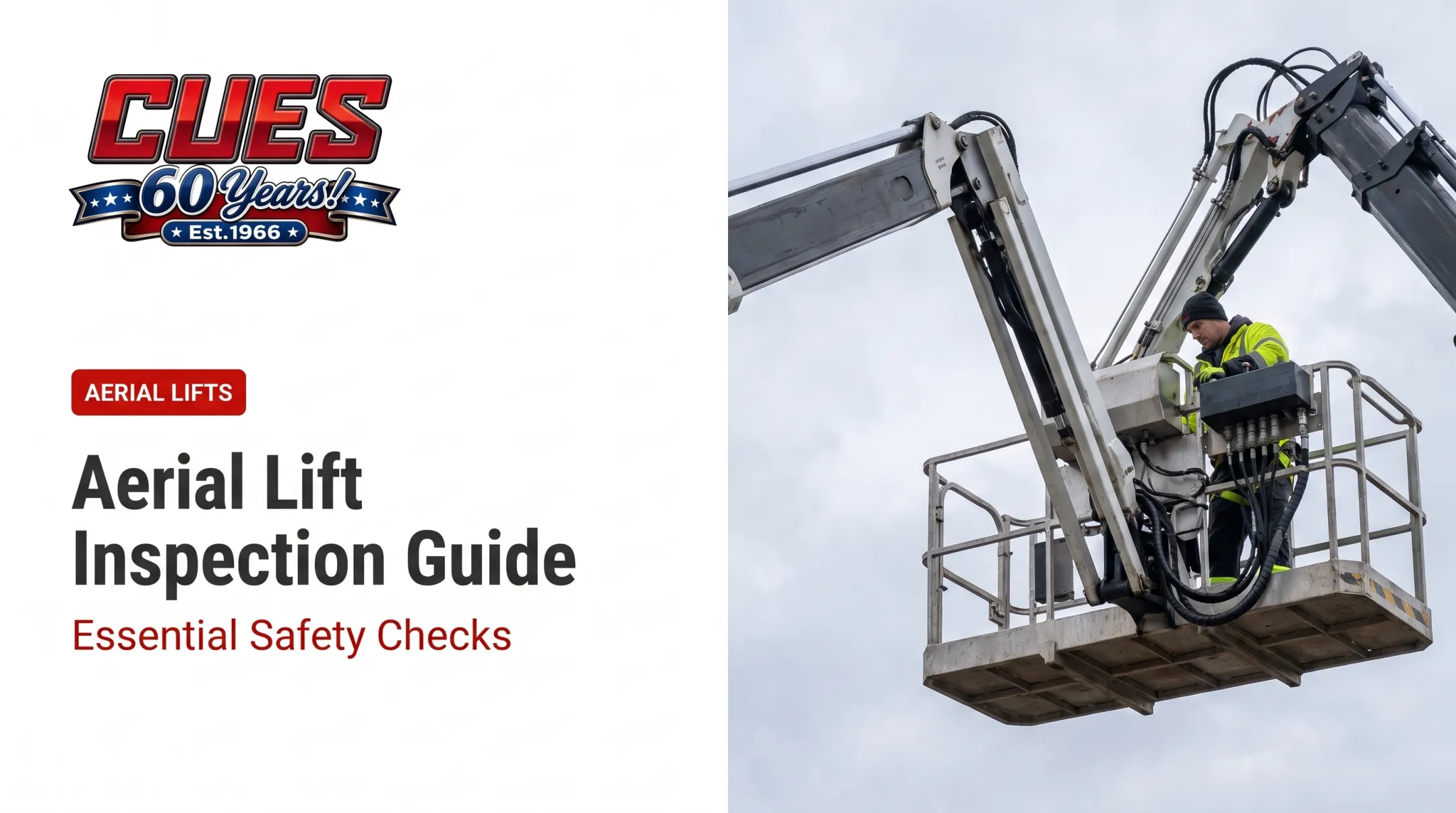

NIOSH data shows worker deaths from contact with electrical energy averaged 411 per year over a 13-year surveillance period, with construction accounting for 40% of those fatalities (NIOSH, 1998). This guide covers what ANSI A92.2 requires at each inspection tier, how to interpret what you find, and the mistakes that put crews at risk. CUES, Inc. is an authorized dealer for Versalift, Elliott, and other aerial device brands, and services ANSI-compliant equipment throughout New England and New York.
TL;DR
- ANSI A92.2 sets four inspection tiers: daily pre-start, frequent, annual/periodic, and major structural
- Operators own pre-start checks; frequent, annual, and major inspections need a qualified technician
- Insulated booms need dielectric testing every 12 months or they cannot be treated as insulated
- A qualified person must clear any defect before the truck returns to service
- Keep full inspection records; they are your OSHA compliance file and legal protection
What You Need to Check a Bucket Truck Under ANSI A92.2
The depth of inspection changes by tier, but the tools and setup stay largely the same across all four levels.
Tools and Indicators Required
- Flashlight or inspection light for welds, pins, and hydraulic fittings
- Dielectric test meter for insulated boom sections
- Torque wrench for fasteners and bearing checks
- Hydraulic pressure gauge
- Stopwatch for boom drift observation
- Cleaning materials for fiberglass sections (contamination skews dielectric readings)
Preconditions and Setup
Complete these setup steps before you start:
- Park on level, stable ground with outriggers fully accessible
- Keep the engine off for structural checks; run it for functional tests so you have hydraulic pressure for boom movement and drift
- Confirm lighting is adequate for weld, fastener, and hydraulic line checks
- Pull the previous DVIR and confirm no open defects were left unresolved
Before any dielectric or fiberglass inspection, the boom must be clean and dry. Moisture or road film on a fiberglass section can cause a false pass or fail—one of the most common and avoidable inspection errors.
Methods to Check a Bucket Truck (Inspection Tiers)
ANSI A92.2 assigns different depth and inspector qualifications to each tier. Choosing the right one depends on the interval and the risk involved.
Method 1: Pre-Start (Daily) Inspection
Who performs it: The operator, before first use each shift.
Tools needed: Flashlight, lower control panel access, a visual checklist.
Steps:
- Walk around the chassis — check tires, fluid levels, lights, and the fire extinguisher
- Visually inspect the boom, fiberglass sections, hydraulic hoses, and outriggers for damage or leaks
- Operate the lower controls through their full range and test the emergency stop/lowering function before anyone enters the bucket

Pros & cons: Fast, and it catches obvious defects: a cracked hose, a dead light, a hydraulic leak. It will not catch internal wear or insulation degradation, which is why the deeper tiers exist.
Method 2: Frequent Inspection (Technician-Level)
Who performs it: A qualified technician, on a schedule set by the manufacturer's maintenance program.
Tools needed: Pressure gauge, torque wrench, fluid sample kit.
Steps:
- Inspect cylinders, the rotation motor, and control linkages for wear or leaks
- Test boom drift under load at an elevated position
- Sample and analyze hydraulic fluid for contamination
Pros & cons: This tier catches developing mechanical issues before they become failures. The tradeoff is downtime: the truck comes out of service while the work is done.
Method 3: Periodic/Annual Inspection and Dielectric Test
Who performs it: A certified technician, following the manufacturer's annual inspection program.
Tools needed: Dielectric test set, structural inspection checklist, certified sign-off documentation.
Steps:
- Perform a full structural inspection — welds, pins, bearing torque
- Apply dielectric test voltage to the boom per the manufacturer's procedure and record leakage current
- Document results and either certify the unit or flag it for repair

Pros & cons: This is the only inspection that verifies insulation integrity. It requires a certified provider and takes the truck out of service for the duration.
Terex's guidance is direct: a boom without a dielectric test in the past 12 months can no longer be considered insulated at all (Terex, dielectric troubleshooting).
CUES, Inc. road service trucks can offset part of that downtime. Mobile units support routine maintenance, electrical repairs, and hydraulic-line work while the annual and dielectric inspection is scheduled or completed.
How to Interpret the Results
Misreading a finding cuts both ways: ground a safe truck unnecessarily and you lose productivity; miss a real defect and someone gets hurt.
| Result | What it looks like | Action |
|---|---|---|
| Normal | Clean fiberglass, no leaks, drift under 2 inches over 5 minutes, dielectric leakage within OEM spec | Cleared for service |
| Minor issue | Small surface nicks, minor fluid seepage, slight drift beyond tolerance | Document and schedule near-term repair or monitoring |
| Out-of-spec | Tracking marks on fiberglass, cracked welds, failed dielectric test, uncontrolled drift | Tag out immediately, remove from service until repaired |

Note: exact drift tolerances and dielectric voltage thresholds vary by OEM and unit category. Always confirm against your specific manufacturer's manual rather than a generic number.
Common Errors in Checking a Bucket Truck
Even solid inspection routines break down when a few high-impact steps get skipped or rushed. These are the mistakes that most often undermine a bucket truck check:
- Skipping the lower-control functional test before entering the bucket — this is your last check before anyone works at height
- Testing dielectric integrity on a dirty or wet boom, which produces an unreliable pass or fail
- Assuming a fiberglass jib is insulating without confirming it's rated and tested for the voltage involved
- Failing to document findings, leaving no audit trail if OSHA or an insurer asks for one
Safety and Best Practices
Daily habits protect crews as much as the annual ANSI inspection. Follow these practices every time the truck is in service:
- Isolate, lock out, and ground to the best available ground per OSHA 1910.269(p) before energized work begins
- Never travel with the boom elevated and a worker in the bucket, unless the OEM specifically permits it
- Require fall protection tied off to an approved anchor point
- Use rubber insulating gloves rated for the voltage involved (OSHA classes range from Class 00 to Class 4)
- Keep booms and buckets clean, dry, and waxed on the OEM's recommended interval. Contamination defeats insulation and produces false test readings
Conclusion
Tier-appropriate ANSI A92.2 inspections keep aerial work routine instead of risky. That means the correct method, the right tools, and a qualified inspector at every interval—no shortcuts.
CUES, Inc. has serviced aerial equipment since 1966, supporting Versalift, Elliott, and other brands across New England and New York with ANSI inspections, dielectric boom testing, hydraulic and electrical repair, and parts sourcing. Whether you need a periodic inspection scheduled or a boom repaired before your next annual test, CUES can help keep your fleet compliant and job-ready.
Frequently Asked Questions
What are the maintenance requirements for bucket trucks?
Maintenance follows the manufacturer's schedule alongside ANSI inspection tiers, covering hydraulic fluid condition, fastener torque, and fiberglass condition. Skipping either track leaves gaps the other doesn't catch.
Does OSHA require a harness in a bucket truck?
Yes. OSHA requires a fall restraint or personal fall-arrest system for covered aerial-lift work. Crews must stay protected whether the bucket is moving or stationary at height.
How safe is a bucket truck?
Bucket trucks are safe when properly inspected, maintained, and operated by trained personnel. Most incidents trace back to skipped inspections or gaps in training, not equipment design.
What are the ANSI A92.2 standards?
ANSI/SAIA A92.2 is the national standard covering design, manufacture, testing, inspection, maintenance, and operation of vehicle-mounted aerial devices, including bucket trucks, aerial ladders, and vertical towers.
How often should a bucket truck be inspected?
Four inspection tiers apply:
- Daily pre-start by the operator
- Frequent technician inspection on the manufacturer’s schedule
- Annual periodic inspection with dielectric testing
- Major structural inspection at 15 years, then every 10 years
Who is qualified to perform a bucket truck's annual inspection?
Only a certified technician trained to the manufacturer’s and ANSI requirements can perform and sign off on periodic and major inspections. Pre-start checks are the only tier an operator can complete alone.